



Age Of Earth's Oldest Asteroid Strike Proven Wrong By Half A Billion Years


Scientists have pushed Earth’s oldest known impact crater back to about 3 billion years, and in doing so, they have re-sharpened the debate over how meteorite strikes shaped the planet’s early history. Said crater, in Western Australia’s Pilbara region, even with its revised timeline, still predates the next-oldest recognized impact structure in the region by roughly 800 million years.

For years, the age of the North Pole Dome in the remote Australian outback has been argued over. One study last year called for a far older age of 3.47 billion years (around the same time as the infamous NWA 12593 meteorite), but later work challenged that estimate and said the impact could not be older than 2.7 billion years. The newest analysis, published in the Geology journal, used mineral dating on zircon, apatite, calcite and muscovite from shatter cones and a shocked quartz vein to pin the event to a little more than 3 billion years ago.

This correction in date also changes the map of Earth’s earliest history. The North Pole Dome structure is the oldest known impact crater on Earth and the only recognized example from the Archean eon, when the planet’s continents were just taking shape. That era is also one of the most opaque in Earth science, because so few rocks have survived from it in readable form.
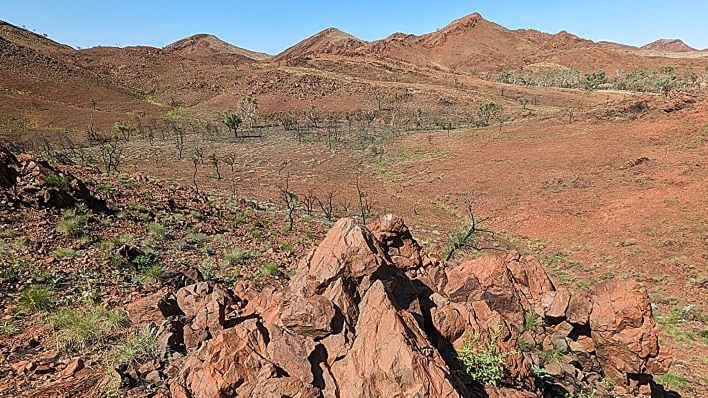
While the surface of the Pilbara today looks like some regular expanse of desert, 3 billion years ago the asteroid likely slammed into an ancient ocean. At the time, the only living inhabitants on our planet were basic micro-organisms forming layered sedimentary rocks called stromatolites. Therefore, a site like the Pilbara is one of the few places remaining where these pristine, ancient time capsules survive, whereas elsewhere Earth's active plate tectonics, erosion, and volcanic activity have all but erased traces of Earth's earliest history.
All images: Curtin University





