



CERN's Upgraded Large Hadron Collider Makes Its First New Particle Discovery


Deep beneath the border of France and Switzerland, the newly upgraded LHCb detector at CERN has captured a signal that physicists have hunted for decades. The particle, designated Ξcc⁺ (pronounced "Xi-cc-plus", a.k.a. Elon Musk's name of choice of his next child), was announced this week at the Rencontres de Moriond conference, and while it belongs to the same baryon family as the common proton, it is roughly four times heavier.
Now, a standard proton consists of two 'up' quarks and one 'down' quark. In this new heavy-duty version, the light up quarks are replaced by two 'charm' quarks. These heavier relatives share the same quantum properties as up quarks but possess significantly more mass.
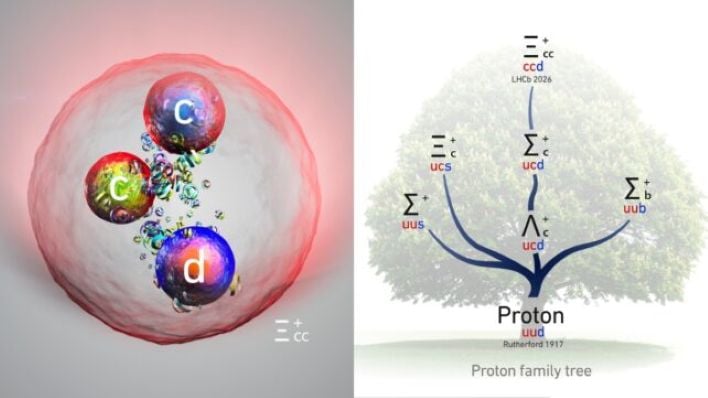
The observation also settles a long-standing scientific dispute. Over 20 years ago, an experiment known as SELEX claimed to have found this particle at a much lower mass, but no other laboratory could replicate the result. The new data from CERN confirms the particle exists at a mass of approximately 3620 MeV/c², aligning with theoretical predictions and its previously discovered twin, the Ξcc⁺+.
Moving forward, the Ξcc⁺ particle provides a test for quantum chromodynamics, the theory describing the strong force that binds quarks and gluons together. By observing how these heavy charm quarks interact, theorists can refine the mathematical models that explain everything from the birth of the universe to the stability of the atoms in our own bodies.





