



Trump Outlines 25% Tariff On Advanced AMD And NVIDIA AI Chips With Key Exemptions


The White House has announced a 25% tariff on certain advanced computing chips, including NVIDIA's H200 silicon based on its Hopper architecture and AMD's Instinct MI325X accelerator based on CDNA 3, both of which now have the green light to ship into China. Interestingly, the levy is described as a tariff on chip imports, not exports.
Back in August, U.S. President Donald Trump reportedly struck a deal with AMD and NVIDIA in which both outfits would pay the government 15% of all revenues from AI chip sales to China. Then in December, Trump posted on his Truth Social network that the U.S. government had explicitly approved H200 chip exports to China for a boosted 25% royalty, and that President Xi had "responded positively" to the agreement.
Fast forward to now and what we have in place are official terms that extend beyond social media, with Trump signing a Proclamation invoking Section 232 of the Trade Expansion Act of 1962 to address national security concerns, according to a newly published Fact Sheet posted by the White House. And with it comes a bit more clarity.
For one, the 25% rate is a tariff on imports. There were questions about the legality of the White House striking a deal with AMD and NVIDIA to collect a 25% cut of AI chip sales to China, but a tariff on chip imports is not likely to face the same legal scrutiny. However, it does require a bit of logistics to accomplish the same result.
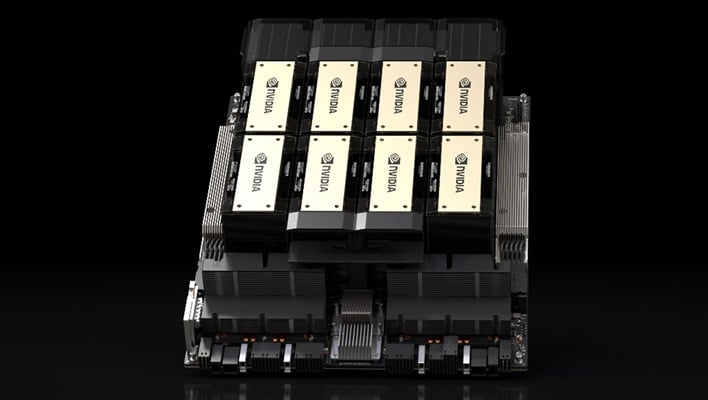
NVIDIA HGX H200
According to Reuters, the Trump administration is requiring that chips bound for China must first be shipped into the U.S. from Taiwan, where the silicon is produced, to be tested by a third-party lab. By making the detour into the U.S., the 25% import tax can be applied, and then shipped off to China.
There are some exemptions. The Fact Sheet issued by the White House states that the 25% tariff "will not apply to chips that are imported to support the buildout of the U.S. technology supply chain and the strengthening of domestic manufacturing capacity for derivatives of semiconductors."
This effectively turns the import tariff into a levy on exports, since chips that are shipped into the U.S. and never leave the country wouldn't necessarily be subjected to the 25% rate. That said, the H200 based on Hopper is now two generations old, with NVIDIA launching its next-gen Vera Rubin architecture at CES and Blackwell serving as the current-gen. China will not have access to either architecture, at least not immediately and not officially.
The Trump administration says the tariff addresses a threat to national security by, among other things, incentivizing domestic semiconductor production and reducing the nation's reliance on foreign supply chains. It's also mentioned in the Fact Sheet that Trump may impose broader tariffs on semiconductor imports and their derivative products.
One final bit of housekeeping involves chip supplies. In a filing by the Department of Commerce (PDF), it's stated that the exporter certifies there is sufficient supply of chips in the U.S., and that production of parts bound for China will not take up capacity for similar or more advanced products for end users in the U.S.




