



4.5 Billion-Year Mystery Of What's Inside The Moon Is Settled, It's Not Cheese


The Moon is not, in fact, a giant cosmic wheel of Gouda. In a landmark paper published in Nature, researchers from the French National Center of Scientific Research delivered a hard truth: the Moon is actually packing a solid inner core of material with a density suspiciously similar to iron. Rather than a massive cheese ball, we're dealing instead with a celestial cannonball.
This discovery basically settles a 4.5-billion-year-old structural mystery. As it turns out, our trusty satellite is built much like its Earthly parent, boasting Earth-like layering. That means a fluid outer core (coming in at 225 miles or 362 kilometers) wrapped around a distinct, solid inner heart—a tiny, metallic bullseye nestled 160 mi (258 km) deep. With an estimated density of 7,822 kg per cubic meter, the core could very well be made of pure iron.
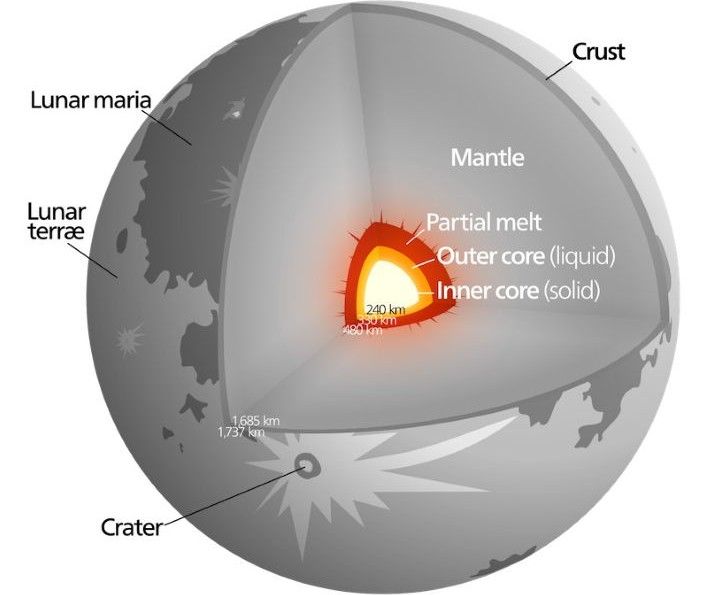
It also turns out that interior structure has always been this static. What the research team found strongly supports a global mantle overturn scenario. Imagine the Moon’s mantle as a lava lamp in extreme slo-mo, where the denser, heavier material constantly decides it’s time for a nap and sinks toward the center, while the lighter, less dense bits float up to the surface. This geological activity may help explain certain volcanic activity observed on the Moon’s surface.
With humanity set to set foot on the Moon again, we might be able to obtain new data to truly listen to the Moon's proverbial heartbeat. Until then, we can at least sleep soundly knowing our faithful companion is structurally sound, highly metallic, and 100% dairy-free.





