
Quantum Battery Breakthrough Fully Charges In Under A Second

The world's first proof-of-concept quantum battery
The world's first proof-of-concept quantum battery - Image: CSIRO
Scientists at CSIRO, Australia’s national science agency, have built a prototype quantum battery that upends classical physics by charging faster the bigger it gets. How fast? Think a quadrillionth of a second.

CSIRO’s clean lab for engineering prototype quantum batteries
CSIRO’s clean lab for engineering prototype quantum batteries - Image: CSIRO

In the world of consumer electronics, size can be a penalty: scaling up an energy storage system, whether it be smartphones or EVs, inevitably means waiting longer at the charging station. Quantum mechanics, however, rejects this logic through a counterintuitive phenomenon known as superabsorption. Under this rule, energy-absorbing molecules stop acting like isolated individuals and begin functioning as a single coordinated collective. The more molecules are packed into the system, the faster they work together to drink up incoming energy.

Led by quantum scientist James Quach, the CSIRO team constructed a proof-of-concept using an optical microcavity, a tiny sandwich structure consisting of two mirrors positioned roughly 100 nanometers apart, with organic dye molecules suspended between these reflective surfaces. When a laser beam fires into the cavity, the light and matter entangle into a hybrid state. Rather than soaking up photons one by one, the entire system absorbs the light simultaneously.
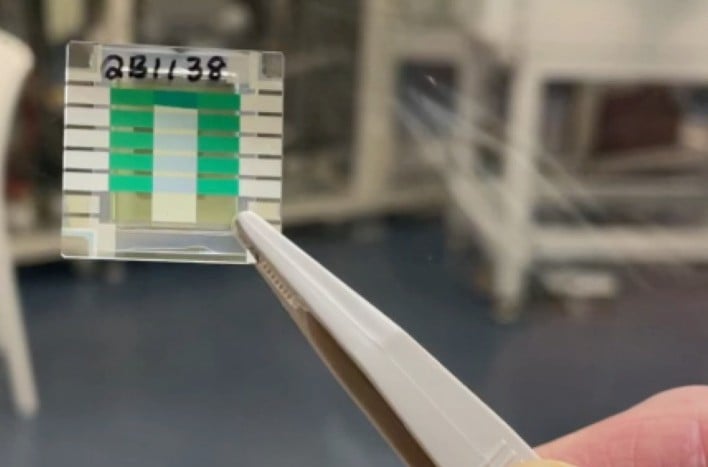
The world’s first fully functioning proof-of-concept quantum battery engineered by CSIRO and collaborators, The University of Melbourne and RMIT.
The quantum battery was engineered by CSIRO and collaborators, The University of Melbourne and RMIT - Image: CSIRO

The performance numbers sound like something out of science fiction: the CSIRO battery fully charges in femtoseconds (or quadrillionths of a second). While a femtosecond is pretty much instant, the system only holds onto that charge for several nanoseconds, although relatively speaking, the energy retention is roughly a million times longer than the charging process. More importantly, this latest iteration is a major breakthrough over earlier lab concepts; by adding an extra functional layer, the team successfully extracted an actual, usable electrical current from the quantum cell for the first time.

Now, before anyone imagines these batteries in EVs and portables, the technology still faces some hurdles. In its current laboratory form, the prototype stores a microscopic capacity measured in mere billion electron volts (an average smartphone holds roughly 100 trillion times more energy). Furthermore, maintaining delicate quantum coherence without ambient thermal noise collapsing the charge is also something Quach and team are constantly battling with.

That said, early real-world applications will likely focus on ultra-specialized hardware, such as supplying precise, low-loss power to quantum computers or wirelessly beaming instantaneous bursts of laser energy to airborne drones mid-flight. The CSIRO team is currently testing hybrid architectures that combine their super-absorbing quantum layers with standard storage mediums that can hold the charge for longer periods.
Aaron Leong

Aaron Leong

Tech enthusiast, YouTuber, engineer, rock climber, family guy. 'Nuff said.
