



Qualcomm Unveils Adreno Neural Fusion To Supercharge Mobile Gaming


Following last week's milestone reveal of the 5GHz Oryon CPU and FlexCache architecture, Qualcomm is continuing its pre-Summit deep-dive series by turning its attention to the graphics subsystem, and what's on tap should have mobile gamers excited. Why is that?
Mobile gaming has traditionally forced trade-offs between high-end visuals, smooth frame rates, and battery life that doesn't die halfway (or earlier) through a session. Qualcomm is aiming to flip the script, in a sense, with Adreno Neural Fusion, a rendering pipeline that bundles neural processing, AI super-resolution, and frame generation directly into the unified graphics workflow. This is a major expansion to graphics and compute architectures seen in previous generations, like the Adreno-powered Snapdragon platforms.
"Historically, mobile upscaling has come with compromises. Fine details could shimmer.
Fast-moving objects could leave behind ghosting artifacts. Images often appeared softer
than native rendering. Adreno Neural Fusion is designed to minimize those tradeoffs,
preserving detail and motion clarity while helping games run more efficiently," Qualcomm says.
According to Qualcomm, the end result is that a significant improvement in image quality compared to previous generation solutions, with reduced artifacts, details that remain consistently sharp, and better frame rate stability.
Adreno Matrix Cores Power Adreno Neural Vision
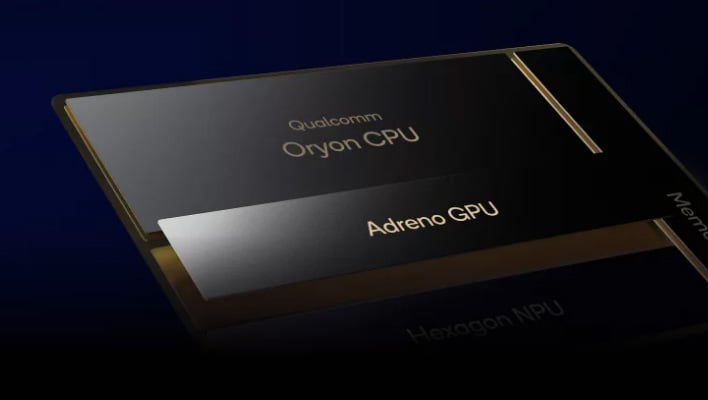
Qualcomm is also introducing Adreno Matrix Cores. Instead of treating AI as an external task to be handled by the NPU, Qualcomm built dedicated AI silicon straight into the GPU via these new Adreno Matrix Cores. This marks the first time Adreno has packed dedicated AI-processing cores inside the graphics pipeline itself, and on paper, it offers some intriguing upsides for mobile gaming.
"By keeping AI workloads inside the graphics pipeline, developers can run increasingly
sophisticated rendering models with lower latency and reduced power overhead. Neural
work no longer has to leave the graphics pipeline to get done," Qualcomm says.
Those Adreno Matrix Cores feature 18MB of Adreno High Performance Memory (HPM), a near-memory design that keeps frame buffers, tile-based rendering, and compute data local on-chip. By keeping intermediate data out of main system memory, the hardware slashes latency and power consumption to extend real-world gaming sessions, according to Qualcomm.
There is a potential challenge that comes from introducing new architectures and AI features—they require developer adoption. However, Adreno Neural Fusion is already supported out of the box across Unity and Unreal Engine, so studios can tap into cleaner upscaling, minimized ghosting artifacts, and better frame stability without custom engine engineering, Qualcomm says.
With the CPU and GPU architecture details now out in the open for Qualcomm's next-generation Snapdragon silicon, the focus will soon turn to its forthcoming Hexagon NPU reveal ahead of the Snapdragon Summit event that runs from September 22 to 24.




