



NVIDIA’s AI Empire Crushes Q2 Estimates As Data Center Demand Soars


NVIDIA has published its financial results for the second quarter of fiscal 2027, delivering yet another record-shattering performance powered by continued global demand for AI infrastructure. For the quarter ending July 26, 2026, the company reported total revenue of $96.2 billion, representing a monstrous 106% increase year-over-year and a more modest 18% sequential gain over Q1. Non-GAAP diluted earnings per share reached $2.22 (and $2.46 GAAP), beating Wall Street estimates of $92.17 billion in revenue and $2.10 per share.
Data Center Dominance Takes Center Stage

In what has become a familiar refrain, the main growth engine driving NVIDIA's record-setting earnings remains its Data Center division, which generated $89 billion in revenue for the quarter. That amounts to a 117% surge from the same period last year and an 18% increase sequentially.
Data Center operations now account for over 92% of the company's total revenue. Looking more closely at the breakdown, the hyperscale portion of NVIDIA's Data Center operations contributed $10.93 billion to the pile, while AI Clouds, Industrial, and Enterprise added $11.63 billion.
GAAP and Non-GAAP gross margins both held firm at 75.0%, up from 72.4% in the same quarter from a year ago, as high-margin enterprise AI platforms dominated sales. Outside of the data center, NVIDIA's Edge Computing division raked in another $7.2 billion, up 27% year-over-year, driven in part by client momentum around new Windows PC integrations like NVIDIA RTX Spark. Note that NVIDIA folded its previous standalone Gaming segment into its Edge Computing segment earlier this year.
Vera Rubin Ramp and Q3 Guidance
Looking ahead to the third quarter, NVIDIA expects total revenue to reach $108.0 billion, plus or minus 2%, for what would roughly amount to 12% sequential growth. Notably, management confirmed that this guidance assumes zero Data Center compute revenue from China due to ongoing export restrictions.
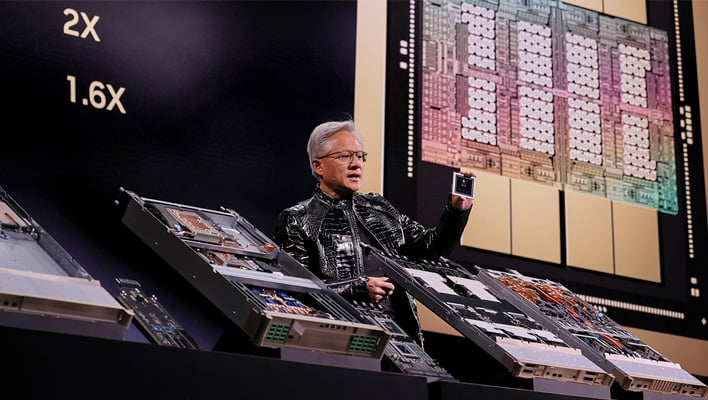
Product shipments for NVIDIA's new and cutting-edge Vera Rubin platform commenced in early August 2026, with full-rack deployments already scaling across key players like Google Cloud, Microsoft Azure, Oracle, and more. In a prepared statement, Huang highlighted that AI has reached an inflection point across training, post-training optimization, and enterprise agentic inference, driving unprecedented long-term supply commitments across high-bandwidth memory suppliers.
"AI has reached its inflection point. It’s doing useful work. Its tokens are productive and profitable. Now, compute is revenue," said Jensen Huang, founder and CEO of NVIDIA. "And demand is accelerating. This time last year, one lab alone was driving the buildout; today, we have a golden age of new AI labs and startups, multiple frontier labs scaling in parallel, a thriving open-model ecosystem and physical AI coming online—with strong momentum across the U.S. and around the world. The AI infrastructure buildout is at full steam. Vera Rubin, now in full production, was built to power exactly this moment."
If there is a concern—because investors always find something to be wary about—it's that gross margins are coming down. This is in large part because of a combination of soaring memory and component costs, and supply constraints. However, these concerns don't appear to be showing up in NVIDIA's order book.
Based on our customer demand and improving supply outlook, our preliminary expectation is for CPU revenue to more than double in fiscal 2028, positioning us as one of the world's leading server CPU suppliers," NVIDIA CFO Collette Kress stated during an earnings call to discuss the company's Q2 financial results.
Kress also said NVIDIA expects to see growth in its hyperscale business re-accelerate in Q4 and into next year "as supply of Vera Rubin grows over time." The CFO admitted that supply will remain a bottleneck through the end of fiscal 2028 and perhaps longer, but with demand outstripping capacity through fiscal 2028, NVIDIA’s primary growth ceiling isn't finding buyers, it's how fast its supply chain can deliver hardware.




