



Is NVIDIA Releasing A Cheaper GeForce RTX 5090 SE? Don't Get Your Hopes Up


The rumor mill is buzzing today with the prospect of NVIDIA releasing a cheaper GeForce RTX 5090 SE graphics card with 32GB of GDDR7 linked to a 384-bit memory bus. But it's not happening, folks. And yes, I'm well aware that speaking in absolutes can lead to eating crow down the line, but if that happens (it won't), then so be it.
So, what's this all about? A report at GameGPU claims NVIDIA is readying a GeForce RTX 5090 SE to replace a hypothetical GeForce RTX 5080 Ti, which would fill a pricing gap between the GeForce RTX 5080 and the flagship GeForce RTX 5090. That could be semi-believable if not for the rumored specs.
According to the site, the SE variant would employ a partially deactivated GB202 processor. The version in the GeForce RTX 5090 is the GB202-300-A1 with 21,760 CUDA cores in total. The flagship model also sports 32GB of GDDR7 linked to a 512-bit bus for 1.79 TB/s of memory bandwidth.
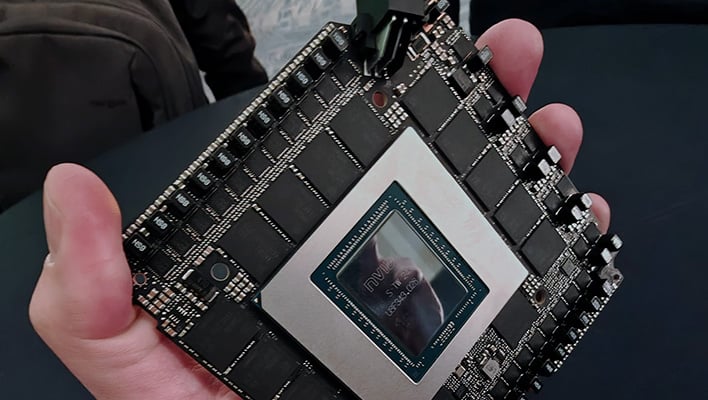
The rumored GeForce RTX 5090 SE is said to feature 14,080 CUDA cores while maintaining the same memory capacity, but tied to a narrower 384-bit bus. That's where the sketchy rumor falls off the rails.
To achieve 32GB with a 384-bit bus on NVIDIA's Blackwell architecture, the company would have to mix memory chip densities. With the GPU die designed around 32-bit channels, a 512-bit bus supports 16 GDDR7 memory chips, while a 384-bit bus is limited to 12 chips.
On the existing 5090, NVIDIA uses 16 × 16Gb (2GB) GDDR7 chips to reach 32GB. NVIDIA has access to 24Gb (3GB) chips, so on a 384-bit Blackwell card it could deliver either 24GB (12 × 2GB) or 36GB (12 × 3GB). The only way to hit exactly 32GB is to mix densities—for example, four 2GB chips and eight 3GB chips.
Is it possible? Technically, yes. Realistically, no. NVIDIA has already stated that mixing densities isn’t possible in its designs (albeit in relation to the GeForce RTX 40 series), citing the need for consistent performance, price optimization, and engineering simplicity. It's not just a matter of making the math work out; mixing densities introduces significant challenges around signal integrity, timing, bandwidth symmetry across channels, PCB complexity, and validation, among other things. It also paves the way for inconsistent performance when dipping into multiple pools of differing capacities.
On top of that, such a card would be reminiscent of the GeForce GTX 970 released in 2014, which used a fast 3.5GB memory pool with a much slower 0.5GB spillover segment. That sparked a community backlash and even a class-action lawsuit alleging misleading specifications. NVIDIA has little incentive to revisit that territory.




