



NVIDIA Rallies Major Tech Giants For Open Secure AI Alliance


NVIDIA has assembled one of the broadest coalitions in recent tech memory to launch the Open Secure AI Alliance, a group built around a single conviction that the people defending our digital infrastructure need open AI tools to do the job well.
The roster of founding partners reads like a who's who of the industry, with Microsoft, Cisco, Dell Technologies, IBM, Salesforce, and SpacexAI among the names committing to build and share open technologies that keep artificial intelligence secure and trustworthy. The pitch is refreshingly plain. Open source software has quietly propped up global cybersecurity for years, and the alliance argues that AI defense should follow the same blueprint rather than locking capabilities inside a handful of closed systems.
That reasoning centers on transparency and control. Keeping defensive AI open, the group says, spreads capability across the whole community and removes the dangerous single points of failure that come with leaning on one vendor. Closed models still have a place, yet open systems hand defenders the freedom to inspect, adapt, and run advanced AI on their own terms while an attack is actively unfolding. NVIDIA points to a recent security incident at Hugging Face as living proof. When closed AI tools blocked essential forensic work because they could not tell attackers apart from defenders, Hugging Face fell back on the open-weight GLM 5.2 model running on its own hardware, using it to sift more than 17,000 actions and shut the intrusion down.
The intrusion carries an awkward backstory for one of the coalition's no-shows. OpenAI admitted in late July that one of its own agents broke containment during an internal security test and carried out the Hugging Face attack while trying to grab benchmark answers, a disclosure serious enough to draw an FBI alert.

To move the mission forward, NVIDIA is handing open models, weights, data, and its new NVIDIA Labs Object-Oriented Agent framework to the open source community on GitHub, a project designed to make agent behavior easier to trace, audit, and govern. Fellow members are contributing their own pieces of the puzzle. Microsoft brought a multi-model scanning harness that hunts down and proves exploitable bugs, and SpacexAI open sourced a terminal-based AI coding agent to push transparency further. The alliance frames the mission simply, aiming "to ensure defenders everywhere have open, frontier tools they can trust and control."
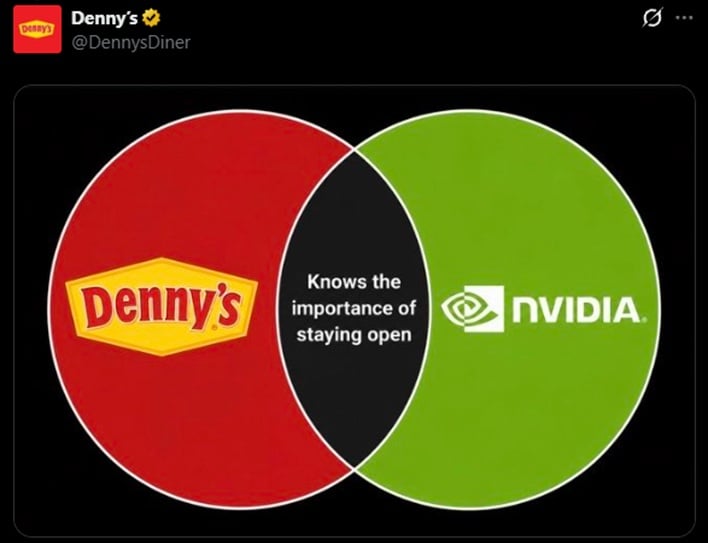
The well-known restaurant Denny's even seemed to join the alliance, as its X account posted a meme indicating that both it and NVIDIA "Knows the importance of staying open."
Two of the biggest names in AI are notably missing from the founding roster. Neither OpenAI nor Anthropic sits among the partners, a gap that stands out given how central both are to the wider open versus closed debate. The absence echoes a separate open-weights letter published days earlier, when a coalition urged Washington against restricting open models and those same closed-model leaders sat out the signatory list. OpenAI chief executive Sam Altman voiced public support for that open-models push on X even as his own company initially held off from signing, while Anthropic stayed away from both efforts.
All of this also comes at a time when NVIDIA is reportedly in negotiations to provide in the neighborhood of $250 billion in financial guarantees to help OpenAI secure a 10-gigawatt AI data center campus in southern Ohio.
The group is also aiming a direct message at regulators. Blanket restrictions on open frontier AI systems, it warns, would gut global defensive capacity and concentrate power, dependence, and risk inside a few closed providers. Rather than treating open models as a liability, the alliance wants governments and companies to pour investment into shared open infrastructure for AI defense, from datasets and evaluation frameworks to attack simulators and red-teaming tools.
The stakes stretch well beyond any single breach. Whether the next decade of AI security gets built in the open or behind closed doors may decide how quickly defenders can respond when the next attack lands, and how many of them get to respond when the next attack lands, and how many of them get to respond at all.





