


JEDEC Previews DDR6 With 4X Bandwidth, Smaller Sticks And A Path To 1TB


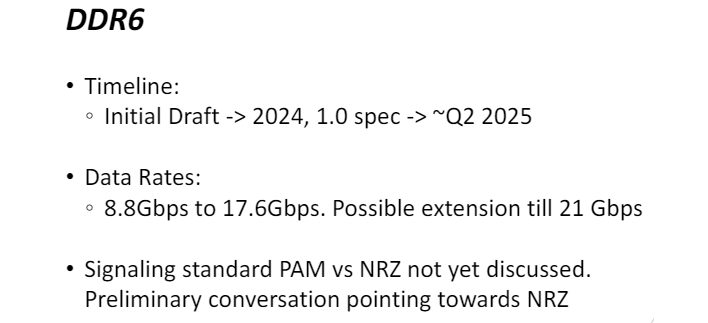
The bandwidth improvements come from a combination of higher data rates and a wider memory interface. Contrary to JEDEC's earlier expectations from 2024, DDR6 RDIMMs are now expected to start at 12.8 GT/s, compared with up to 9.2 GT/s for DDR5 RDIMMs. JEDEC's roadmap calls for speeds reaching 14.4 GT/s and beyond. The other major change is the data bus, which expands from 64 bits to 96 bits. That's a 50% increase in width, but DDR6 will also introduce a new pseudo-channel architecture designed to improve bandwidth per DRAM package and make memory access more flexible.
Put those changes together and DDR6's planned baseline configuration offers a theoretical 153.6 GB/s of bandwidth per module. That's four times the 38.4 GB/s offered by baseline JEDEC DDR5-4800 modules. The comparison is worth qualifying, though; against DDR5-8800 MRDIMMs, which offer 70.4 GB/s per module, the initial DDR6-12800 configuration would deliver a little over twice the bandwidth, not four times as much.
Also, DDR6 will double the number of available banks compared with DDR5 while improving refresh operations. End-users won't notice these changes, but they're intended to keep the wider interface fed with data and maintain efficiency as speeds and memory capacities increase. Electrically, JEDEC says DDR6 will adopt VSS-terminated I/O alongside data-center-focused low-power operating modes. The stated goal is significantly better performance per watt than DDR5, although the organization didn't give any numbers on that yet.
The physical changes to the new standard are almost as interesting as its performance targets. JEDEC is planning a module length of 74mm; for context, DDR5 modules are 133mm in length. That's a reduction of roughly 44%, making the next generation's memory modules substantially shorter, and more similar to laptop SODIMMs. The smaller footprint is intended to help system builders accommodate greater memory density, particularly in servers where space and memory capacity are at a premium.
JEDEC is also working toward support for several module types, potentially including RDIMM, UDIMM, and CAMM. The final mix of supported form factors remains to be determined. The smaller modules will also benefit from denser DRAM packages. DDR6 is being designed to support die densities of up to 128Gb, equivalent to 16GB per DRAM die. Improvements to die stacking will allow manufacturers to put more memory into individual packages without requiring a proportionally larger module footprint.

Those density improvements are what make the prospect of 1TB memory modules particularly interesting. JEDEC hasn't formally announced a 1TB module specification or promised that capacity for any particular form factor. However, support for 128Gb dies and more efficient die stacking provide a route toward substantially higher per-module capacities.
You'll notice that we've mostly been talking about server memory here. Indeed, just like the rest of the tech world, JEDEC's announcement is all about the server market. Its initial DDR6 speed targets are specifically about RDIMMs, and the 1TB possibility is obviously most relevant to high-capacity server configurations.
Finally, JEDEC also emphasizes reliability and power efficiency, both considerations most important in the data center. DDR6 will support multiple system-level error-correcting code (ECC) implementations, giving platform designers flexibility to balance reliability, power consumption, and cost.
This isn't the final DDR6 spec, so progress continues apace. JEDEC hasn't announced a timeline for the finalized spec nor for commercialization, and details like final module configurations and operating characteristics aren't public, if they're even set in stone yet. Still, the preview outlines an ambitious next step for system memory: faster interfaces, smaller modules, considerably higher DRAM density, and a path toward capacities that would have seemed utterly excessive not so long ago.