



Intel Demos XeSS Counterattack On DLSS, FSR In Unreal Engine And It Looks Pretty Great


Given that Arc cards will compete head-to-head with NVIDIA GeForce and AMD Radeon offerings, Intel will offer all the latest industry buzzwords to deliver high-quality visuals in today's games. As it's DirectX 12 Ultimate compatible, you'll find Mesh Shading, Variable Rate Shading, and Real-Time Ray Tracing support.
Intel will also offer its take on NVIDIA DLSS 2.0 and AMD FidelityFX Super Resolution, which it calls Xe Super Sampling, or XeSS for short. We've already seen what XeSS can do when upscaling 480p video content to 4K resolution. However, the same artificial intelligence (AI) neural network that makes video upscaling possible also applies to games. The result is that Intel can take lower resolution input from games and reconstruct when with improved detail at a higher output resolution. In addition, the use of AI networks makes XeSS more closely aligned with NVIDIA DLSS.
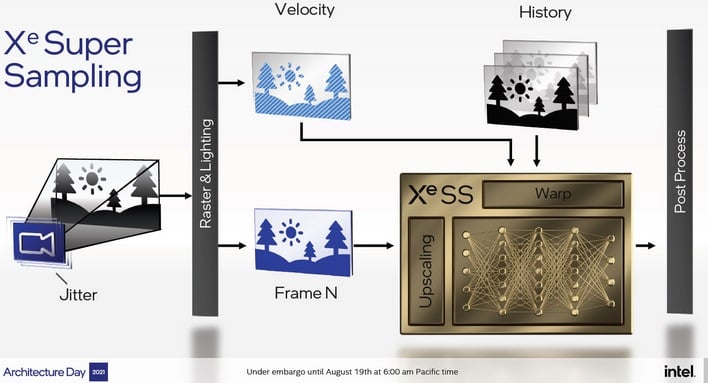
Of course, Intel touted the benefits of XeSS using a video demo, which was running on a pre-production Arc (Alchemist) desktop graphics card. Intel's 4K XeSS mode offered a 2x performance uplift while running the demo at native 4K resolution while maintaining similar image quality/fidelity.
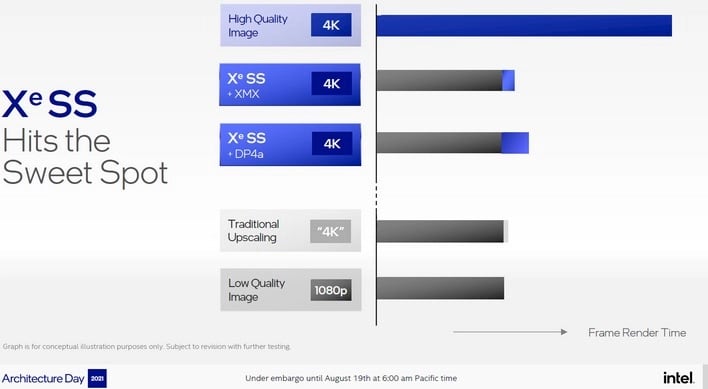
Intel also acknowledged that Xe Matrix Extensions (XMX) that are part of Xe-HPG architecture. Arc cards will leverage XMX to provide XeSS support. However, in an interesting twist, it will also offer a version of XeSS that will work on competing GPUs from NVIDIA and AMD via DP4a instructions, although you'll take a slight performance hit.
We'll still need to see how game developers respond to XeSS either in native form or with the third-party option. AMD is taking a similar open-source approach with FidelityFX SR, so we'll be interested in seeing which gains the most traction in game engines. Intel appears to be coming out of the gate swinging with Arc, as the underlying Xe-HPG architecture definitely has the features to compete with the likes of NVIDIA and AMD. Still, we'll be more interested in seeing if actual performance is up to snuff when cards debut in early 2022.




