



Google Images Gets Biggest Redesign In 25 Years With New AI Tools


The redesigned Google Images home swaps out the familiar wall of thumbnails for a dynamic gallery that pulls visuals from across the web and tailors them to individual interests. It refreshes in real time, so what surfaces can change over time. Collections themselves become tabs above the main gallery, which makes returning to a half-finished kitchen remodel or a running list of hiking spots considerably less tedious. A signed-in Google Account is the entry point, and the rollout begins on desktop in the United States in English.
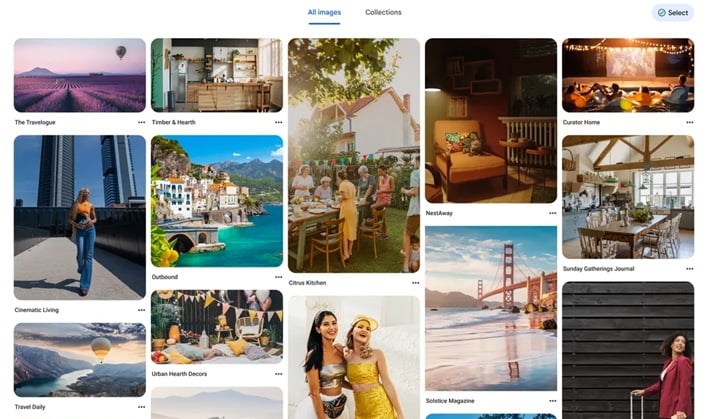
Others have compared the new layout to Pinterest, and it is not a stretch. A personalized visual feed that refreshes as it scrolls, with Google Collections functioning much like Pinterest boards, describes that product almost exactly. Google never mentions the company in its announcement, and this would not be its first attempt. Google built a Pinterest-style app called Keen in 2020 and shut it down four years later.
The second change is the more consequential one. Google is putting image generation inside AI Overviews, so when nothing on the open web matches what someone has in mind, a text prompt can conjure it instead. Google credits its latest Nano Banana model here, pointing to the Nano Banana 2 Lite release from late June, a model built for speed and volume that turns text into an image in roughly four seconds and costs developers about three and a half cents per 1K-resolution image. Every output carries SynthID watermarking. Generation in AI Overviews rolls out in English across regions that already support image creation in AI Mode.
Put those two together and Google Search becomes less dependent on pictures that already exist. Alongside a redesigned Google Images experience, it will have another way to provide visuals when the open web does not contain exactly what someone is looking for. That is a real departure for a product that spent a quarter century answering where a specific photo lives.
That product exists because of a dress. After Jennifer Lopez wore her green Versace gown in 2000, Google watched a screen full of blue hyperlinks fail to answer what everyone actually wanted, which was to see the thing. Google Images launched in July 2001. Similar Images followed in 2009 for anyone who searched "bow" and got both hair accessories and archery gear. Search by Image arrived in 2011 and let a picture serve as the query itself. Google Lens brought a phone camera into Search in 2018, Multisearch stitched text and images together in 2022, and Circle to Search landed in 2024 with a gesture that now works on more than 580 million Android devices.
The pace has quickened since. Lens merged with AI Mode last year using a visual image fan-out technique that splits one photo into dozens of sub-queries to read the whole scene. Search Live turned a live camera feed into a running voice conversation. This year brought multi-object recognition to Circle to Search, letting a single gesture pull apart an entire outfit, along with an intelligent search box that accepts several image uploads at once with questions attached. Google called that the biggest upgrade to its Search box in over 25 years.
Brad Kellett, senior engineering director for Search, framed the anniversary around Search evolving "from a text-based experience to one that allows you to visually explore the world." Twenty-five years of that evolution have produced something Google's founders would barely recognize, and the generative layer arriving now is the sharpest turn yet.
It also raises a question Google's announcement leaves alone. A gallery tuned to personal taste and a generator that fabricates whatever the index lacks both reduce reasons to click through to the sites hosting those pictures in the first place. Google spent 25 years indexing other people's images and sending traffic their way in exchange. The next stretch looks likely to involve a lot more of Google making its own.





