



Breakthrough Holographic 3D Printing Tech Creates Objects In Half A Second


If you thought your Bambu X1 Carbon was fast, a new 3D printing technique that can fabricate complex millimeter-scale objects in just 0.6 seconds may bring some buyer's remorse. To achieve such performance, the tech uses holographic light fields to solidify resin all at once, obviously taking away the wait needed for layer-by-layer process of traditional machines. If eventually massed produced, this technology could transform production of everything from smartphone parts to medical implants.

Led by a team from Tsinghua University, the breakthrough (published in Nature journal), introduces Digital Incoherent Synthesis of Holographic light fields (DISH). At present, conventional 3D printers stack thin layers of material over minutes or hours, whereas DISH functions more like a high-speed volumetric projector. It bypasses mechanical movement entirely, using a high-speed rotating periscope to project multi-angle holographic light into a vat of photosensitive resin. This light-field manipulation allows the three-dimensional structure to materialize nearly instantaneously like something out of Star Trek.
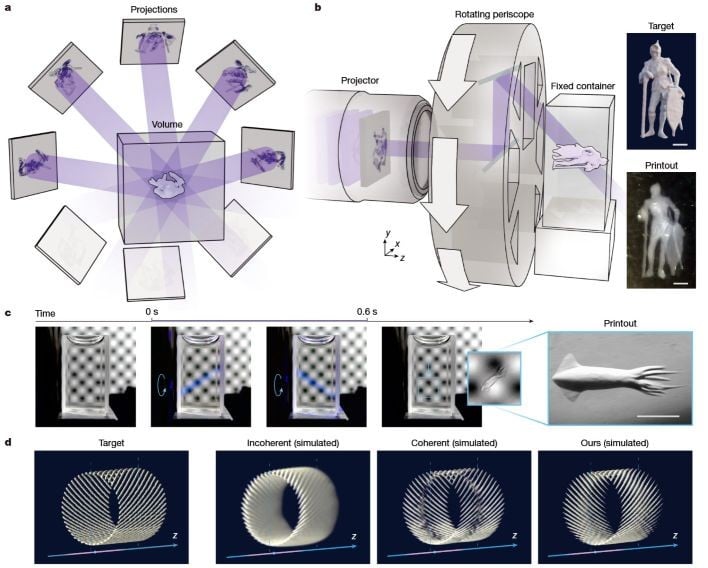
DISH also solves the speed-precision trade-off that many in the additive industry tend to struggle with. Traditionally, achieving high resolution required slower, point-by-point scanning. However, DISH maintains an impressive resolution of 19 micrometers (about one-fifth the width of a human hair) while achieving a volumetric printing rate of 333 cubic millimeters per second. This is currently the fastest reported speed for 3D printing objects of this scale, thanks largely to the system requiring only a single optical plane and no precise movement of the resin container.
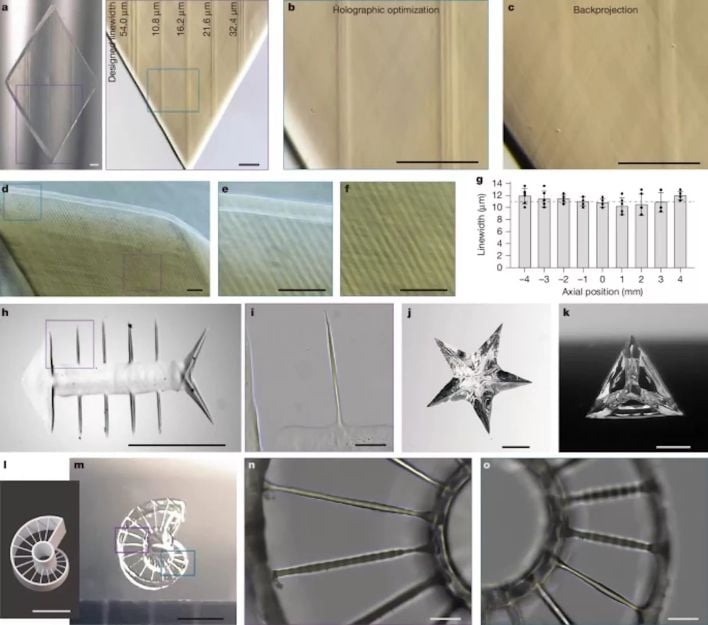
Already, the practical implications of such speed are open to the imagination. In the world of consumer electronics, DISH could be used for the mass production of intricate components like smartphone camera modules and photonic computing chips. These parts often feature complex curved surfaces and sharp angles that are difficult and time-consuming to manufacture with standard tools. By using light as a medium, manufacturers could potentially produce these items in bulk, placing materials directly inside fluid channels for continuous, pipeline-style printing.
DISH likewise holds immense promise in the biomedical field. The research team envisions using holographic printing to create high-resolution 3D tissue models for drug testing or regenerative medicine. The ability to print complex biological scaffolds in under a second could reduce the risk of material degradation and allow for more rapid experimentation. Additionally, the team demonstrated that the process is compatible with various acrylate materials of different viscosities, suggesting it can be adapted for a wide range of industrial applications.
Main image credit: Wikimedia Commons/Subhashish Panigrahi
Article images: Tsinghua University via Nature





