



Is Blue Light Really Wrecking Your Sleep? New Report Casts Doubt


If you're having trouble sleeping, exposure to blue light may not actually be the culprit despite its reputation as a villain to a good night's rest. While research shows that blue light can affect sleep patterns, there are important nuances and caveats to consider, including how much blue light you're actually be exposed to by your daily devices.
Thomas Germain at BBC waded through the weeds of blue light research and found that the effects are perhaps not as straightforward as we've been led to believe by various studies. According to Germain, the concern over blue light reached a fever pitch after a 2014 study examined the effects of staring at an iPad before bed (two years later, we wrote about Microsoft developing blue light reduction for Windows 10) . The study focused on 12 individuals, half of which read on an iPad before going to bed, all of which took longer to fall asleep, felt groggier the next morning, and produced less melatonin than those who didn't use an iPad.
Among other things, the study found that using portable light-emitting devices right before bed has biological effects that can negatively affect sleep and disrupt circadian rhythms, which in turn can adversely impact performance, health, and safety.
Germain consulted with experts to see if that's really the case, and that's where things get interesting. Jamie Zeitzer, a professor of psychiatry and behavioral sciences at Standford University, called the study an "incredibly deceptive piece of work." Zeitzer didn't take issue with the science behind the study, but said it led people to draw bad conclusions.
According to Zeitzer, the amount of light from today's screens "is really inconsequential" and not in line with that is tested in various studies.
"We bring someone into the laboratory, and they are exposed to very dim light all day long. And then they are given a bright light stimulus," Zeitzer says.
Citing another bit of research, Germain says that 24 hours of blue light from today's devices is equivalent to just one minute outdoors, as the Sun emits much more than our devices do.
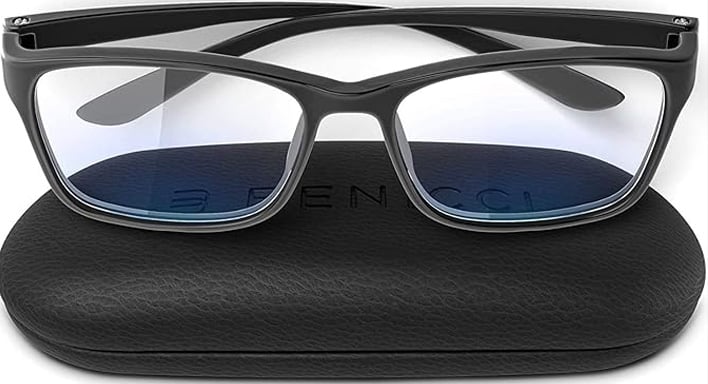
He also cited studies claiming that glasses with special coatings to filter blue light are inadequate, and that the most effective ones have deep orange, red, or amber lenses. They also wrap around the eyes to prevent blue light from seeping in through the sides.
One of the most interesting parts of the report, however, deals how much light you absorb throughout the day, and the timing of it all. According to Zeitzer, taking in more light during the day minimizes the impact of light in the evening.
The full report is worth a read before you rush out to buy a set of blue light-filtering glasses. In my own anecdotal experience, blue light hasn't seemed to affect my sleep patterns, though I did recently exchange a pair of prescription glasses with blue light filtering lenses because I didn't like how they changed the color of the scenery.




