Black Hole Grown In A Lab Traps Sound Waves In Wild Physics Experiment
by
Aaron Leong
—
Monday, October 12, 2026, 11:48 AM EDT
A new SBH design takes inspiration from how black holes absorb light - Image: Norbert Kowalczk via Unsplash
By adapting cosmic black hole physics, acoustic engineers have created a device that swallows sound inside pipes to eliminate unwanted acoustic energy such as echoes and vibrations.
When sound travels through enclosed ducts, ventilation, or plumbing systems, encountering obstructions normally creates jarring echoes. A research team led by engineer Deng Jie and acoustics engineer Oriol Guasch at La Salle, Universitat Ramon Llull in Spain developed a 3D-printed plug-in sonic black hole (SBH) that negates those reflections by progressively slowing sound waves down as they move through the pipe until their acoustic energy is absorbed as heat.
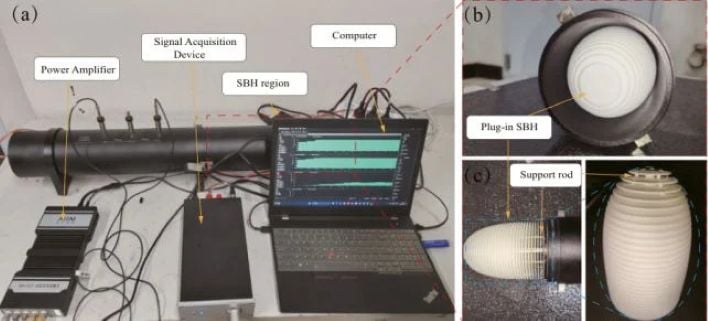
Plug-in SBH setup showing the 3D-printed sonic black hole with the rings mounted along a central support rod - Image: Deng et al
"Imagine standing in front of a duct that is closed at the far end and shouting into it," Guasch told Science Alert. "After a short delay, depending on the length of the duct, you would hear an echo coming back from the termination. If the duct were terminated with a sonic black hole, you would essentially hear no echo at all. Acoustically, it would be almost as if the tube were infinitely long, with no end from which the sound could be reflected back towards you."
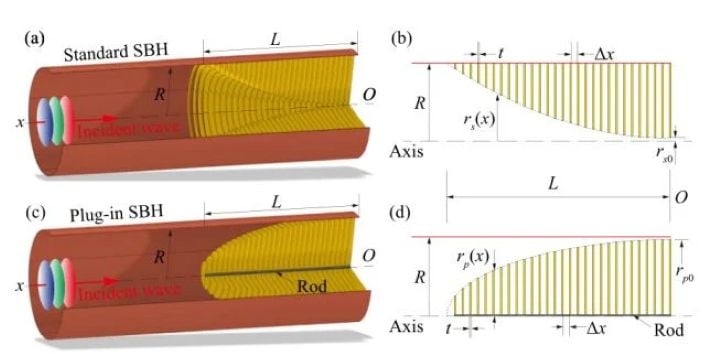
Standard sonic black holes require complex rings built directly into the interior walls of a pipe, making them difficult to retrofit into existing infrastructure. Deng and Guasch solved this problem by turning the geometry inside out, mounting a series of 29 varying-diameter rings onto a central rod like a miniature Christmas tree. This modular shape can be manufactured independently and plugged directly into any existing pipe.
A standard SBH has rings built into the walls of a pipe, while the plug-in design mounts the rings on a central rod - Image: Deng et al
As sound enters the structure, its wavelength contracts while its energy becomes intensely concentrated. Rather than bouncing back, the concentrated acoustic energy dissipates through friction and heat exchange between the air and the device's surfaces. "What happens to the wave as it approaches the end of a sonic black hole has a certain resemblance to what the external observer sees near an astrophysical black hole: the wave appears to take an infinite time to reach the limiting point," Guasch noted.
Published in the Science Direct journal, the team's experimental tests using a 3D-printed prototype confirmed that the plug-in design significantly reduces reflections across a much broader range of frequencies than traditional built-in ones. Deng and Guasch also hope to expand the concept into applications for room acoustics.