



ASUS ROG NeoCore Wi-Fi 8 Router Concept Brings Dungeons And Dragons Vibes


Forget for a moment that ASUS is already embracing the Wi-Fi 8 standard when the vast majority of consumers have yet to upgrade their home networks to Wi-Fi 7 hardware, let alone Wi-Fi 6E or even Wi-Fi 6. The real story here is the design of ASUS ROG's NeoCore Wi-Fi 8 router concept—is it just me or does it look it could be rolled like a D20 in a Dungeons and Dragons session?
Okay, maybe that's not actually the real story, but if you're not seeing DnD dice after looking at the NeoCore's design, then I don't know what to tell you. I mean, check out this more expanded view...
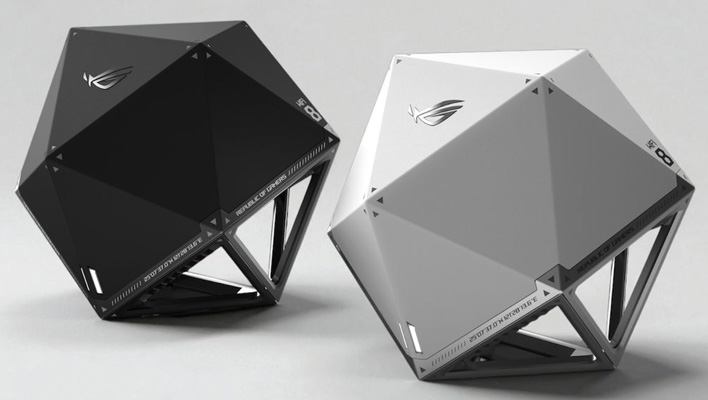
All that's missing is a set of numbers on the angled panels. You could also argue that it looks like a spinning top, but those toys are more of a relic in the year 2026.
ASUS is no stranger to design languages that buck the norm. The ROG Rapture GT-AX11000 Wi-Fi 6 router I reviewed six and a half years ago (which is still going strong, by the way) looks like a head crab. In reality, it doubles as a cat perch...
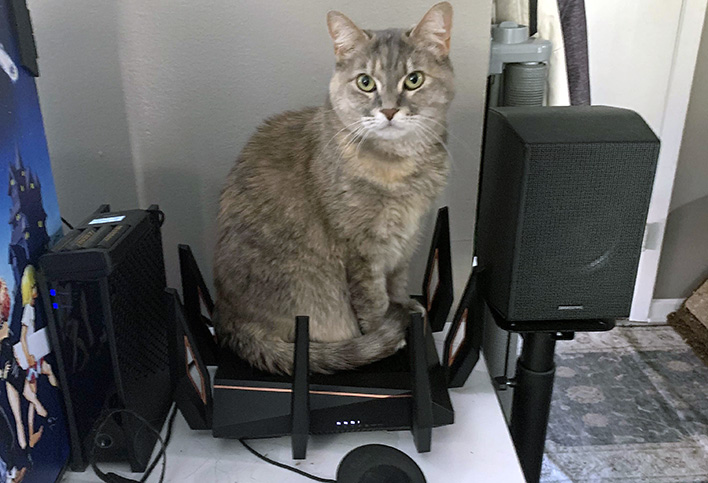
That face says, 'I care not for your disapproval of me blocking the vents—if I fits, I sits!'. That's a common sight, particularly in the winter months, and it continues to work just fine.
Anyway, getting back to the DnD dice ROG NeoCore, ASUS used the concept router to achieve what it says is the "world's first real-world throughput test" for Wi-Fi 8.
We don't get much in the way of specs or features, but ASUS does say it plans to release its first Wi-Fi 8 models this year, including mesh systems powered by its AiMesh technology and "AI Network Engine."
"WiFi 8 is not just about chasing peak speed—it’s about making every connection smarter and more reliable," said Tenlong Deng, Corporate VP & General Manager of Wireless and Networking for ASUS. "It enables seamless collaboration between smart homes, AI assistants, and cloud services, delivering stable performance anytime, anywhere."

Speed is part of the equation too, though, even if not directly. According to ASUS, users can expect up to 2X faster real-world average speeds and twice the coverage for IoT devices. The major caveat there, of course, is that client devices will have to support Wi-Fi 8 too, in order to take full advantage of the protocol's capabilities.
The real potential for Wi-Fi 8, however, is better reliability. Whereas Wi-Fi prioritized speed, Wi-Fi 8 prioritizes ultra-high reliability (UHR) with better network management with features like multiple access point coordination, lower latency, improved range, and advanced power management.
It's really a topic for another day, though. While ASUS plans to ship Wi-Fi 8 routers later this year, including possibly a finalized version of its ROG NeoCore, we're still a ways off before the standard becomes ubiquitous.




