



Apple's 2nd Gen AirTag Launches With Major Tracking Upgrades, Are They Worth It?


Nearly five years after introducing its first AirTag tracker, Apple is rolling out its second-generation iteration with key upgrades, including an expanded Bluetooth range and a louder built-in speaker. The core functionality remains the same and Apple is maintaining the same price points for its single pack and four-packs, though deals on the first-generation tracker muddy the value proposition.
The newest AirTag model, unofficially referred to as AirTag 2, features Apple's second-generation Ultra Wideband chip. It's the same chip Apple injected into its mobile devices, including the iPhone 17 series, iPhone Air (see our review), Apple Watch Ultra 3, and Apple Watch Series 11.
"Using haptic, visual, and audio feedback, Precision Finding guides users to their lost items from up to 50 percent farther away than the previous generation.1 And an upgraded Bluetooth chip expands the range at which items can be located. For the first time, users can use Precision Finding on Apple Watch Series 9 or later, or Apple Watch Ultra 2 or later, to find their AirTag, bringing a powerful experience to the wrist," Apple explains.
Apple says it reworked the internal design for a 50% louder AirTag, which the company claims enables users to hear it from twice as far as the first-generation tracker. In theory, AirTag trackers should be easier to find with the combination of a louder chime and enhanced Precision Finding capabilities. In practice, it partially depends on your situation. For example, Precision Finding isn't brand new to the AirTag, but was previously exclusive to iPhone, whereas now it works on Apple Watch Series 9 and later and Apple Watch Ultra 2 and later devices.
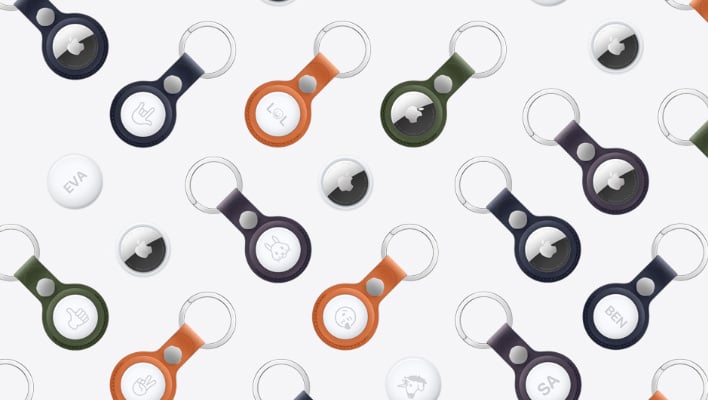
AirTag continues to integrate with Apple's Find My Network to help track down lost items. It also integrates with Apple's Share Item Location feature in iOS, which allows users to temporarily share location data with third parties. The example Apple uses is that of an airline in aid of tracking down lost luggage equipped with an AirTag. Once retrieved, the user can disable the function. It also expires automatically after seven days.
The same privacy features that were added to the original AirTag have been carried over to the second-generation iteration.
"AirTag is designed to discourage
unwanted tracking. If someone else’s AirTag finds its way into your stuff, your iPhone or Android phone will notice it’s traveling with you and send you an alert. If you still havenʼt found it after a while, the AirTag will start playing a sound letting you know it’s there," Apple explains.
"Of course, if you happen to be with a friend who has an AirTag, or on a train with a whole bunch of people with AirTag, don’t worry. These alerts only get triggered when an AirTag is separated from its owner," Apple adds.
The latest AirTag iteration uses the same user-replaceable CR2032 lithium coin battery as the previous model (the same as found in a typical PC motherboard), with Apple claiming you can get "more than a year" of battery life. It also features the same overall design, and while ever-so-slightly heavier, there's nothing to indicate that it won't fit in existing accessories that are compatible with the AirTag.
Apple's second-generation AirTag is available now direct from Apple online, followed by broader availability at Apple retail stores and from authorized resellers later this week. Pricing is set at $29 for a one-pack and $99 for a four-pack.
Meanwhile, Apple's first-generation AirTag is on sale...
- Apple AirTag (1st Generation), 1-Pack: $25.99 (10% off)
- Apple AirTag (1st Generation), 4-Pack: $69.99 (29% off)
The four-pack is an especially enticing offer, as it breaks down to $17.50 each. While the longer Bluetooth range and louder chime are nice updates, if you're looking at buying more than one AirTag tracker, this is a deal worth considering.




