


AMD Snatches More Server CPU Share As Intel Rallies In Desktop Market


There was some moving and shaking in the CPU market share breakdown between AMD and Intel, as well as Arm's continued encroachment into territories typically dominated by x86 silicon. The two things that stand out the most are AMD's upward swing in the lucrative server space, and Intel posting its first overall x86 gain since 2025 amid an impressive surge on the desktop.
According to Mercury Research, which sent us the breakdown over email, the third quarter PC CPU market declined to a bigger degree than expected, in the wake of an equally unexpected better second quarter for CPU shipments. According to the market research firm, this is solely the result of a downturn in mobile CPUs, which not coincidentally was the same segment that overperformed in the previous quarter.
"Both Intel and AMD
indicated in their earnings results that there was a rapid
softening in PC demand late in the third quarter that impacted
client processor shipments and that the outlook for client CPUs in
the fourth quarter will be a decline in excess of 20%.
Unlike client CPUs, however, server processors continued to grow
strongly in the past quarter," Mercury Research president Dean McCarron noted in his email.
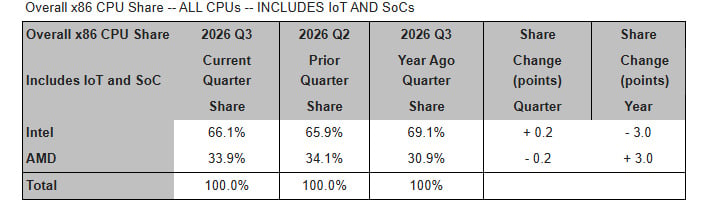
Looking at the breakdown, Intel's lead in overall x86 CPU share nudged up slightly to 66.1% in the third quarter, up from 65.9% in the previous quarter but down from 69.1% a year. That means AMD's x86 CPU share slipped slightly from 34.1% (Q2) to 33.9% (Q3), versus 30.9% a year ago.
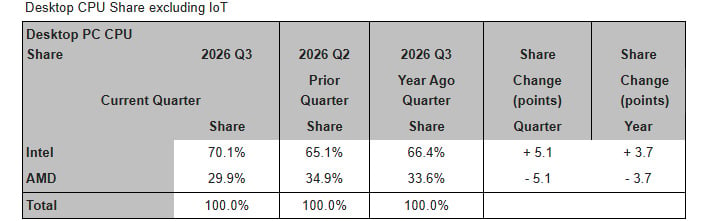
On a quarterly basis, that's not much movement. If narrowing the focus to specific categories, however, the numbers paint a far more interesting picture. Namely, Intel saw a "considerable increase in desktop CPU shipments" to claim a 70.1% share in the third quarter, which is up from 65.1% in the previous quarter and up from 66.4% a year ago. That pushed AMD down from its record-high 34.9% share last quarter to 29.9% in Q3, compared to 33.6% a year ago.
"It's difficult to know the driver of this for
sure, but we speculate that due to the lower mobile CPU demand,
Intel could allocate more products to the desktop market, which
normally sees a significant demand increase in the third quarter,
and Intel had been under-supplying this market earlier in 2026," McCarron says.
It also doesn't appear as though AMD had a seasonal increase. Somewhat ironically, this may be due to AMD having greater exposure to the PC gaming market compared to Intel. While normally that would be an advantage, supply constraints of gaming GPUs impacted the market as a whole, including CPUs for gaming PCs.
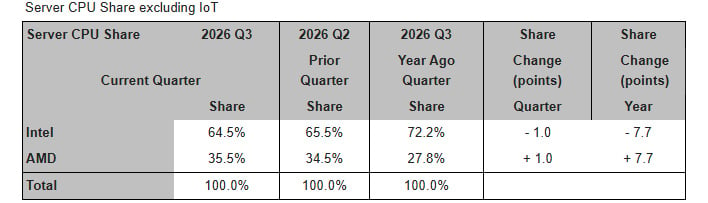
Of course, the server category is where big tech is making a killing right now, and AMD continues to chip away at Intel's lead in the category. AMD added another percentage point in Q3 to land at a 35.5% share of the server CPU market (excluding IoT), and that also represents a 7.7 percentage-point gain from a year ago. Meanwhile, Intel's server CPU share slipped to 64.5%, down from 65.5% in Q2 and down from 72.2% last year.
AMD's rise in the data center is coming at exactly the right time, helping propel the company to a record Q3 that puts it on pace to top Intel's revenue for the first time.. According to the latest Mercury Research data, the server CPU segment shipped 20% more units this time of year compared to last, resulting in the category's highest on-year growth in nearly five years.
"Demand was higher for both
data center class server processors and workstation CPUs, which
are seeing an increase driven by growing shipments of small
departmental sized AI servers," McCarron noted.
That's also benefiting Intel, which still leads the segment. In a separate email commenting on the latest Mercury Research breakdown, an Intel spokesperson pointed to the firm's massive 78% year-over-year surge in the data center, which raked in $7.3 billion last quarter. The results were Intel's best for its Data Center and AI (DCAI) division in 15 years.
Finally, the other thing to monitor is how Arm fares going forward. McCarron notes that Arm estimates are challenging because does not exist any centralized reporting of Arm-based server or client CPU revenues. Even so, the research firm estimates that Arm latched onto a record high 15.3% of the PC client CPU space in Q3.