



AMD Hits Record x86 Market Share To Cut Into Intel's Chip Lead In Every Segment


The global PC processor market experienced an unexpected surge in the second quarter of 2026, with total x86 and Arm-based CPU shipments growing more than 10% sequentially to defy normal seasonal trends, according to fresh data from Mercury Research. What's especially interesting, however, is that AMD gained more ground on rival Intel across every CPU category, propelling its own x86 share to a record high (again).
Looking at overall x86 CPU share, which includes internet of things (IoT) and system-on-chip (SoC) silicon, AMD catapulted to 34.1%. That's a 4.7% gain year-over-year, and up from 32.6% last quarter. The good news for Intel is that it is still dominating—its overall x86 CPU share sits at 65.9%. However, that's down from 70.6% a year ago, and 67.4% last quarter.
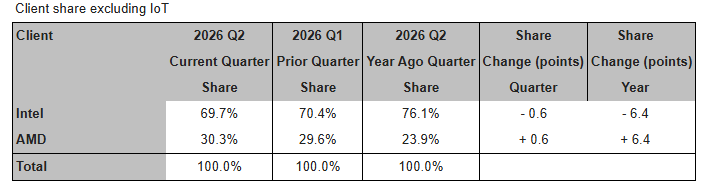
According to the report, AMD's total x86 client share hit and exceeded 30% for the first time in the company's history. Across the client landscape, which combines desktop and mobile processors while excluding IoT and SoC silicon, AMD reached a milestone 30.3% share in the second quarter of 2026 against Intel's 69.7%. Share breakdown aside, AMD's total unit shipments also hit a record high.
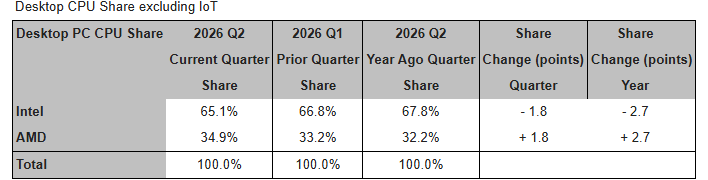
Breaking down the client segments, AMD captured 34.9% of the desktop market (up 1.8% sequentially) and 28.9% of the mobile market (up 0.6% sequentially). While desktop shipments across the entire industry faced a severe downturn, plummeting over 20% year-over-year due to higher PC prices, limited GPU supplies, and seasonal trends, AMD's declines were milder than Intel's.
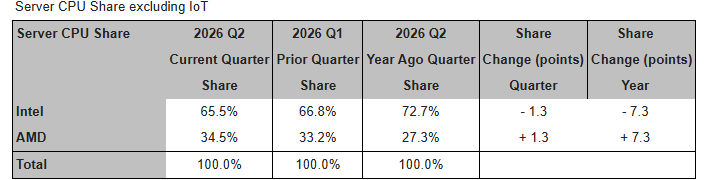
In the data center space, x86 server CPUs continued to "shine brightly" with nearly 20% year-over-year growth. Excluding IoT, AMD's server CPU share climbed to 34.5% (up 1.3% sequentially and 7.3% year-over-year), leaving Intel at 65.5%.
"Demand was higher
for both data-center class (Xeon SP and AMD EPYC) processors as
well as networking and storage products. If market share were
computed using only Xeon SP v. EPYC— eliminating the accounting
issues around other products—AMD's share would be up to 46.4
percent of the market," said Dean McCarron, President at Mercury Research.
The good news for Intel is that it is still dominating overall. Meanwhile, Intel CEO Lip-Bu Tan has Intel on a solid trajectory with major investments in its foundry business and execution on cutting-edge process nodes in the angstrom era. Related, recent benchmark leaks of a not-yet-released Core Ultra 9 4950K chip suggest that Intel's Nova Lake architecture will deliver massive gains.
Intel also noted in its most recent earnings, in which it posted its strongest revenue growth in 15 years, that its Q2 year-over-year server growth was the strongest on record. Meanwhile, Xeon 6 continues to be one of the fastest-ramping products in the company's history, underscoring improved execution and strong customer demand. And on the client side, Intel's AI PC revenue increased 26% sequentially to no account for two-thirds of its client revenue mix.
In other words, both AMD and Intel are in good shape.




