



Why AMD Isn't Losing Sleep Over Panther Lake's Big GPU Upgrade


As impressive as the debut of Intel's mobile Panther Lake lineup at CES 2026 was, AMD has gone on the record as being "not afraid" of Intel's latest and greatest architecture. The reason for this is because Intel didn't compare Panther Lake to AMD's top-of-the-line Strix Halo in its slides, with an AMD executive saying, "Strix Halo, or Ryzen AI Max, will kill it. [...] It's not even a fair fight at that point, because it's discrete level graphics."
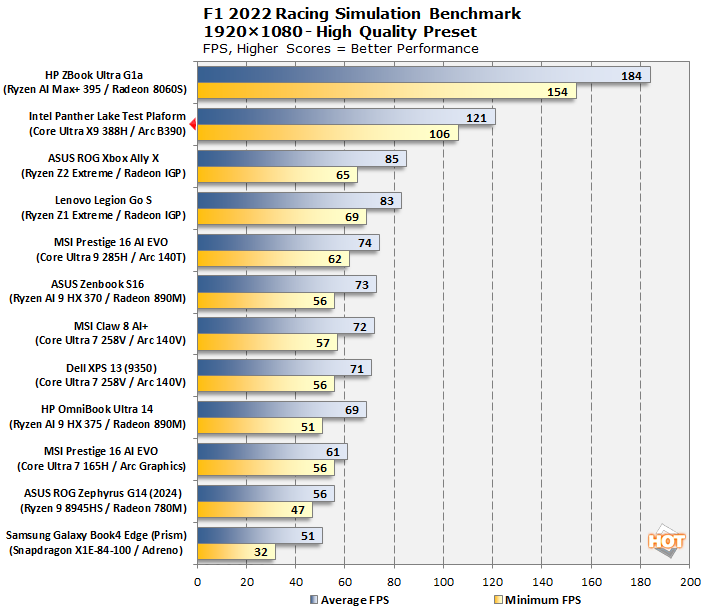
There's certainly truth to these statements, and they're reflected in our own benchmarks following the reveal of Panther Lake at CES 2026. In terms of graphics alone, AMD's Strix Halo outperforms Panther Lake's integrated Arc GPU. Our detailed sorting of Intel's Panther Lake GPU benchmarks with our collection of benchmarks place the new Arc B390 iGPU below AMD Strix Halo's Radeon 8060S, but also well above the rest of AMD's iGPU solutions, like Radeon 890M. That raw performance doesn't necessarily tell the whole story, though.
AMD SVP and GM of Client Product Group Rahul Tikoo continues, telling Tom's Hardware that "Strix Halo Ryzen AI Max compete against [Panther Lake 12 Xe], and it's better than that in terms of graphic performance, all of that. And then, for the mainstream of the market, that don't value that much graphics, because honestly, most of the people that are using notebooks that are outside of the creator or gaming spaces are...you know, they don't need that graphics performance. [...] People make choices, right? [...] There's a reason why they didn't compare it right there. [...] They compared their highest-end to our midpoint. [...] Wait until you see the price point on that."
While Rahul Tikoo's argument does indeed carry some weight, that "wait until you see the price point" actually pushes quite heavily in both directions of the argument. AMD Strix Halo PCs and the RAM required to make the most of them are not cheap, and performance of Radeon iGPUs below that—the integrated GPUs in the Ryzen 7000/8000 series, the Ryzen AI 300/400 series, and the Ryzen Z series SoCs—hasn't moved much since the introduction of "Phoenix" with the Ryzen 7000 series despite a 25% increase in core count with "Strix Point", as the architecture is power-limited by the shared 4nm fabrication process.
It's true that AMD holds the uncontested iGPU performance crown with Strix Halo—but it's also true that devices with that chip can easily cost $2,000 or more. In the sub-$1,200 price range, you're only getting up to 890M/Z2 Extreme levels of performance, and if Intel can squeeze Panther Lake chips with the Arc B390 iGPU into laptops or handhelds in that price range, or even slide between Z2 Extreme and AI Max 395+ well enough, AMD could be in trouble. Tikoo is correct about at least one thing: it's very much a "wait until you see the price point" argument, indeed.




