



AMD FidelityFX Super Resolution Lights Up GitHub As Hot Game Engines Add Support


Today's update sees the arrival of four additional games with native FSR support. Those games include Arcadegeddon and Necromunda: Hired Gun, which will receive FSR updates tomorrow (July 16th). In addition, Edge Of Eternity and Resident Evil Village will jump on the FSR bandwagon towards the end of July. Looking further down the road, AMD says that other popular titles like Far Cry 6, Baldur's Gate 3, and Vampire the Masquerade: Bloodhunt are scheduled for FSR updates in the future.
As promised, AMD is also making FSR available via GPUOpen, which means anyone can access the source code for free using an open-source MIT License. This could result in a significant boost in adoption for FSR in gaming going forward, as it isn't tied to a single vendor's GPU (like NVIDIA DLSS 2.0). DLSS 2.0, which is NVIDIA's competitor to FSR, is only possible with GeForce RTX GPUs. FSR, on the other hand, is compatible with AMD, NVIDIA, and even Intel GPUs. As we've seen in our benchmarks, even older GeForce GTX GPUs can see a significant performance (and image quality boost) when running FSR.
"With this release, you can also have a look behind the scenes as to how FSR works and see how easy it is to implement FSR into your game project to get a boost in performance," writes AMD. "This boost can help you create next-generation gaming experiences that can support a wide range of hardware and deliver high framerates for as broad an audience of gamers as possible."
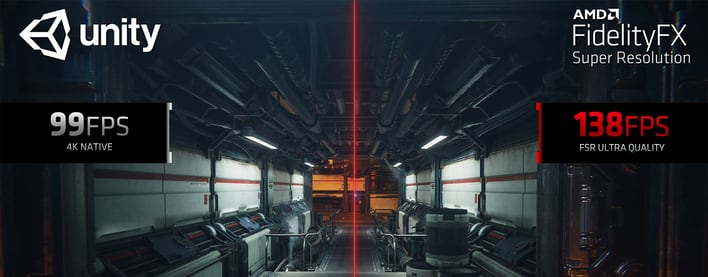
It should also be noted that FSR is already incorporated into two of the most popular game engines used on PC: Unity and Unreal Engine 4. Supporting FSR in these widely-used engines makes it easier for developers to push out updates for existing games and ensure that their future games come fresh out of the gate. For example, FSR is incorporated into the latest beta branch of Unity 2021.2 HDRP, while Epic's Unreal Engine 4 adds support via a patch.
"With the source code now available to everyone, and the new support we have for FSR in both Unreal Engine and Unity, we're very much looking forward to seeing what game developers do with it and what amazing gaming experiences we'll be able enjoy at higher performance thanks to FSR," AMD concludes.
In practice, we've found that FSR, like DLSS 2.0, represents a big boon for gamers that want to improve image fidelity without taking a big hit to performance. As long as you aren't pixel peeping like a madman, the obvious benefits of these upscaling technologies can't be ignored.




