



Watch This AI-Designed Spinning Drone Turn Invisible In Flight


Made from the stuff of blurry UFO sightings, engineers at Northwestern University have unveiled a drone that nearly vanishes in mid-air and not by using advanced camouflage or light-bending materials, but simply by spinning too fast for the eye to track.
Presented at the Robotics: Science and Systems 2026 conference in Sydney, Australia, the unmanned aerial vehicle (UAV), called the Phantom Twist, exploits the motion blur phenomenon. While a regular quadcopter keeps its main body stationary while spinning separate blades, the Phantom Twist consists of just one motor and one propeller. The propeller spins rapidly in one direction while the entire body of the drone rotates in the opposite direction. Revolving up to 25 times per second, the drone effectively tricks human eyes, which process visual information in a way similar to a camera's exposure time. Instead of seeing a flying object, observers see a ghostly, semi-transparent smudge that blends into the background.
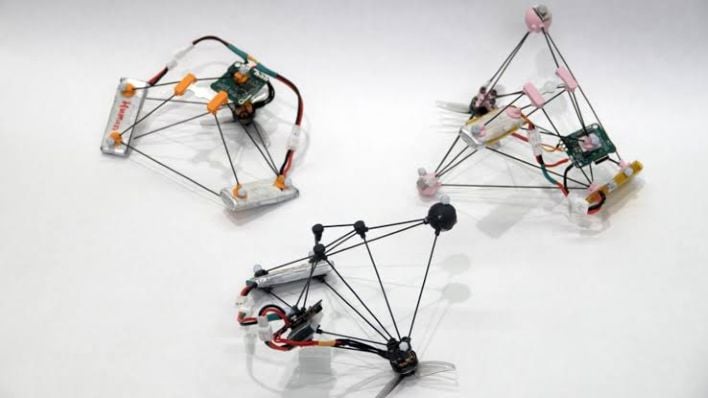
To design a robot capable of stable flight while spinning like a top, the research team, led by associate professor Michael Rubenstein, turned to AI (and optimization algorithms). The model they used generated roughly 20,000 potential configurations, shifting the positions of the motor, batteries, circuit boards, and counterweights. The team simulated how each variant would look while spinning against a hundred real-world backgrounds, utilizing a perception model to approximate human vision.
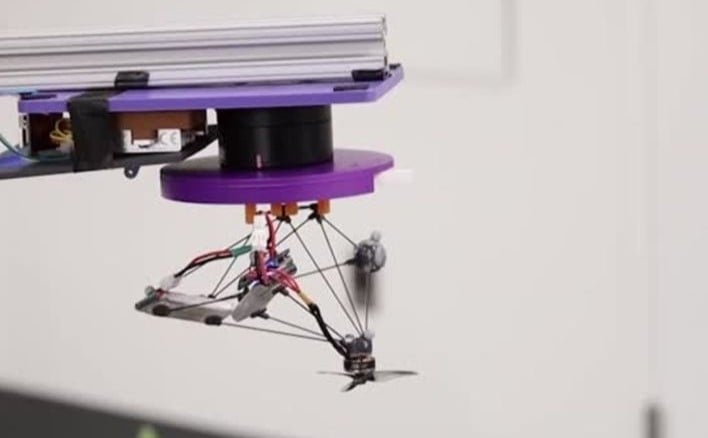
The optimization algorithms narrowed the field down to those that received the lowest visibility scores. The final physical prototype spreads its hardware across different heights and angles with empty space in between. This layout ensures that when the drone is in motion, its opaque components never overlap from the perspective of an onlooker. Instead of a solid mass, the hardware visually averages with the ambient light and surroundings. The team reckons that Phantom Twist is about ten times less visually perceptible than a conventional quadcopter.
There's still room for improving the "invisibleness," however. The wires and support rods still catch the light in certain conditions, and the single propeller generates a very obvious whine. The researchers plan to address these hurdles in future iterations by experimenting with highly transparent materials and quieter propulsion mechanisms.
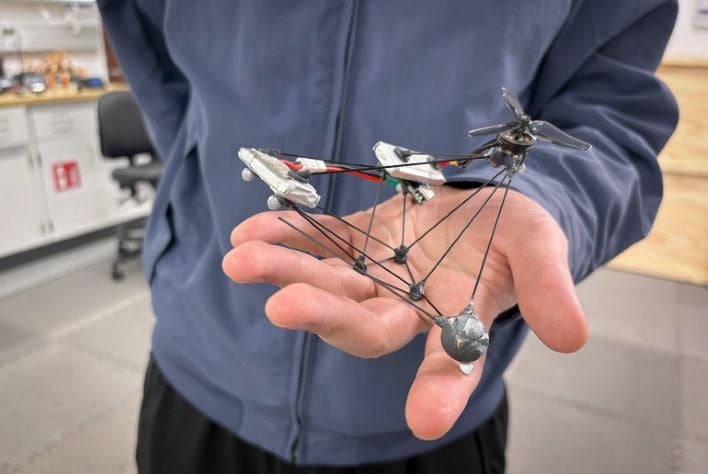
What comes from the Phantom Twist project could benefit low-impact aerial monitoring, for example. Conventional drones are highly disruptive; their mechanical silhouette and sudden movements frequently startle wildlife, skewing environmental data, and can provoke privacy concerns or behavioral shifts in human environments. By blending into the open sky as a faint haze (wait, is that a UFO?), future versions of the Phantom Twist could inspect aging infrastructure, map ecosystems, and observe nesting birds without bothering the natural dynamics around it.
Image credits: Rubenstein / Northwestern University





