



Steam Frame Teardown Finds Modular VR Design A Breeze Until You Hit The Fan


Valve’s long-awaited standalone virtual reality headset, the Steam Frame, not only finally launched this month, it also made it onto the dissection table. In its latest teardown, the folks at iFixit put the newly launched hardware under the knife (and other surgical instruments) to determine how easily users can service and repair it.
The verdict? It's an almost entirely headache-free affair thanks to a surprisingly modular design.
That said, there is a notable disclaimer. The popular teardown and DIY repair site partnered with Valve to provide parts, tools, and repair guides for the company's hardware, including the Steam Frame. However, iFixIt insists that Valve had no input on its editorial process, and given the site's strong reputation as a consumer advocate for DIY repairs, we have no reason to doubt it. That said, the teardown ends without the usual 10-point repairability score.
We're not sweating the lack of a score, though, because the write-up and YouTube video that the site posted are thorough. As a point of reference, Valve's Steam Deck previously earned a 7 out of 10 score, one of the highest at the site for a handheld, and iFixIt says the Steam Frame "carries much of that repair-friendly thinking into a much less forgiving shape."
As with any wireless device, having access to a swappable battery is a chief concern. Batteries inevitably degrade over time, and if they're not easy to swap out, then you eventually end up with a glorified paperweight. In this case, getting to the battery is mostly easy, save for some glue. A little bit of "isopropyl alcohol and gentle prying" proved effective in removing the curved, two-cell lithium-polymer pack.
"We won’t yet be selling Steam Frame batteries when parts go live in our store. We hope that will change. Gamers who drop over $1000 on this headset will rightly expect to be able to use it for more than a couple of years," iFixIt says.
Some of the other highlights from the teardown analysis include a simple three-latch mechanism to pop off the entire head strap and outer plastic chassis in seconds, a snap-in design for facial cushioning and headrest padding, the microSD card slot being easy to access, internal lenses that magnetically attach to the interpupilary distance (IPD) rail, and user-swappable AA batteries in the controllers.
It wasn't all sunshine and thornless roses, though. Outside of using adhesive for the battery, the biggest drawback is the cooling fan. Getting to it requires navigating past the optical assemblies, and that's where the Steam Frame's hardware becomes more tightly packed and trickier to access.
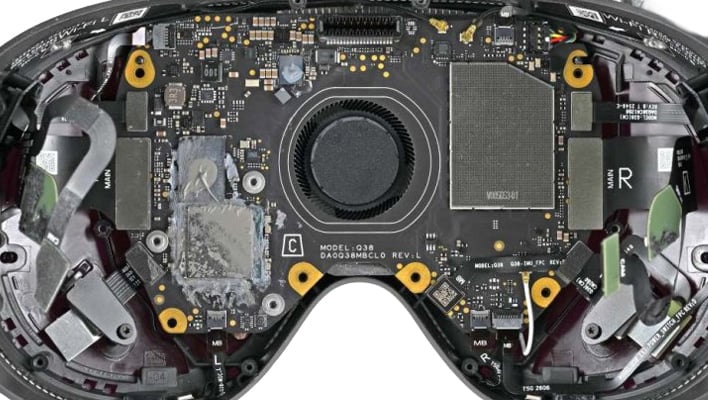
"The thermal hardware and fan appear to be separate parts, which is welcome. Getting to them, though, is the problem. Removing the fan takes us past the optics and through the dense internal assembly, disturbing far more hardware than we’d like for a replacement.
The fan is the Frame’s clearest missed opportunity," iFixIt says.
A big reason for the disappointment is because fans inevitably collect dust. It's a part that requires periodic maintenance, and the site laments that it doesn't get the same design attention as the other components.
In the end, the teardown analysis revealed that there is room for improvement, but overall is easier to work on than expected, delivering much of what the site's tech surgeons hoped Valve would port for the Steam Deck.




