



Brain Chip Implant Enables Paralyzed ALS Patient To Speak And Work Again


The participant, Casey Harrell, was diagnosed with ALS and developed severe dysarthria, a condition that rendered his speech nearly impossible to understand. In 2023, neurosurgeons at the University of California, Davis, as part of the multi-institutional BrainGate2 clinical trial, implanted four microelectrode arrays into Harrell's left precentral gyrus, the part of the brain that's responsible for controlling speech muscles. These four arrays contain a total of 256 electrodes designed to record the electrical firing of individual neurons when Harrell attempts to speak or move.
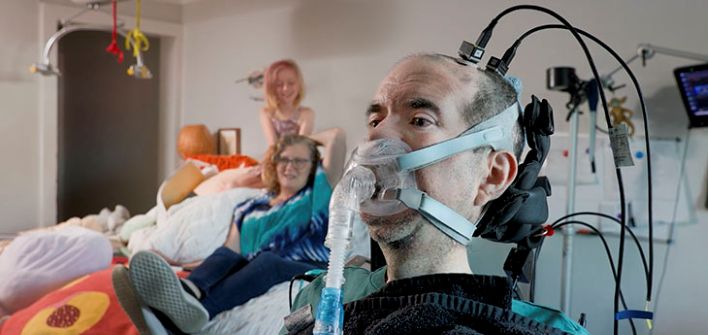
While previous neural prosthetics could decode words with high accuracy, they typically relied on intensive manual calibrations and a team of technicians present in a laboratory setting. The system deployed by UC Davis uses an AI decoder that continuously translates neural activity into text and simultaneously handles on-screen cursor navigation. During controlled testing, the AI system was able to achieve a 99% word accuracy with a vast 125,000-word vocabulary, keeping pace even when Harrell attempted to speed up his speech.
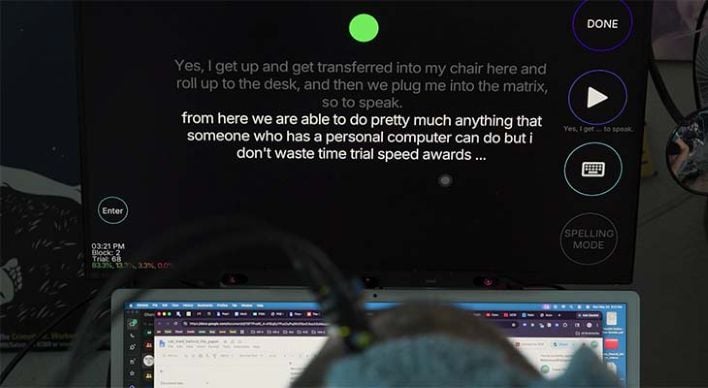
Impressively, Harrell frequently operates the system for up to 12 consecutive hours in a single day to surf the web, shop online, and text friends. The system also features a customized text-to-speech voice trained on audio recordings taken before his disease advanced, allowing his daughter to hear a voice that mirrors how her father used to sound.
All the more, the thousands of hours of high-res neural data gathered during the study represent the largest dataset of single-neuron speech recordings ever collected, offering researchers insight into how the human brain orchestrates language, which could in turn pave the way for commercial neural prosthetics.
Image credit: Regents of the University of California, Davis





