



105,000 Synced Nano-Oscillators Offer Blazing-Fast Silicon Transistor Alternative


Traditional silicon microchips process data by moving physical electrons through billions of microscopic switches, generating massive amounts of waste heat in the process. Spintronic computing offers an elegant alternative by manipulating the inherent spin of electrons (rather than their physical movement) to transmit information using spin waves.
At the heart of this technology are spin Hall nano-oscillators (SHNOs), which generate propagating magnetic spin waves. To build a powerful brain-like processor, these nanoscale devices must be aligned so they oscillate in unison. Up till now, researchers have struggled to scale this technology. The strongest coupling was previously limited to just 64 synchronized oscillators in a two-dimensional grid; scaling beyond this required putting the devices closer together, which was long considered a barrier due to the precision required.
To solve this, an international collaboration of physicists from IIT Bhubaneswar in India, the University of Gothenburg in Sweden, and Tohoku University in Japan created ultra-narrow nano-constrictions measuring just 10 and 20 nanometers across. Using advanced tungsten-tantalum and cobalt-iron-boron trilayers, the team successfully crammed more than 100,000 magnetic components onto a single, massive grid.
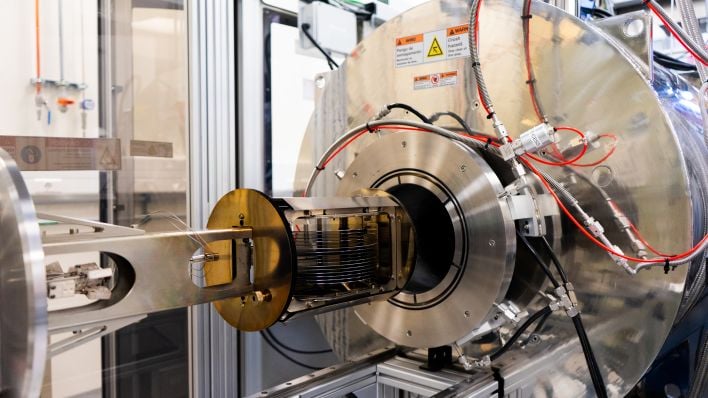
By packing these nano-constrictions tightly, the team found that that the network's overall microwave power and signal quality scaled exceptionally well. This level of performance brings scientists one step closer to developing specialized processors known as Ising machines. Unlike general-purpose silicon chips, synchronized magnetic networks are mathematically made to tackle complex, multi-variable optimization challenges almost instantaneously. These tasks range from finding the most efficient shipping routes across global supply chains to resolving real-time financial risk models and optimizing neural networks for advanced AI.
While this tech is still in early experimental stages, the ability to synchronize thousands of nanomagnetic devices in a fraction of a microsecond is very promising for our future computational demands.
Main image credit: IIT Bhubaneswar





