|
|
| Introduction and Specifications | |||
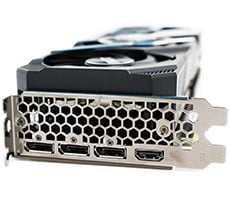
While workstation cards are certainly more expensive than their gaming-class brethren, it’s absolutely possible to build a budget-level system with a workstation-class graphics card to match. Both Nvidia and ATI have workstation-class cards which scale down well below $500, a fraction of the price of the high-end cards we looked at in our prior article. Today, we’ll be looking at a few products which make up this new generation of relatively inexpensive workstation cards, and we’ll see how performance compares to their high-end counterparts as well. We’ll be looking at three cards in particular – two from ATI and one from Nvidia. From ATI, we’ve got their new FireGL V5600 512 MB card along with their low-end FireGL V3600 256 MB card. In the Nvidia camp, we’ve got our hands on the popular QuadroFX 1700 512 MB card. All three of these cards are very tolerable in terms of size, power consumption, noise, and (most of all) price . While one shouldn't expect top of the line performance from these cards, in our tests we found performance in many applications to be impressively good, proving that you don’t need to spend four digits to get solid workstation performance. (Left to Right) FireGL V5600, QuadroFX 1700, and FireGL V3600 Graphics Cards Unlike our high-end cards, which were relatively close in terms of specifications and price, these mid-range cards vary much more. These three cards have a wide range of different options, which means potential buyers should take a much closer look at the specifications before buying, rather than just looking at the benchmark charts.
Strictly looking at the specifications, the FireGL V5600 looks like a better value, delivering over twice the memory bandwidth and running at a much higher GPU clock rate compared to the FX1700, while shipping at an MSRP of $100 less. The QuadroFX 1700 does have special features, such as SLI and HDTV out, although the 12 GB/s of memory bandwidth leave something to be desired. Of course, these are just specs – and performance levels in real world applications are what truly matters. Let’s take a closer look. |
| Nvidia QuadroFX 1700 | ||||
Nvidia’s G84 graphics processor, which is at the heart of the QuadroFX 1700, is manufactured on an 80nm manufacturing process. While it shares many similarities to Nvidia’s high-end G80 processor seen in their high-end workstation cards, the G84 is far smaller and less powerful. While the G80 processor has 128 unified shader processors, the G84 which we see here only has a quarter of that, 32 shader processors. This effectively cuts performance heavily across the board, but does make for a very small, efficient chip. The G84 has 289 million transistors stuffed into a core which is 169mm squared. Despite its size, the G84 supports DirectX 10, OpenGL 2.1, and even includes Nvidia’s VP2 hardware video decoding engine as well, something which even the high-end G80 processor doesn’t have. The QuadroFX 1700 ships with its G84 processor clocked at 460 MHz with 800 MHz DDR2 memory, along with its shader clock set to 920 MHz. These numbers are quite a bit lower compared to the GeForce 8600 gaming card, which is based on the same GPU, and runs at 540 MHz GPU with 700 MHz memory and a 1.19 GHz shader clock speed. Of course, this is fairly typical with Quadro FX cards, running at lower clock speeds compared to their gaming brethren, so what we’re seeing here is not out of line for Nvidia. With a tame clock speed and an advanced 80nm manufacturing process for its GPU, the QuadroFX 1700 doesn’t need elaborate cooling. Nvidia outfits this board with a very small aluminum alloy thin-fin cooler with a 4-pin PWM thermally controlled fan. While the fan is small, it doesn’t run at a high RPM, so you don’t get any high-pitched fan noise. It’s a very quiet card overall, even under heavy loads. The board is equipped with 512 MB of DDR2 memory from Hynix. The memory modules are set to 400 MHz clock rate, and connect to the GPU via a 128-bit memory bus, allowing for 12.8 GB/s of memory bandwidth. Not that impressive for a $700 board. The memory modules are left un-cooled on the PCB, since they do not run warm enough to require any type of cooling.
The FX1700 is equipped with two dual-link DVI output ports, which are capable of driving 2560 x 1600 30” displays per port. In addition, the board has an HDTV output port, in case you want to hook up this board to a component-enabled display. The board does not support stereoscopic output, nor can it connect to Genlock/Framelock boards like high-end Quadro cards. The card and its feature set are somewhat unimpressive, considering its price tag, which means that in order for it to get a recommendation, it’s going to have to outperform ATI’s cards in the benchmarks and offer a better value. There’s nothing inherently wrong with FX1700 – it simply doesn’t seem to have a feature set which matches up against its price tag. |
| ATI FireGL V5600 and V3600 | ||||
The RV630 graphics processor is quite flexible, as shown by the two cards we’re looking at today. Despite having the same GPU at their core, these cards can deliver very different performance levels and they sell for vastly different price points. The low-end V3600 has an MSRP of about $300, whereas the mid-range V5600 sells for twice that at $600. Why such a large price difference between two cards on the same GPU? We’ll tell you. The V5600 runs its RV630 graphics processor at 800 MHz, whereas the V3600 runs it at 600 MHz. Right off the bat, this means that the V5600 is 33% more powerful in terms of raw GPU rendering performance. The V5600 also has twice the memory, a full 512 MB of GDDR-4 memory, whereas the V3600 only has 256MB of DDR2 memory. The V5600 also runs its memory modules much faster, at 1100 MHz which nets the card peak bandwidth levels of 35 GB/s. The V3600 runs it memory at less than half that, at 500 MHz for 16 GB/s of memory bandwidth. In order to deal with the additional heat created by the higher clocked GPU and memory chips, the V5600 comes with a much larger cooler and includes an elongated PCB. The RV630 GPU has 120 stream processors, quite a bit less than the 320 stream processors used in the high-end R600 GPU we looked at earlier. It’s a unified shader design which is manufactured on an 80nm process. The GPU has an estimated 390 million transistors and measures 169mm squared, meaning it’s physically a larger chip compared to the one used in the QuadroFX 1700. The chip fully supports DirectX 10 and OpenGL 2.1, and sports ATI’s “Avivo HD” video processor. It’s definitely a solid mid-range GPU, when clocked high enough - and our tests with the FireGL V8560 showed us that ATI’s latest generation architecture does play well in the workstation market. Both the FireGL V5600 and V3600 consume less than 75W of power, so both can be powered directly by a PCI Express x16 slot. This means that neither card requires a power adapter, which is somewhat rare in this day and age. Both cards also have two dual-link DVI ports, capable of driving 2560 x 1600 30” displays each. Neither card has HDTV or Stereo output ports, and neither can drive a Genlock/Framelock card. The V5600 card is equipped with a second-generation Crossfire multi-GPU connector, although ATI does not allow for multi-GPU performance bonding with their current FireGL driver set. Of course, multiple cards can be used in a single system, although they will run independently of each other.
Both cards fared quite well in terms of noise, as well. We found both the FireGL V5600 and V3600 to be very tolerable in terms of noise. Both cards feature thermal sensing fans, which ran at nearly in-audible noise levels throughout all of our testing. ATI is definitely putting up a much more intense fight for the workstation market than they have before, as show by these two cards. The V5600 delivers a very solid feature set at an MSRP less than Nvidia’s competing QuadroFX 1700 card. The $299 V3600 card appears to be a good buy on paper as well, although we’ll need to see the performance numbers before judging it. |
| Power Consumption | ||||
![]() ![]() It looks like our initial expectations were right. While the V5600 only consumes about 10W more than its competing cards (FX1700 and V3600) at idle, under load it consumes about 40W more than the FX1700. Nvidia’s QuadroFX 1700 looks great, in terms of power consumption, as this mid-range workstation graphics card is consuming less power compared to ATI’s budget-level workstation card. |
| Testbed and Cinebench | ||||||||
Just as with our high-end workstation graphics card shootout, we’ve tested these mid-range cards with Windows XP. Both Nvidia and ATI claim XP to still be the dominant workstation-class operating system, and performance is fine tuned for this operating system in order to reflect that.
Our first test doesn’t bode well for Nvidia. Cinebench 10 shows a nice level of performance scaling between ATI’s low/mid/high-end workstation cards, although Nvidia’s mid-range QuadroFX 1700 card shows performance levels lower than that of the FireFL V3600 card, which costs half as much. |
| 3D Studio Max 2008 and Maya 8.5 | ||||||||
Surprisingly, we don’t see that much variance in these two high-end OpenGL applications between our ultra high-end cards and the mid-range / budget cards. 3D Studio Max shows a much larger degree of change between the cards, Maya shows nearly none. In 3D Studio Max 2008, we see the QuadroFX 1700 delivering the fastest benchmark times of the three cards we’re testing today, edging out the V5600 by a small margin. If you’ll also notice, the $699 QuadroFX 1700 card is also besting the $2,999 FireGL V8650 card in this particular suite. The tables turn in our Maya benchmark, which obviously favors ATI hardware. All of our ATI cards rendered the benchmark suite faster than our two Nvidia cards, even the monster QuadroFX 5600 card. So, if you want a simple answer, if you’re a 3D Studio Max user, go Nvidia. If you use Maya, go ATI. |
| Spec ViewPerf 10 | ||||
![]() ![]() ![]() ![]() Our first round of ViewPerf 10 OpenGL tests don’t showcase a clear winner between the mid-range cards. 3dmax is neck and neck between the QuadroFX 1700 and FireGL V5600, whereas Nvidia powers a win in the Catia benchmark. The FireGL V5600 takes wins in both Ensight and Maya, where the QuadroFX 1700 sits in second place and the V3600 sits in last. Again, solid Maya performance from the ATI camp, solid Catia performance from Nvidia. |
| Spec ViewPerf 10 (Continued) | ||||
![]() ![]() ![]() ![]() The rest of the Viewperf suite shows ATI’s mid-range cards in a much better light, as they win three of the four tests. SW, Twx, and Ugnx all run faster on ATI’s FireGL V5600 hardware as opposed to the QuadroFX 1700. In fact, the QuadroFX 1700 takes a thorough beating in these tests, as ATI’s budget-level V3600 card manages to outpace it as well, with a price tag which is half that of the QFX1700. The only saving grace is ProEngineer, which runs quite well on the QuadroFX 1700 card, besting all ATI cards we tested against. |
| GPGPU Computing | ||||
![]() ![]() ![]() Our first set of GPGPU tests on these mid-range cards look good for ATI’s product line, as they sweep the benchmark charts. All three tests ran faster on both the FireGL V5600 and the V3600 compared to the QuadroFX 1700. The final, most intensive test, failed to run on either the QuadroFX 1700 or the FireGL V3600 card. Performance scaling looks about as expected given the hardware and price points of these cards. |
| GPGPU Computing (Continued) | ||||
![]() ![]() ![]() Our second round of GPGPU benchmarks is a much closer race. In our Monte Carlo tests, the QuadroFX 1700 and FireGL V5600 are fairly neck and neck throughout the suite, although the QuadroFX 1700 retains a slight performance edge. A nice win for the QuadroFX 1700, although given it’s a bit more expensive, the price/performance ratio is still slightly in ATI’s favor. |
| 3DMark06 and Crysis | ||||||||
Looking to game a little bit after hours? Or perhaps you’re a game developer and want to do some real-time DirectX engine testing on your system? Well, as these benchmarks show, the FireGL V5600 is likely the better card for this scenario. The QuadroFX 1700 card performs about as well as the FireGL V3600 card in these tests, which isn't very impressive. Frankly, none of these mid-range cards would be considered good for a gaming environment, but the FireGL V5600 is the most tolerable of the mid-range / budget bunch. |
| OpenGL Effect Benchmarks | ||||||||
Our two OpenGL effects benchmarks run much quicker on ATI hardware, especially the “Fur” benchmark, which runs nearly four times as fast on the FireGL V5600 compared to the QuadroFX 1700 card. Considering the QuadroFX card is still more expensive, that’s a huge win for ATI. The numbers are a bit closer in the “Soft Shadows” test, although even here, ATI’s low-end card is besting Nvidia’s mid-range card in performance. |
| Conclusion | ||||||||||||
In our last workstation-class graphics card shootout, we compared two high-end cards to eachother and concluded that Nvidia had the performance edge at the high-end. In the mid-range workstation market, however, the tables are turned 180 degrees. In this space, ATI currently has a better performing product across the board with the FireGL V5600 512 MB card. While Nvidia has a few wins here and there, overall the FireGL V5600 is simply a stronger product.
QuadroFX 1700:
FireGL V3600:
|