|
|
| Introduction and Related Information | |||||||
Last week, due to some unexpected circumstances, we were able to post a sneak peek of the RV770 GPU and ATI Radeon HD 4850 graphics card. As our limited testing showed, the Radeon HD 4850 was quite promising for a $199 graphics card. But we weren't able to tell the complete story. While the initial benchmarks definitely looked good, there was a lot more to talk about in regard to the Radeon HD 4850 and the RV770 GPU at the heart of the card.
As the above list of specifications and features show, the new Radeon HD 4800 series has much in common with the Radeon HD 3800 series. Both offer DX10.1 and Shader Model 4.1 support, both series of GPUs are manufactured on TSMC's 55nm process node, and both support ATI's CrossFireX multi-GPU technology. Because we've covered many of the shared features of the Radeon HD 4800 and 3800 series cards before, we won't be going in depth again here. However, we would recommend taking a look at a few recent articles to brush up on the tech if you're so inclined.
|
| RV770 Architecture and Features |
As we've already explained, the initial line-up of Radeon HD 4800 series cards will be comprised of the single-slot Radeon HD 4850 and dual-slot Radeon HD 4870. AMD is touting the Radeon HD 4850 as the first single-GPU solution to offer 1TFLOPs of compute power, thanks to its 625MHz RV770 GPU. The card features GDDR3 memory and has a max power of about 110W. As you'd probably expect, the Radeon HD 4870 is markedly more powerful. Although based on the same GPU, the 4870 is clocked higher at 750MHz, and thus offers 1.2TFLOPs of compute power. The Radeon HD 4870 also makes use of newer GDDR5 memory technology and has a higher max power of 160W. More on the cards themselves a little later. AMD was able to do this by redesigning virtually all of the functional blocks within the GPU. The 800 stream processing units are grouped in a new SIMD core layout, and the texture units, ROPs, and cache have been restructured to minimize transistor count, while also increasing performance. We should also point out that the ring-bus memory controller introduced with the X1K series has been replaced with a new memory controller that can make use of GDDR5 memory. With the RV770, AMD claims that the SPs in the GPU offer 40% more performance per square millimeter, and that more aggressive clock gating offers improved performance per watt. Likewise, the newly streamlined design of the RV770 texture units reportedly offer 70% more performance per square mm with double the texture cache bandwidth and large increases in 32- and 64-bit filter rates. |
| More Features of the RV770 |
The render back-ends in the RV770 GPU have been significantly enhanced over those in the RV670 as well, with the goal of improving anti-aliasing performance.
Also new to the RV770 is a distributed memory controller architecture that's laid out around the perimeter of the chip, with individual controller segments situated adjacent to the primary bandwidth consumers. In comparison to the ring-bus memory controllers of previous ATI GPU, this new distributed design reduces latency, silicon area, and power consumption. In addition, the new memory controller also supports GDDR5 memory technology. GDDR5 is an evolution of GDDR3/4 technologies that allows for shorter traces, lower voltages, and increased bandwidth.
To quickly test the number crunching abilities of the RV770, we enlisted the help of a small application dubbed "GPUQuant" that performs Black & Scholes or Monte Carlo calculations on either a CPU or GPU. The results show NVIDIA's GTX 200 series GPUs with a marked advantage in this test, but both AMD and NVIDIA GPUs offer huge gains over even a quad-core GPU.
|
| The Radeon HD 4850 and 4870 |
As we've already mentioned, the initial line-up of Radeon HD 4800 series cards will be comprised of the Radeon HD 4850 and Radeon HD 4870. Some time later, factory overclocked versions of these cards are due to arrive, followed by the R700.
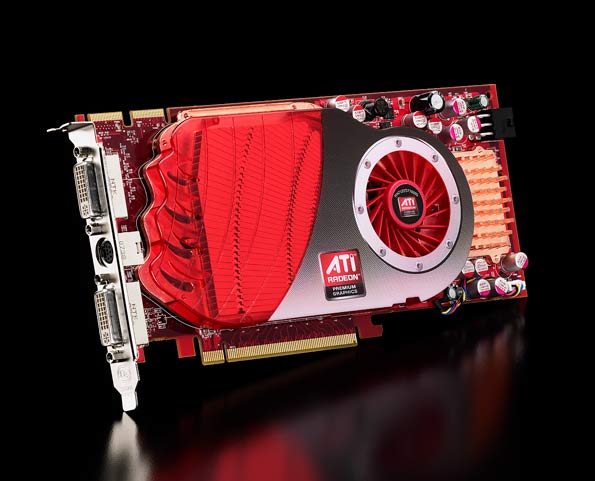
The Sapphire Radeon HD 4850 you see pictured here has a core GPU clock speed of 625MHz with 512MB of GDDR3 memory clocked at 993MHz. The memory is connected to the GPU via a 256-bit memory bus, which offers roughly 63GB/s at default clock speeds. And as you can see, the card is cooled by a single slot, copper fansink, that remained relatively quiet during our brief testing, but man did it get hot. The drivers reported an idle temperature of around 80'C, and the card was way too hot to touch even while sitting idle at the Windows desktop. During our testing, Sapphire sent an updated BIOS for the card that was designed to alter the fan-speed profile and thus lower temperatures, but due to time constraints we were unable to test it. Until ATI's R700 arrives, which features a pair of RV770 GPUs on a single PCB, ala the Radeon HD 3870 X2, the Radeon HD 4870 is AMD's flagship Radeon HD 4800 series card. Technically, the GPU powering the 4870 is identical to the 4850. However, its implementation on the 4870 is totally different. For one, clock speeds are higher. On the 4870, the GPU is clocked at 750MHz and it is linked to cutting edge GDDR5 DRAMs clocked at 900MHz (1.8GHz x 2 = 3.6Gbps). In this configuration, the 4870's memory offers about 115.2GB/s of peak memory bandwidth. The card is cooled by a dual-slot fansink similar to the one found on the 2900 XT, but this version is much quieter for the most part. The Sapphire Radeon HD 4870's accessory bundle was identical to the 4850's, but pricing on this more powerful card is expected to be $299.
For a comparison of how these new Radeon HD 4800 series cards stack up again the Radeon HD 3870, we present to you this simple table. As you can see, the Radeon HD 4870 and 4850 share much in common with the Radeon HD 3870 but the number of stream processors and texture units have been beefed-up significantly. Although the RV770 is comprised of roughly 45% more transistors, AMD was able to increase the SP and TU counts more than two fold, while also implementing support for more advanced memory technologies and enhancing the capabilities of the AVIVO video processing engine.
Of course, NVIDIA caught wind of the impending Radeon HD 4800 series launch and was prepping a product to rain on AMD's parade. Out of the blue, a couple of graphics cards arrived here in the lab based on a "new" GPU from NVIDIA. What you see pictured above is the upcoming GeForce 9800 GTX+. |
| Our Test Systems and 3DMark06 | ||||||||||||
HOW WE CONFIGURED THE TEST SYSTEMS: We tested all of the graphics cards used in this article on either an Asus nForce 790i SLI Ultra based Striker II Extreme motherboard (NVIDIA GPUs) or an X48 based Asus P5E3 Premium (ATI GPUs) powered by a Core 2 Extreme QX6850 quad-core processor and 2GB of low-latency Corsair RAM. The first thing we did when configuring these test systems was enter their respective BIOSes and set all values to their "optimized" or "high performance" default settings. Then we manually configured the memory timings and disabled any integrated peripherals that wouldn't be put to use. The hard drive was then formatted, and Windows Vista Ultimate was installed. When the installation was complete we fully updated the OS, and installed the latest DX10 redist and various hotfixes, along with the necessary drivers and applications.
3DMark06's default benchmark test is essentially CPU bound with all current high-end graphics cards, hence the right grouping seen in the results above. The new Radeon HD 4800 series cards handily outpace the HD 3870 and sandwich the GeForce 9800 GTX. In this test, the upcoming GTX+ outpaces both Radeon HD 4800 series cards, but as you'll see later, with actual games, the new Radeons fare much better.
If we tunnel down into the individual Shader Model 2.0 and 3.0 results, we see a similar performance trend. The SM 2.0 test is mostly CPU bound with anything more than a single GPU, as is the SM 3.0 test. Both of the new Radeon HD 4800 series cards once again fall victim to the GTX+ according to the SM 2.0 test, but in the SM 3.0 test, the Radeon HD 4870 jumped ahead and hung right alongside the more expensive GeForce GTX 260. |
| 3DMark Vantage | ||||||
The relatively new 3DMark Vantage is far more intensive than the aging 3DMark06, and as such the spread is far more pronounced between the different configurations we tested. Here, the Radeon HD 4850 edges out the upcoming GeForce 9800 GTX+ by a few points and the Radeon HD 4870 finishes just behind the GeForce GTX 260.
3DMark Vantage's individual GPU tests tell essentially the same story, although in GPU test 2 the Radeon HD 4850 finishes just behind the GeForce 9800 GTX+. The Radeon HD 4850's slightly larger margin if victory over the GTX+ in GPU test 1, however, gave it the overall edge in this benchmark. We should also note that both NVIDIA's and ATI's solutions show excellent multi-GPU scaling in 3DMark Vantage with the exception of the quad-CrossFireX 3870 X2 setup, which suffered from visual anomalies and lower than expected scores. |
| Half Life 2: Episode 2 | ||||||
Our custom Half Life 2 benchmark tells an interesting story. First, it appears that the NVIDIA configurations used more CPU resources, which resulted in somewhat lower scores for the two- and three-way SLI setups in the lower-resolution tests than the Radeon HD 4800 series CrossFire configurations. Overall, the Radeon HD 4850 finished just shy of the mark set by the GeForce 9800 GTX+, but the Radeon HD 4870 abd GeForce GTX 260 actually traded victories here. So far, the Radeon HD 4870 has proven to be a strong competitor to the GTX 260, even though it is expected to sell for about $100 less. |
| Unreal Tournament 3 | ||||||
Our performance results with Unreal Tournament 3 somewhat mirrored those of HL2:EP2. Once again, the Radeon HD 4850 was slightly outpaced by the GeForce 9800 GTX+. The Radeon HD 4870, however, actually nudged past the more expensive GeForce GTX 260. The new Radeons also showed good multi-GPU scaling, as did the NVIDIA configurations, with the exception of the 3-way SLI setups which were more CPU bound. |
| Enemy Territory: Quake Wars | ||||||
Our custom Quake Wars: Enemy Territory benchmark proved to be somewhat of a strong point for the new Radeon HD 4800 series cards. Both the Radeon HD 4850 and Radeon HD 4870 performed well, slightly outperforming the GeForce 9800 GTX+ and GeForce GTX 260, respectively. We should note that we encountered some texture flashes in this game with the new Radeons running in CrossFire mode with the latest driver build, that did not occur on the Radeon 3800 series. Performance scaled as expected, however. |
| Crysis Performance | ||||||
Our custom Crysis benchmark echoed many of our previous results. In this game, the new Radeon HD 4850 wasn't quite as fast as the upcoming GeForce 9800 GTX+, but the Radeon HD 4870 was just a hair faster then the GeForce GTX 260. Multi-GPU scaling was slightly better on the NVIDIA configurations, however, which allowed the GeForce 9800 GTX+ SLI-based system to outpace both of the Radeon HD 4800 series CrossFire configurations. |
| SD and HD Video Performance | ||||
We also did some quick testing of the Radeon HD 4870's video processing engine, in terms of both image quality and CPU utilization with some HQV and H.264 playback tests.
HQV is comprised of a sampling of SD video clips and test patterns that have been specifically designed to evaluate a variety of interlaced video signal processing tasks, including decoding, de-interlacing, motion correction, noise reduction, film cadence detection, and detail enhancement. As each clip is played, the viewer is required to "score" the image based on a predetermined set of criteria. The numbers listed below are the sum of the scores for each section. We played the HQV DVD using the latest version of Cyberlink's PowerDVD HD, with hardware acceleration for AMD AVIVO HD and NVIDIA PureVideo HD extensions enabled.
|
| Power Consumption, Noise, Thermals | ||||
We'd like to cover a few final data points before bringing this article to a close. Throughout all of our benchmarking and testing, we monitored how much power our test systems were consuming using a power meter. Our goal was to give you all an idea as to how much power each configuration used while idling and under a heavy workload. Please keep in mind that we were testing total system power consumption at the outlet here, not just the power being drawn by the motherboards alone.
Both of the new Radeon HD 4800 series cards consumed somewhat more power than the NVIDIA GeForce 9800 GTX+ and standard 9800 GTX, while idling and under load. Overall consumption was surprising high for the 4800 series cards, relatively speaking, and was actually higher than even the Radeon HD 3870 X2. |
| Our Summary and Conclusion | ||||
Performance Summary: Summarizing the Radeon HD 4850's and Radeon HD 4870's performance, thankfully, is quite easy. The Radeon HD 4850 is generally faster than the GeForce 9800 GTX and right on-par with or somewhat faster than the upcoming GeForce 9800 GTX+ in most applications. The Radeon HD 4870, however, is definitely a step up from the GeForce 9800 GTX+ and actually compares favorably to the $100 more expensive GeForce GTX 260. In fact, the Radeon HD 4870 was able to slightly outperform the GeForce GTX 260 in a couple of tests, including ET:QW and UT3. When the Radeon HD 2900 XT launched in may of last year, we were genuinely concerned for the future of ATI GPUs as a viable alternative to NVIDIA on the desktop. Our fears were quelled somewhat when the Radeon 3800 series arrived, and today our outlook is completely different. While they have certainly hit some major speed-bumps over the last couple of years, it is clear AMD has a lot of fight left and this latest round of ATI Radeons proves it. At their respective price points, the Radeon HD 4850 and Radeon HD 4870 are extremely strong products. For $199, it is very easy to recommend the Radeon HD 4850. Its single-slot design is desirable for a number of applications, its feature set is second to none, and performance is very good in comparison to the GeForce 9800 GTX and upcoming GTX+. At $299 the Radeon HD 4870 is a very desirable product as well, especially in light of the $399 GeForce GTX 260. The Radeon HD 4870's feature set is also very good, its cooler is relatively quiet, and performance is top notch. And dare we say a $300 graphics card represents and excellent value, from a price point perspective? These cards are definitely going to put significant price pressure on NVIDIA's GTX 200 series. One drawback common to both cards though is heat. Both the Radeon HD 4850 and 4870 ran surprisingly hot, so hot that they couldn't be touched.
|