|
|
| NVIDIA’s G92 Architecture, A New GPU For The GeForce 8800 GT | |||||||||||||||||||||||||||||||||||||||||||||||||||||||
Below is an easy to digest table of specifications for various members of NVIDIA's G8 series of GPUs and their associated reference board build-outs. Here you'll be able to more easily place where the new GeForce 8800 GT should fall, in terms of overall performance and capabilities.
OK, we know what you're thinking, 754M transistors with goosed up core clock and memory clocks that compete a GeForce 8800 GTX but this is a "mid-range" card. And you'd be correct. As the saying goes, today's high-end will be tomorrow's mid-range, so to speak. But there's more to the picture here than the numbers really show. With 112 Stream Processors and a 256-bit memory interface, the new GeForce 8800 GT offers higher overall fill-rate than a GeForce 8800 GTS but slightly less memory bandwidth, though some third party board partners may offer higher speed variants versus the reference design. From a pure fill-rate perspective, the new GeForce 8800 GT should come within striking distance of a GeForce 8800 GTX but at a fraction of the cost, thanks in part to that 65nm die shrink.
If the above block diagram looks vaguely familiar, it's because it is. What you're looking at is the same basics block layout of the NVIDIA G80 architecture but with only seven groups of 16 Steam processor units. 7 times 16 equates to 112 total stream processors. So we have our basic math in check here but why the odd number of SP units? Good question. The simple fact is that this new GPU core is more or less a die shrink of the existing G80 minus one SP unit, or at least one of the 8 available on the original G80 core has been disabled. However, in the immortal words of a cheesy infomercial host, but wait, there's more! NVIDIA brought new features and engine enhancements to the GeForce 8800 GT and we'll dig into those next. |
| New Features – PCI Express 2.0, Pure Video HD and TRMS AA | |||
|
The way to PCI Express 2.0 has been paved by Intel's new X38 chipset and NVIDIA decided to follow it with the launch of this new GPU. The PCI Express 2.0 standards specification calls for a 5 Gigabit/sec SerDes (serializer/deserializer) physical interface. These new higher speed links will offer twice the available dedicated bi-directional bandwidth keeping the GPU fed with pre-processed rendering workload from the host "root complex" system CPU. Though this new high speed serial interface will become more important down the road, as game engines and new platform designs begin to take advantage of it, think of this new GPU feature as an insurance policy of sorts, offering a level of future-proof
NVIDIA VP2 video processing engine offers AES128 decryption for HDCP content as well as full hardware acceleration from bitstream processing to motion compensation and decode for H.264 high def content. A diagram from that past launch illustrates NVIDIA's GPU video processing migration over the past few releases. GeForce 8800 series GPUs currently are only VP1 enabled but in later releases of the GeForce 8500 and 8600 series GPUs, NVIDIA brought out VP2 and has also migrated the new processing engine into the GeForce 8800 GT and will likely do so for roadmap products as well.
Note that Half Life 2: EP2 has its own transparency AA technology built into the engine, so setting transparency AA in the driver control panel for that game engine, isn't worth doing. However, as you can see in EP1, our chain link fence looks decidedly more defined and crisp, especially in far-reaching areas and along the bottom of these shots, with TRMS AA enabled versus the shot without it. Finally, as you can see here, the super sample AA mode doesn't offer much if any additional image quality enhancement over TRMS. Examples of current game engines that can benefit from TRMS are Half Life 2 and HL2 EP1, Oblivion, FarCry and Serious Sam 2. Examples of games that have built-in transparency AA are Half Life 2: EP2, Company of Heros, Team Fortress 2, Battlefield 2 and Battlefield 2142. |
| The GeForce 8800 GT Graphics Card |
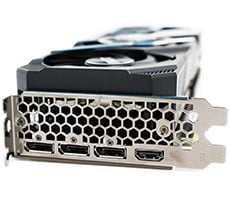
The GeForce 8800 GT itself is diminutive in size and due to the GPU's 65nm process technology, comes built on a single slot design 9" PCB that just begs for a multi-GPU SLI configuration. Though the slim form-factor is certainly a big plus, no pun intended, the small turbine style the reference design employs can definitely get a bit whiney, especially on initial boot up, where the card is downright annoying. However, once the card's drivers kick into gear in the OS, the card throttles way back and the fan isn't audible unless the card is under heavy load or thermally challenged due to tight chassis space constraints. Under serious loads and when things get warm, expect the fan speed to spin up to tolerable though decidedly noticeable levels. MSI's retail offering is shown here with virtually no difference in board design versus NVIDIA's reference design. The card however does come factory overclocked to a 660 MHz core and 1900MHz memory speeds. Don't expect the acoustics to be any better with this card but again, the GeForce 8800 GT's whiney little fan isn't what we would call a show-stopper. |
| Test Setup And 3DMark 06 | ||||||||||||||
HOW WE CONFIGURED THE TEST SYSTEMS: We tested all of the graphics cards used in this article on either an Asus Striker Extreme nForce 680i SLI motherboard (NVIDIA GPUs) or an Asus P5E3 Deluxe (ATI GPUs) powered by a Core 2 Extreme QX6850 quad-core processor and 2GB of low-latency Corsair RAM. The first thing we did when configuring the test systems was enter their BIOS and set all values to their "optimized" default settings. Then we manually configured the memory timings and disabled any integrated peripherals that wouldn't be put to use. The hard drive was then formatted, and Windows Vista Ultimate and the latest DX10 update was installed. When the installation was complete, we then installed the latest chipset drivers available, and installed all of the other drivers necessary for the rest of our components. Auto-Updating and System Restore were also disabled and the hard drive was defragmented.
If we look at the individual Shader Model 2.0 and Shader Model 3.0 / HDR tests built into 3DMark06, we see that the new GeForce 8800 GT offers significantly stronger performance than the GTS and Radeon HD 2900 XT in the Shader Model 2.0 test. In the SM 3.0 test, the 8800 GT finished just behind the 2900 XT, however.
The GeForce 8800 GT's strong performance in the Shader Model 2.0 test propel it to the head of the pack according to 3DMark06's overall score.
In a multi-GPU configuration, the new GeForce 8800 GT performs well ahead of a pair of GeForce 8800 GTS card and right on par with a Radeon HD 2900 XT CrossFire configuration. We've also thrown in the result from a single 8800 GTX, to show you how a pair of these relatively inexpensive GTs compares to the more expensive GTX. |
| Half Life 2: EP2 – Single GPU and SLI | ||||||
In a single card configuration, the new GeForce 8800 GT significantly outpaced both the GeForce 8800 GTS and the Radeon HD 2900 XT in our custom Half Life 2: Episode 2 benchmark. At the higher resolutions, the GT performed very well in comparison to the 2900 XT in particular, where the 8800 GT was upwards of 26% faster in this game.
Running in a multi-GPU configuration boosts performance across the board, but the performance trend remains relatively unchanged. The new GeForce 8800 GT was still faster than the GTS and Radeon, and the single GTX, at the higher resolutions, but the deltas got a little smaller. |
| ET: Quake Wars – Single GPU and SLI | ||||||
In our custom Enemy Territory: Quake Wars benchmark, the GeForce 8800 GT continued its winning ways for the most part. The two GeForce cards were neck and neck with the GT getting the better of the GTS for the most part. The Radeon HD 2900 XT, however, finished well behind.
The Radeon HD 2900 XT CrossFire configuration had significant corruption in this game, so we ommited the results from our graph. We weren't confident everything was being rendered correctly and don't want to post innaccurate results. If we focus on the GeForce comparison, however, we see a similar trend with the new GT finishing just ahead of the GTS. |
| World In Conflict – Single GPU and SLI | ||||||
The performance trend we've seen up to this point shifted with our custom World In Conflict benchmark. In this game, the GeForce 8800 GTS took the lead, followed closely behind by the new GeForce 8800 GT. The Radeon HD 2900 XT, however, had trouble here and wasn't even competitive.
When we switched to a multi-GPU configuration, the performance trend in World in Conflicted shifted yet again. This time around, the GeForce 8800 GT SLI configuration outpaced a pair of GTS cards by a couple of frames per second. The single GTX card was still a bit faster and while the Radeons' performance improved in CrossFire mode they still faultered in this game. |
| Bioshock – Single GPU and SLI | ||||||
Bioshock proved to be a bit of a strong point for the 8800 GT. In this test, the single GeForce 8800 GTS finished a few frames per second ahead of the GeForce 8800 GTS at all resolutions and well in front of the Radeon HD 2900 XT.
In a multi-GPU configuration, the Radeon HD 2900 XT CrossFire configuration showed better scaling than the GeForce cards and the Radeons actually finished in front of the GeForces at the higher resolutions. The new GT outpaced the older GTS yet again though. |
| Crysis SP Demo - Single GPU and SLI - 11/7/07 Update | ||||
If you're at all into enthusiast Computing, the highly anticipated single player demo of hot new upcoming FPS smash-hit Crysis, should require no introduction. Crytek's game engine visuals are easily the most impressive 3D renderings we've seen on the computer screen to date. The engine employs some of the latest techniques in 3D rendering like Parallax Occlusion Mapping, Subsurface Scattering, Motion Blur and Depth-of-Field effects, as well as some of the most impressive use of Shader technology we've seen yet. In short, for those of you that want to skip the technical jib-jab, Crysis is HOT.
Even with our image quality settings configured without Anti-Aliasing, Crysis serves up an absolutely punishing workload for any graphics card on the market today and certainly amongst the cards we tested here. We tested with game engine settings all set to "high" instead of "very high", which reduces some of the image post-processing effects workload like motion blur and makes use of slightly less complex lighting and shadowing effects, just to name a few of the compromises. Regardless, the changes are hardly noticeable in action and as you can see, our graphics test-bed still had a bit of work to do, keeping up. |
| Pure Video HD Performance | ||||||||
|
HQV is comprised of a sampling of SD video clips and test patterns that have been specifically designed to evaluate a variety of interlaced video signal processing tasks, including decoding, de-interlacing, motion correction, noise reduction, film cadence detection, and detail enhancement. As each clip is played, the viewer is required to "score" the image based on a predetermined set of criteria. The numbers listed below are the sum of the scores for each section. We played the HQV DVD using the latest version of Cyberlink's PowerDVD, with hardware acceleration for AMD AVIVO and NVIDIA PureVideo extensions enabled.
The HQV benchmark has lost much of its luster with us. Not only because both ATI's and NVIDIA's respective architectures produce near perfect scores (130 points is a perfect score here), but because this benchmark leaves a portion of the scoring open to interpretation and depending who you talk to (Silicon Optics, Intel, NVIDIA, ATI, etc.) you'll likely get a different answer as to how to score a particular product. Regardless, thanks to AVIVO and PureVideo, the PC is a solid platform for playing most SD content. You'd have to spend thousands of dollars to get a DVD player that can produce similar results in this benchmark. Overall, we'd tip our collective hats toward NVIDIA's PureVideo HD output versus AMD's AVIVO but we've seen the tables turn from launch to launch and unless you're really a pixel snob, the differences are rather subtle.
Here we see NVIDIA's PureVideo HD enabled system with the GeForce 8800 GT, on par mostly with AMD's AVIVO technology running on the Radeon HD 2900 XT. Though the peaks and valleys are significantly more dramatic with the 2900 XT, overall CPU utilization recorded was 14% on average for either system, which is pretty spectacular when you consider the processing requirements for playing back such high quality digital video content. |
| Overclocking, Power Consumption and Heat | ||||||||
With any new GPU architecture, especially one built on a new, leading-edge 65nm manufacturing process, we'll always try to push the envelope a bit in an effort to see just how much headroom the card has above and beyond factory specifications.
Ultimately we managed to crank up our GeForce 8800 GT reference card to a blistering 720MHz core speed and a full 2GHz memory interface speed. The net result is a 20% core speed increase and an 11% memory interface speed increase. Here are the results.
Below we've graphed total power consumption for the systems we used for testing, along with their associated graphics subsystems. Our goal was to give you all an idea as to how much power each configuration used. Please keep in mind that we were testing total system power consumption at the outlet here, not just the power being drawn by the video cards alone.
The first notable you should observe here is that obviously the nForce 680i-based systems draw significantly more power than the Intel 975X-based system. This is mostly due to the larger number of PCI Express lanes available in the 680i chipset. Beyond that, the area to focus on is the variance in power consumption from idle to load conditions, which shows worst-case power consumption with the GPUs under full load. We simply looped 3DMark 06's shader model 3 test and recorded power consumption with a power analyzer drawing from the wall outlet. The GeForce 8800 GT drew an extra 73 watts under under a graphics workload while in stark contrast, the Radeon HD 2900 XT drew 168 watts more under the same load condition. One word describes the performance-per-watt variance here; ouch. |
| Performance Analysis and Conclusion | ||||
| Performance Summary: Virtually across the board NVIDIA's new GeForce 8800 GT is as fast or faster than a 640MB GeForce 8800 GTS card and significantly faster than a Radeon 2900 XT, save for a couple of CrossFire/SLI enabled tests like 3DMark and Bioshock, where driver maturity is likely the limiting factor for the new NVIDIA card. From a purely a DX10 gaming perspective, the GeForce 8800 GT ran roughshod over the significantly more expensive Radeon HD 2900 XT and even outscored a GeForce 8800 GTS in more than a few spots as with our Bioshock single card testing. Finally, in terms of HD digital video processing and image quality, the GeForce 8800 GT, with its second gen PureVideo HD engine, is roughly on par with AMD's AVIVO solution currently.
NVIDIA's second foray into 65nm GPU technology is a resounding sucess in our humble opinion. And how could anyone argue a Graphics product that consumes less power, costs less and performs better than the previous genertion? The proverbial hat-trick of high tech electronics is what we're looking at when we consider all of the performance metrics we showed you today against the backdrop of price. NVIDIA's GeForce 8800 GT will be available in retail and e-tail immediately at an MSRP ranging from $199 to $249. Likely 256MB cards will weigh in at the lower cost price point with 512MB cards closer to the $249 tag. About the only thing we would mildly take issues with relative to this new product, is its thermal management solution that occasionally reminds you of its whiney existance. Beyond that, for a reasonable investment, you get a product that will run just about any game engine at high resolution with support for DirectX 10 and HD digital video processing offload. In fact, for less than the cost of a single GeForce 8880 GTX, you could buy two of these cards and run them in SLI for even better performance. The real question mark is how the GeForce 8800 GT will perform versus AMD's soon to be released RV670 mid-range GPU. We're hearing stories of new 55nm, 700M transistor Radeon GPUs dancing in like sugarplums just in time for the holiday buying season. We'll have to see how this all unfolds in the weeks ahead, but for today, its all NVIDIA limelight shining down on the new cost and power-efficient GeForce 8800 GT.
|