Logo   Banner   TopRight
TopUnder
Transparent
NVIDIA's GeForce GTX Titan: Yes, It CAN Play Crysis 3
Transparent
Date: Feb 21, 2013
Section:Graphics/Sound
Author: Marco Chiappetta
Transparent
Introduction and Specifications
A couple of days ago, we showed you the new NVIDIA GeForce GTX Titan in all its glory—almost. While we were able to reveal the card itself, discuss its new features and specifications, and talk about some of the new systems it will be powering, we weren’t able to post any performance data. Fortunately, that all changes today. We’ve been able to test NVIDIA’s GeForce GTX Titan in a number of different configurations, including SLI and in a multi-monitor setup, and have the goods for you here today. And yes, we’ve got some Crysis 3 action on tap as well.

If you haven’t already done so, we suggest checking out our initial preview of the GeForce GTX Titan. In our original piece, we outline the card’s specifications and cover its new features, like GPU Boost 2.0 and display overclocking, so we won’t be covering them again here. We do have lots of performance data though, including some GPGPU tests, and some overclocked scores too.


The GK110-Based NVIDIA GeForce GTX Titan

NVIDIA GeForce GTX Titan
Specifications & Features

Graphics Processing Clusters 5
Streaming Multiprocessors 14
CUDA Cores (single precision) 2688
CUDA Cores (double precision) 896
Texture Units 224
ROP Units 48
Base Clock 836 MHz
Boost Clock 876 MHz
Memory Clock (Data rate) 6008 MHz
L2 Cache Size 1536K
Total Video Memory 6144MB GDDR5
Memory Interface 384-bit
Total Memory Bandwidth 288.4 GB/s
Texture Filtering Rate (Bilinear) 187.5 GigaTexels/sec
Fabrication Process 28 nm
Transistor Count 7.1 Billion
Connectors

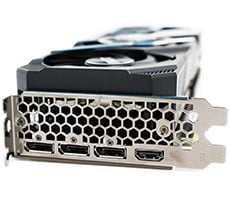
2 x Dual-Link DVI
1 x HDMI
1 x DisplayPort

Form Factor Dual Slot
Power Connectors One 8-pin and one 6-pin
Recommended Power Supply 600 Watts
Thermal Design Power (TDP) 250 Watts
Thermal Threshold 95°C


The GeForce GTX Titan’s specifications portend to the card’s immense horsepower. Not only is the GK110 at the heart of the GTX Titan twice the size of the GK104 used in the GeForce GTX 600 series, but it offers some new features as well, and it’s paired to a gigantic 6GB frame buffer. Yes, the GeForce GTX Titan’s TDP is lower than NVIDIA’s current flagship GeForce GTX 690 and the Titan is quieter too.


The Maingear SHIFT Super Stock with 3-Way GTX Titan SLI. PCs Don't Get Sexier Than This!

According to NVIDIA, “GeForce GTX TITAN was built to power the world’s fastest gaming PCs. From massively powerful 3-way SLI gaming supercomputers to super-fast and elegant small form factor rigs.” And that’s a big part of the Titan’s story. As you’ll see in the pages ahead, the card is extremely fast. But it doesn’t supplant the GeForce GTX 690. What it does do, however, is allow NVIDIA and its system partners—like Maingear—to offer new ultra powerful gaming PCs and quiet, small form factor rigs with much higher performance than they could before.

We’ve got a couple of a systems in house already that we’ll be showing you soon enough. For now though, we’re sure many of you are wondering just how well the GeForce GTX Titan performs. So without further delay, here are the benchmarks you’ve been itching to see…

Transparent
Test System and Unigine Heaven v4.0

How We Configured Our Test Systems: We tested the graphics cards in this article on an Asus P9X79 Deluxe motherboard powered by a Core i7-3960X six-core processor and 16GB of G.SKILL DDR3-1866 RAM. The first thing we did when configuring the test system was enter the system UEFI and set all values to their "high performance" default settings and disable any integrated peripherals that wouldn't be put to use. The memory's X.M.P. profile was enabled to ensure better-than-stock performance and the hard drive was then formatted and Windows 7 Ultimate x64 was installed. When the installation was complete, we fully updated the OS and installed the latest DirectX redist along with all of the drivers, games, and benchmark tools necessary to complete our tests.

HotHardware's Test System
Intel Core i7 Powered

Hardware Used:
Intel Core i7-3960X
(3.3GHz, Six-Core)
Asus P9X79 Deluxe
(Intel X79 Express)

Radeon HD 7970 GHz Edition x 2
GeForce GTX 680 x 2
GeForce GTX 690
GeForce GTX Titan x 3

16GB GSKILL DDR3-1866
Western Digital Raptor 150GB
Integrated Audio
Integrated Network

Relevant Software:
Windows 7 Ultimate x64
DirectX April 2011 Redist
AMD Catalyst v13.2 Beta 6
NVIDIA GeForce Drivers v314.07 / v314.09

Benchmarks Used:

Unigine Heaven v4
3DMark "Fire Strike"
Batman: Arkham City
Hitman: Absolution
Alien vs. Predator
Metro 2033
Sleeping Dogs
Crysis 3

Unigine Heaven v4.0 Benchmark
Pseudo-DirectX 11 Gaming


Unigine Heaven v4.0

Unigine's Heaven Benchmark v4.0 is built around the Unigine game engine. Unigine is a cross-platform, real-time 3D engine, with support for DirectX 9, DirectX 10, DirectX 11 and OpenGL. The Heaven benchmark--when run in DX11 mode--also makes comprehensive use of tessellation technology and advanced SSAO (screen-space ambient occlusion). It also features volumetric cumulonimbus clouds generated by a physically accurate algorithm and a dynamic sky with light scattering.

The GeForce GTX Titan crushes the Radeon HD 7970 GHz Edition and GeForce GTX 680 in this latest version of Unigine's Heaven benchmark, outpacing both cards by about 57%. The dual-GPU powered GeForce GTX 690, however, pull ahead of the Titan by a decent margin.

Transparent
3DMark Fire Strike Test

Futuremark 3DMark11
Synthetic DirectX Gaming


Futuremark 3DMark Fire Strike

Fire Strike has two benchmark modes: Normal mode runs in 1920x1080, while Extreme mode targets 2560x1440. GPU target frame buffer utilization for normal mode is 1GB and the benchmark uses tessellation, ambient occlusion, volume illumination, and a medium-quality depth of field filter. The more taxing Extreme mode targets 1.5GB of frame buffer memory and increases detail levels across the board. Extreme mode is explicitly designed for CrossFire / SLI systems. GT 1 focuses on geometry and illumination, with over 100 shadow casting spot lights, 140 non-shadow casting point lights, and 3.9 million vertices calculated for tessellation per frame. Only 80 million pixels are processed per frame. GT2 emphasizes particles and GPU simulations. Tessellation volume is reduced to 2.6 million vertices, but the number of pixels processed per frame rises to 170 million.

Futuremark's latest edition of 3DMark shows the new GeForce GTX Titan dominating the single-GPU powered Radeon HD 7970 GHz and GeForce GTX 680. The dual-GPU powered GeForce GTX 690 pulls ahead of Titan, however, mostly due to a large advantage in performance in 3DMark's Game Test 1.
 

Transparent
Alien vs. Predator Performance

Alien vs. Predator
DirectX 11 Gaming Performance


Alien vs. Predator

The Alien vs. Predator benchmark makes use of the advanced Tessellation, screen space ambient occlusion, and high-quality shadow features available with DirectX 11. In addition to enabling all of the aforementioned DirectX 11-related features offered by this benchmark, we also switched on 4X anti-aliasing along with 16X anisotropic filtering to more heavily tax the graphics cards being tested.

The GeForce GTX Titan had no trouble dispatching the GeForce GTX 680 in the Alien vs. Predator benchmark. Because this game (at the settings we choose to test) benefits greatly from additional GPU memory bandwidth, the Radeon HD 7970 GHz Edition with its 384-bit memory bus--like Titan's--fares a bit better, but it still loses out by a significant margin. The dual-GPU GeForce GTX 690 continued to rule the roost though.
 
Transparent
Metro 2033 Performance

Metro 2033
DirecX11 Gaming Performance


Metro 2033

Metro 2033 is your basic post-apocalyptic first person shooter game with a few rather unconventional twists. Unlike most FPS titles, there is no health meter to measure your level of ailment; rather, you’re left to deal with life, or lack thereof, more akin to the real world with blood spatter on your visor and your heart rate and respiration level as indicators. The game is loosely based on a novel by Russian Author Dmitry Glukhovsky. Metro 2003 boasts some of the best 3D visuals on the PC platform and includes a DX11 rendering mode that makes use of advanced depth of field effects and character model tessellation for increased realism. This title also supports NVIDIA PhysX technology for impressive in-game physics effects. We tested the game at resolutions of 1920x1200 and 2560x1600 with adaptive anti-aliasing and in-game image quality options set to their High Quality mode, with DOF effects disabled.

The GeForce GTX Titan annihilated the Radeon HD 7970 GHz Edition and the GTX 680 once again in the Metro 2033 benchmark, regardless of the resolution. The GeForce GTX 690 was still the fastest overall, but the delta separating Titan from the GTX 690 were relatively small.

Transparent
Batman: Arkham City Performance

Batman: Arkham City
DirectX Gaming Performance


Batman: Arkham City

Batman: Arkham City is a sequel to 2009’s Game of the Year-winning Batman: Arkham Asylum. This recently released sequel, however, lives up to and even surpasses the original in many ways. The story takes place 18 months after the original game. Quincy Sharp, the onetime administrator of Arkham Asylum, has become mayor and convinced Gotham to create "Arkham City" by walling off the worst, most crime-ridden areas of the city and turning the area into a giant open-air prison. The game has DirectX 9 and 11 rendering paths, with support for tessellation, multi-view soft shadows, and ambient occlusion. We tested in DX11 mode at various resolutions with all in-game graphical options set to their maximum values.

Batman: Arkham City proved to be somewhat of a strong suit for the new GeForce GTX Titan. In this game, NVIDIA's latest flagship single-GPU powered card spanked the Radeon HD 7970 GHz Edition and the GeForce GTX 680 and trails the dual-GPU powered GeForce GTX 690 by only a few percentage points.
 

Transparent
Sleeping Dogs Performance

Sleeping Dogs
DX11 Gaming Performance


Sleeping Dogs

Sleeping Dogs is an open-world game in which you play the role of Wei Shen, an undercover cop trying to take down the Triads from the inside. In the game, you have to fight your way up in the organization and take part in various criminal activities without blowing your cover. We tested Sleeping Dogs at two resolutions, with all in-game graphical options set to their maximum values with FXAA enabled.

Sleeping Dogs tends to favor AMD's GCN architecture, but that didn't help the Radeon HD 7970 GHz Edition much. The deltas separating the Radeon and Titan aren't huge in this game, but the GeForce GTX Titan scores another victory over the single-GPU powered cards nonetheless.
 

Transparent
Hitman: Absolution Performance

Hitman: Absolution
DirectX 11 Gaming Performance


Hitman: Absolution

Hitman: Absolution follows Agent 47, a cold-blooded assassin, who takes on his most dangerous contract to date. Betrayed by those he once trusted - and now hunted by the police - he suddenly finds himself at the center of a dark conspiracy and must embark on a personal journey through a corrupt and twisted world. We tested the game at multiple resolutions, with all in-game options set to their maximum values and global illumination and 4X anti-aliasing enabled.

Due to its support for Global Illumination (which we enable during testing), Hitman: Absolution tends to favor AMD's GCN architecture as well. Regardless, the new GeForce GTX Titan clearly outpaced the Radeon HD 7970 GHz Edition and GeForce GTX 680 here, and came close to catching the GTX 690 at 1920x1200 as well.
 

Transparent
Crysis 3 Performance

Crysis 3
DirectX 11 Gaming Performance


Crysis 3

Crysis 3, which is powered by Crytek’s proprietary CryENGINE 3, technology is the third installment in this popular franchise. Crysis 3 is the sequel to 2011’s Crysis 2 and follows Prophet as he returns to New York a few years after the events of Crysis 2. Like previous games in the franchise, Crysis 3 has impressive visuals that can tax even the most powerful PC’s when cranked up to their maximum values. We tested this game at various resolutions with all in-game graphics options set to Very High, with 4X MSAA and 16X anisotropic filtering enabled and motion blur set to high.

The dual-GPU powered GeForce GTX 690 remains the fastest card overall in Crysis 3, outpacing the new GeForce GTX Titan at both resolutions. Titan, however, clearly outpaces the other single-GPU powered cards which couldn't put up playable frame rates in this game, with the very high image quality settings that we used for testing.  Back the image quality down a bit, however, and of course the game is playable for all cards.

Transparent
SLI Performance

After testing the new GeForce GTX Titan in a single-GPU configuration, we moved on to testing two and 3-way SLI multi-GPU modes. For reference purposes, we've left the dual-GPU powered GeForce GTX 690 in the graphs (this is NOT quad-SLI) and doubled-up on the GeForce GTX 680 and Radeon HD 7970 GHz Edition cards as well.

SLI and CrossFire Testing
Multi-GPU Configurations

The Hitman: Absolution benchmark didn't want to scale past two GPUs with the GeForce GTX Titan, but it didn't really matter. Two of these cards outpace everything else in this game once you hit higher resolutions. And performance is only going to get better once the game scales properly.


The GeForce GTX Titans ruled the roost in the Batman: Arkham City benchmark. The two GeForce GTX Titan card setup outpaced everything else by a wide margin and things only got better--though not by much--once the third card was added to the mix. Note that the Radeons did not scale properly at all in this game.
 

Transparent
SLI Performance (Cont.)

Next up, we've got some multi-GPU numbers with Alien vs. Predator and Sleeping Dogs...

SLI and CrossFire Testing (Cont.)
Multi-GPU Configurations

Wow. Just wow. The Alien vs. Predator benchmark always ran really well on the Radeon HD 7970, due to the card's wide memory bus, relatively large frame buffer, and high-clocks, but the GeForce GTX Titan SLI configuration easily dispatches the CrossFire setup. And once a third card is added to the mix, performance simply goes through the roof.

More goodness from the GeForce GTX Titan. Performance scaled considerably in the Sleeping Dogs benchmark, and the GeForce GTX Titan SLI configurations clearly lead the pack once again.
 

Transparent
SLI Performance (Cont. II)

For our final batch of SLI and CrossFire multi-GPU tests, we've got some numbers from the Metro 2033 benchmark and Crysis 3...

SLI and CrossFire Testing (Cont.)
Multi-GPU Configurations

Moving to three GPUs didn't improve performance all that much in the Metro 2033 benchmark, because the game appears to be somewhat CPU limited, but it didn't matter. The GeForce GTX Titans were still the fastest overall.

A single GeForce GTX Titan could already play Crysis 3 with Very High image quality settings. Double or triple up on these monsters though, and they have no trouble at all with this game. The GeForce GTX 680 SLI and Radeon HD 7970 GHz Edition CrossFire configurations were evenly matched, but the GeForce GTX Titans were in a league of their own.
 

Transparent
Multi-Monitor Performance

Next up, we have some performance data recorded with each of the multi-GPU configurations we tested connected to a trio of 1080p Dell monitors to test NVIDIA's Surround Gaming and AMD's Eyefinity multi-monitor technologies. The combined resolution of the three monitors used for these tests is 5760x1080.

NVIDIA Surround and AMD Eyefinity Testing
Multi-Monitor Configurations

When moving from two to three cards in these particular games, performance didn't scale much with the GeForce GTX Titans, but they still managed to clearly outpace the competition by wide margins.
 

Transparent
Multi-Monitor Performance (Cont.)
We continued our multi-monitor and multi-GPU testing with Alien vs. Predator and Crysis 3...

NVIDIA Surround and AMD Eyefinity Testing (Cont.)
Multi-Monitor Gaming 

Once again we see the GeForce GTX Titan configurations taking the lead. And although the game just came out and offers some of the most impressive visuals ever, Crysis 3 is playable on the highest in-game image quality settings possible, with 4X anti-aliasing enabled on Tri-Titan configuration. It's not cheap, but if you want to play Crysis 3 on multiple monitors without sacrificing image quality or playability, it's already possible with Titan.
 
Transparent
GPGPU Performance

We mentioned in our preview article that the GeForce GTX Titan includes a full 64 Double Precision CUDA Cores per SMX versus 192 Single Precision CUDA Cores. But, by default, the GeForce GTX Titan runs its DP cores at 1/8th their full clock speed, since they generally don't benefit gamers Since each SMX has one third the number of DP cores vs. SP cores, double precision operations run at 1/24 the SP rate, which is similar to GeForce GTX 680.


NVIDIA's Drivers Give Users The Ability To Unlock Full DP Mode on Titan

NVIDIA, however, gives users the ability to enable full speed DP in the drive control panel. In order to unlock full performance DP you must open the NVIDIA Control Panel, navigate to “Manage 3D Settings” and under the Global Settings tab find the option titled “CUDA – Double Precision”. Select it, then tick the GeForce GTX Titan checkbox to enable full speed DP. Then click OK and apply the settings. The CUDA – Double Precision listing should then change from “None” to “GeForce GTX Titan”. When full speed DP is enabled though, the GeForce GTX Titan's GPU operates at lower-than-stock frequencies, so this option should be disabled unless you're a GPU-accelerated application that will benefit from it.

To test the GeForce GTX Titan's GPU compute capabilities, we ran a couple of GPGPU benchmarks with SiSoft SANDRA and Computemark. We tested all of the cards represented here with SANDRA's GP (GPU/CPU/APU) Processing benchmark, using the OpenCL GP Processor option and have the aggregate and native double-shader scores for you reported below.

SiSoft SANDRA 2012 SP4
GPGPU Performance

We tested the GeForce GTX Titan with an without full DP enabled here. Even with full DP disabled, the Titan is clearly faster than the GeForce GTX 680, due to the increased number of cores available in the GPU. Titan still trails the Radeon HD 7970, however. With full DP enabled though, the Titan's performance jumps up considerably and outpaces all of the other cards we tested.

Computemark
Compute Shader Benchmark


The Computemark benchmark doesn't benefit from the Titan's full speed DP mode, so we left it disabled for these tests. Regardless, Computemark leverages all of the cores available in the GK110 for its simulations quite well, and as such, the GeForce GTX Titan clearly outpaces all of the other cards here.
 

Transparent
Overclocking the GeForce GTX Titan

We spent a little time overclocking the GeForce GTX Titan to see what kind of additional frequency headroom it had left under its hood. For these tests, we used the latest edition of EVGA's Precision X GPU tweaking utility, which is designed to work with Titan.

Overclocking a Kepler-based GeForce GTX series graphics card requires a bit more tweaking then previous-gen products, due to all of the new options available and the complexities associated with GPU Boost. Sometimes, you’ll find that increasing a particular voltage or frequency may appear to function properly, when in fact performance decreases due to errors or throttling. You may also find that the actual GPU Boost clock may travel above or below the designated offset value when the power and/or temperature targets are also increased.


EVGA's Precision X Tweaking Utility Running On The GeForce GTX Titan

We did a few things when experimenting with overclocked speeds on Titan.  First we tried the most basic option available--we simply changed the temperature target from the default 80'C and increased it to 90'C to see what kind of impact it would have on performance.  Then, to push things much further, we increased the power and temperature targets to 105% and 92'C, respectively, and also increased the GPU and Memory clock offsets and ran a few tests.

Overclocking The GeForce GTX Titan
Tweakin' The GPU

Interestingly enough, increasing the temperature target to 90'C resulted in a small increase in performance, not only because the GPU was able to run at higher boost frequencies for longer periods, but the boost frequency actually increased as well. Although the default GPU boost clock on Titan is 876MHz, we observed frequencies as high as 993MHz. For our more aggressive overclocking tests, we saw a much higher GPU boost frequency of almost 1.1GHz, and when coupled with higher memory clocks, the performance increases were significant. Hitman in particular showed a 12% increase in performance. Keep in mind, these clocks were possible without manually tweaking the Titan's voltages. With further experimentation, we're certain the GeForce GTX Titan can hit even higher clocks than what we've shown here.

The moral of the story: Even with 7.1B transistors under the hood, the GeForce GTX Titan has plenty of frequency headroom left for overclockers.

Transparent
Power Consumption, Noise, Temps
Before bringing this article to a close, we'd like to cover a few final data points--namely, power consumption, temperatures, and noise. Throughout all of our benchmarking and testing, we monitored acoustics and tracked how much power our test system was consuming using a power meter. Our goal was to give you an idea of how much power each configuration used while idling and also while under a heavy workload. Please keep in mind that we were testing total system power consumption at the outlet here, not just the power being drawn by the graphics cards alone.

Total System Power Consumption
Tested at the Outlet

Despite offering significantly better performance, the GeForce GTX Titan consumed only slightly more power than the Radeon HD 7970 GHz Edition while under load. Versus the other GeForce GTX cards, the Titan's power consumption falls right in line with expectations based on its performance--it uses more power than a GeForce GTX 680, but less than the dual GK104-powered GeForce GTX 690. 

We've included this temperature data to essentially show the GeForce GTX Titan's idle temperature because reporting the max temp under load is pointless due to GPU Boost 2.0.  Because of Titan's GPU Boost 2.0 features, it will run up to the maximum temperature target while under load and throttle voltages and fan speed accordingly to maintain that target temperature. Because the default temperature target is 80'C, the Titan peaked at 80'C under load. Set the temp target to 75'C and that's how high its GPU temperature will go.

Having a hard temperature target with the GeForce GTX Titan is interesting because it means cards that are better cooled--either through liquid cooling or when installed in a high-performance chassis--should offer somewhat better performance. The cooler a GeForce GTX Titan runs, the longer it will be able to maintain maximum GPU Boost frequencies, which will ultimately improve performance.

In terms of acoustics, the GeForce GTX Titan is simply awesome. It is easily the quietest high-end graphics card we have ever tested. Period. End of story. In real world conditions, the GeForce GTX Titan is somewhat quieter under load than a GTX 680 and is much quieter than a Radeon HD 7970.

Transparent
Our Summary and Conclusion

Performance Summary: The GeForce GTX Titan is easily the fastest single-GPU powered graphics card we have ever tested, bar none. In every benchmark or game we threw at it, regardless of resolution, the GeForce GTX Titan clearly outpaced the Radeon HD 7970 GHz Edition and the GeForce GTX 680, sometimes by margins over 50%. The GeForce GTX Titan couldn’t quite keep pace with the dual-GPU powered GeForce GTX 690, but the Titan is in the same league. The GeForce GTX Titans acoustics are also best of class. Considering the immense horsepower offered by Titan, the card is just plain quiet. Power consumption is also in-line with expectations.


The GeForce GTX Titan is the fastest single-GPU powered card available.

We really dig the GeForce GTX Titan. It may not offer framerates as high as the dual-GPU powered GeForce GTX 690, but it is the fastest single-GPU powered graphics card by far. The GeForce GTX Titan is also quieter than any other high-end graphics card we’ve tested, it offers some new features not available on any other products yet, and the thing just plain looks cool too. GPU Boost 2.0 offers a lot of flexibility to users who want to tweak acoustics or performance and display overclocking should offer immediate benefits to users willing to experiment and find the sweet spot for their particular monitor, and the card’s massive 6GB frame buffer somewhat future-proofs the card for users that want to play the latest games on multi-monitors at the highest possible settings. Though, nothing available today really taxes a frame buffer that big.

As we mentioned in our initial preview, the GeForce GTX Titan should be available immediately from many of NVIDIA’s key system partners, with limited retail availability to follow. The price for this beast: $999, which is right in line with the GeForce GTX 690. There’s no denying there’s a steep premium for a card like the GeForce GTX Titan, but enthusiasts that want the best of the best have always had to pay up. While the GeForce GTX Titan’s performance isn’t quite as high as the GTX 690 on its own, the card does set a new benchmark for ultra high-performance when configured in tri-SLI and in a single-card configuration the GeForce GTX Titan can fit into smaller form factors where the GeForce GTX 690 could not. While the GeForce GTX Titan may not knock the GTX 690 from its position atop the 3D graphics food chain, it does allow NVIDIA and its partners to offer new flagship systems gaming systems and more powerful small form factor systems, which should appeal gamers and systems builders alike.

We wish the GeForce GTX Titan was more affordable so that more gamers could experience the power of this beast, but for now the card will remain a luxury for those that can afford it. The GeForce GTX Titan’s relatively high price doesn’t detract from its pure awesomeness though. Yeah, it would be great if it was more affordable, but 7.1 billion transistors, a 6GB frame buffer, best of class performance, and some hot new features make the GeForce GTX Titan one of the most exciting products we’ve tested in a quite a while.

And if you haven’t had enough GeForce GTX Titan coverage, stay tune to HH—we’ve got a 3-way SLI Maingear SHIFT in house and a SFF Titan-enabled small form factor system from AVA Direct on the test bench as well.


  • Awesome Performance
  • Great Acoustics
  • GPU Boost 2.0
  • Display Overclocking
  • Looks Cool Too
  • Uber Pricey
  • Not As Fast As The GeForce GTX 690


Content Property of HotHardware.com