|
|
| Introduction and Specifications | ||||||||||||||||||||||||||||||||||||||||
There’s just something about high-end, custom graphics cards that makes us a little giddy. Perhaps it’s their menacing appearance--even the fastest, most powerful processors just look like their lower-end counterparts when sitting side-by-side. But a hulking custom graphics card, with an elaborate, oversized cooler and fierce heat pipes wrapping around a gargantuan heatsink just looks freakin’ cool no matter how you slice it. Whip out a high-end graphics card and a CPU in front of a casual geek and we promise you they’ll point to the graphics card and blurt out, “What the heck is that?” far more often than not.
This is the part of graphics card review where we’d usually discuss what additional goodies and software were included with the card, but our Gigabyte GeForce GTX 680 Super OverClock unfortunately shipped sans accessory bundle. Regardless, consumers don’t usually spring for a card like this one because it includes a couple of adapters and a nifty tchotchke or two. The hardware is the star of the show with a product like the Gigabyte GeForce GTX 680 Super OverClock, and this puppy is a star indeed. More pics await on the next page. |
| Gigabyte GeForce GTX 680 SOC |
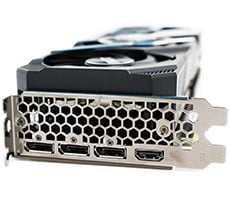
The first thing you’ll notice about the Gigabyte GeForce GTX 680 Super OverClock is that the card is huge. This monster is about 11.5” long and sports a thick, triple-slot cooler that’s outfitted with not just one or two cooling fans, but five fans that actually pull air upward, parallel to the PCB, unlike most other graphics cards on the market. Underneath the gigantic cooler on the Gigabyte GeForce GTX 680 Super OverClock lies an NVIDIA GeForce GTX 680 GPU, with a base clock of 1137MHz and a boost clock of 1202MHz, and 2GB of GDDR5 frame buffer memory clocked at an effective 6200MHz. If you’re keeping track, those are some hefty overclocks above the reference GeForce GTX 680’s base, boost, and memory clocks of 1006MHz, 1058MHz, and 6005MHz, respectively. The heatsink on the Gigabyte GeForce GTX 680 Super OverClock is about 9” long and 2.5” tall, and it consists of a dense array of aluminum heatsink fins and a vapor chamber, linked together by five 9.6mm copper heatpipes. As we’ve mentioned, there are five small cooling fans mounted along the top of the card, which pull air upward over the entire length of the heatsink fins. As you’ll see a little later, this cooler configuration does an excellent job keeping temperatures in check, but that cooling performance comes at a price. The smallish fans on the card emit an audible, high-pitched whine when the card is under load. More on that a little later. In addition to its custom cooler, there are a few other things that differentiate the Gigabyte GeForce GTX 680 Super OverClock. For one thing, this card is a member of Gigabyte’s Ultra Durable VGA+ family of products, which means it's outfitted with high-quality components such as Japanese Solid Capacitors, Ferrite Core and Metal Chokes, and Low RDS MOSFETs. This particular card also sports Tier 1 Samsung or Hynix memory and Prodalizers to help maintain clean and smooth power delivery. Gigabyte’s Super OverClock boards are also treated with aggressively binned and tested GPUs to ensure stability at factory overclocks and ensure some additional overclockability. Further, the Gigabyte GeForce GTX 680 Super OverClock has a dual-BIOS switch that gives users the ability to switch from the standard BIOS to an alternate BIOS that caters to extreme LN2 overclockers. Other features of the Gigabyte GeForce GTX 680 Super OverClock include dual-8-pin power connectors, a rigid aluminum backplate, dual DVI outputs, and HDMI and DP outputs, as well as a custom case bracket with the letters "SOC" cut out to form vents. |
| Test System and Unigine Heaven v3 | ||||||||||||
How We Configured Our Test Systems: We tested the graphics cards in this article on an Asus P9X79 Deluxe motherboard powered by a Core i7-3960X six-core processor and 16GB of G.SKILL DDR3-1866 RAM. The first thing we did when configuring the test system was enter the system UEFI and set all values to their "optimized" or "high performance" default settings and disable any integrated peripherals that wouldn't be put to use. The memory's X.M.P. profile was enabled to ensure better-than-stock performance and the hard drive was then formatted and Windows 7 Ultimate x64 was installed. When the installation was complete, we fully updated the OS and installed the latest DirectX redist along with the drivers, games, and benchmark tools necessary to complete our tests.
The Gigabyte GeForce GTX 680 Super OverClock dominated the Unigine Heaven benchmark. In terms of framerate and the overall score, this card put up the best numbers by a significant margin, thanks to its higher clocked GPU and memory. |
| 3DMark 11 Performance | ||||||
The performance trend in 3DMark11 looks much like Unigine Heaven on the previous page. The Gigabyte GeForce GTX 680 Super OverClock put up the highest scores once again, besting the reference GTX 680 and Radeon HD 7970 GHz Edition cards by significant margins. |
| Alien vs. Predator Performance | ||||||
The Alien vs. Predator benchmark eats up memory bandwidth, hence the major advantages for the Radeons and their 384-bit memory bus here. Compared to the reference GeForce GTX 680, however, the Gigabyte GeForce GTX 680 Super OverClock performed very well, outpacing the stock card by almost 6%. |
| Metro 2033 Performance | ||||||
All of the cards we tested were evenly matched in the Metro 2033 benchmark. The Gigabyte GeForce GTX 680 Super OverClock was the fastest at 1920x1200, but the factory-overclocked ASUS Matrix Radeon HD 7970 Platinum put up the best average score at the higher 2560x1600 resolution. The deltas separating the cards were tiny, however. |
| Batman: Arkham City Performance | ||||||
We had another fairly tight grouping in the Batman: Arkham City benchmark, and once again the Gigabyte GeForce GTX 680 Super OverClock comes out on top at the lower resolution. With the resolution cranked up to 2560x1600 though, the ASUS Matrix Radeon HD 7970 Platinum takes the pole position. |
| F1 2012 Performance | ||||||
All of the cards we tested were tightly grouped in the F1 2012 benchmark, although we did see a trend similar to previous tests in this game as well. Here, the Gigabyte GeForce GTX 680 Super OverClock took the top spot at 1920x1200, only to fall victim to the ASUS Matrix Radeon HD 7970 Platinum once again at 2560x1600. |
| Sleeping Dogs Performance | ||||||
The Sleeping Dogs benchmark heavily favors the AMD Radeon-based graphics cards tested here, as evidenced by the 7970 cards' dominant performance overall. The Gigabyte GeForce GTX 680 Super OverClock puts up a decent score, however, and outruns the reference GTX 680 by over 10%. |
| Hitman: Absolution Performance | ||||||
Hitman: Absolution's support for global illumination put a hurting on the GeForce-powered cards here. As such, the Radeons hold onto a clear lead. The Gigabyte GeForce GTX 680 Super OverClock, however, clearly outpaces the reference card--as expected. |
| Power Consumption, Noise, Temps | ||||
| Before bringing this article to a close, we'd like to cover a few final data points--namely, power consumption, temperatures, and noise. Throughout all of our benchmarking and testing, we monitored acoustics and tracked how much power our test system was consuming using a power meter. Our goal was to give you an idea of how much power each configuration used while idling and also while under a heavy workload. Please keep in mind that we were testing total system power consumption at the outlet here, not just the power being drawn by the graphics cards alone.
Somewhat surprisingly, despite being outfitted with five cooling fans and being clocked much higher than the reference card, the Gigabyte GeForce GTX 680 Super OverClock consumes only slightly more power. While idle, the Gigabyte card consumed only 4 more watts, and under load that delta shrunk to only 2 watts. Also note that the GeForces consume significantly less power than the Radeons, hinting at the GeForces' better power efficiency.
We also monitored temperatures throughout testing and were somewhat impressed with the Gigabyte GeForce GTX 680 Super OverClock's cooling. The oversized, triple-slot wide cooler and five fans clearly outperform the two-slot reference cooler; Gigabyte's card was a full 13'C cooler under load. Further, in real-world conditions, the Gigabyte card's cooling fans never spun up past 48%. The five small fans on the GeForce GTX 680 Super OverClock, however, emit an audible high-pitched whine under load, which may irk some users. The card isn't loud in real-world situations, but it may be bothersome to users sensitive to certain sounds. |
| Our Summary and Conclusion | ||||
Performance Summary: To put it simply, the Gigabyte GeForce GTX 680 Super OverClock is a beast of graphics card. In fact, it is one of the fastest single-GPU powered graphics cards we have ever tested. The card's increased GPU and memory frequencies give it a significant performance advantage over reference GeForce GTX 680s in many circumstances. The Gigabyte GeForce GTX 680 Super OverClock also outperforms a reference Radeon HD 7970 GHz Edition more often than not, although the similarly monolithic and factory-overclocked ASUS Matrix Radeon HD 7970 Platinum outpaced the GTX 680 at higher resolutions.
|