|
|
| Introduction | ||||||||||||||||||||||||||||||||||||||||||||||||||||||||||||
The PC world was treated to one of those rare occurrences a few weeks back--a 1-2 punch into the 3D graphics fray from both ATI and NVIDIA. We're talking about the near simultaneous launches of the ATI Radeon HD 4890 and NVIDIA GeForce GTX 275. Both of their names lead to obvious suggestions about where they fit into their respective families.
With all that reading out of the way, we're set to take a look at our first cards based on ATI's RV790. |
||||||||||||||||||||||||||||||||||||||||||||||||||||||||||||
| ASUS ENGTX275 and EVGA GeForce GTX 275 1792MB |
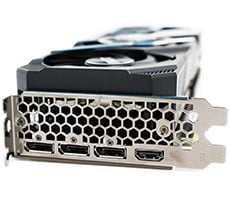
Much like what we saw and reported with the HD 4890s, three of the four GeForce GTX 275s in our round-up look almost exactly the same. The Gigabyte, ASUS, and EVGA branded cards are all using the same stock cooler and fan, and clock in at the default speeds of 633 MHz for the GPU, 1404 MHz for the shader cores, and 1134MHz for the GDDR3 (2268MHz effective). There is, as they say, more than meets the eye with each of these models, however.
EVGA ships all four versions of their GTX 275 cards in relatively similar packaging. As such, one needs to look closely at the details and the price tag to ensure they are getting the expected variant. They include a plain vanilla version, a slight overclock in the Superclocked model, a much better overclock in their FTW release, and finally a double-sized frame buffer model, increasing the onboard memory to 1792MB. This is the model we received for testing. The card, like the box, is primarily done up in black, from the PCB to the shroud with a piston-like graphic on it and a red plastic inlay along the top. The red plastic doesn't appear to serve any other function other than to be an eye-catcher, as this is the edge that would be facing outward in an open-windowed chassis. A company logo stylized "e" finds its way to the top of the fan, but otherwise we're looking at another stock cooler. |
| Test Setup and 3DMark Vantage Results | ||||||||||||
|
HOW WE CONFIGURED THE TEST SYSTEMS: We tested all of the graphics cards used in this article on an Asus Rampage II Extreme motherboard powered by a Core i7 920 quad-core processor and 3GB of Qimonda DDR3. The first thing we did when configuring these test system was enter the system BIOS and set all values to their "optimized" or "high performance" default settings. We also used "CPU Level Up" in the BIOS to automatically overclock our system to the same level as the Core i7 965 Extreme in order to provide the most computational power we could afford to our suite of graphics cards. Finally, we manually configured the memory timings and disabled any integrated peripherals that wouldn't be put to use. The hard drive was formatted, and Windows Vista Ultimate was installed and updated to Service Pack 1. With the operating system installed, we installed the latest hotfixes, along with the necessary drivers and benchmark applications.
Although the GeForce GTX 285 rules the roost in both the overall score and GPU Test, MSI's Twin Frozr OC version of the GTX 275 made the best attempt at running it down. A little over 600 points separates the two in the overall score, and just over two and a half frames per second in the game tests. Each of the other GTX 275s finds itself in a close battle with the other two with very similar scores across the board. Interestingly, the double-sized buffer on the EVGA GTX 275 has little positive effect in 3DMark Vantage, with the card actually posting the lowest scores of the four GTX 275s being tested. |
| Crysis v1.21 | ||||||
While 3DMark Vantage gave the ATI fanbase a reason to pause, Crysis, typically considered one of the hardest benchmarks on GPUs, portrays the HD 4890 in a different light. It's not exactly a runaway, but the Diamond and HIS HD 4890's ran the highest frame rates at 1280x960, with the XFX model finishing just behind the only overclocked GTX 275 of the bunch. That advantage seems to slip, however, as we raise the resolution settings. At 1920x1080, the MSI and Gigabyte cards begin to make up a little ground, although all told the vast majority of both GTX 275s and HD 4890s are running within a half of a frame per second of each other. |
| Enemy Territory: Quake Wars v1.5 | ||||||
It's a clear victory for the GeForce GTX 275 here: each of our NVIDIA-based entries posted frame rates as high as 20 fps faster than any of the HD 4890s we used. MSI's Twin Frozr OC lead them all as the extra boost in GPU and memory speeds translates into an extra 3-4 frames over the next nearest card, the EVGA GTX 275. We also noticed that the advantage that the GTX 275 enjoyed over the HD 4890 is still present at the higher resolutions as well, although it diminished by half by the time we reached 1920x1080. |
| Far Cry 2 v1.02 | ||||||
Far Cry 2 results were at stark contrast with ET: Quake Wars with no distinctive advantage given in either direction. The two highest frame rates come, naturally, from the two cards with the highest default clock speeds: the MSI GeForce GTX 275 Twin Frozr OC on the green team, and Diamonds Radeon HD 4890 XOC on the red. Following those two, the remaining five cards are basically operating on the same level, with a combined delta of less than 2 frames per second. |
| Left 4 Dead | ||||||
Left 4 Dead benchmarks were also quite close - at least within each camp. All three Radeons found themselves pushing out just over 159 fps at 1280x960, regardless of their differences in speeds. With the exception of ASUS ENGTX275, our GeForce GTX 275 quartet improved on the Radeons by close to three frames per second. This equated to a performance delta of just under 2 percent. That margin of difference increases this time at the higher resolutions, ultimately topping out at closer to 4 percent when comparing the top-performing HD 4890 card to the top GTX 275. |
| Tom Clancy's H.A.W.X. | ||||||
Tom Clancy's H.A.W.X. gives us an opportunity to compare a GTX 275 using DirectX 10.0 with the Radeon HD 4890 using DX 10.1. The results, as you can see, are dramatic. Using the XFX HD 4890 as an example, we ran the initial run at 1280x960 twice, once using DX 10.0 and then again using DX 10.1. The difference was 15 fps - a 20% increase in frame rates by using the updated version of the API. It also helped catapult the Radeons from what would have been a second-place finish to the GTX 275 to a healthy lead at all resolutions. |
| SLI and Crossfire Testing | ||||
Having the sheer number of cards at our disposal begs for some dual and even triple GPU combinations. Luckily for us, having an Intel X58-based motherboard allows us to run both our GeForce GTX 275s in 3-way SLI and 3 Radeon HD 4890s in CrossFireX - no need for swapping out parts.
Doubling the number of cards has almost but not quite the effect one would expect - the overall performance and frame rates were just under twice the original scores. With the GeForce GTX 275 already enjoying a comfortable lead with single GPU testing, that margin of difference now becomes nearly double when comparing SLI to Crossfire results. Adding in a third card to the mix obviously increases performance even further, but to a lesser degree than we saw when adding in the second. Benchmarking Crysis with the same combinations of cards points out that 3-way SLI performance is scaling better than the CrossFireX combo, at least in this game. Whereas the GTX 275 saw increases of 83% when using 2 cards, and 167% in total when going with 3 GPUs, the Radeon HD 4890 "only" received a 60% boost when running in Crossfire with 2 GPUS, and 94% total gain with three HD 4890s running in tandem. This might be something that ATI should look at with newer Catalyst drivers, as the multi-GPU advantage when running Crysis is surely in NVIDIA's court. |
| Overclocking Results | ||||||
|
| Power Consumption and Thermals | ||||
We'd like to cover a few final data points before bringing this article to a close. Throughout all of our benchmarking and testing, we monitored how much power our test systems were consuming using a power meter. Our goal was to give you an idea as to how much power each configuration used while idling and under a heavy workload. Please keep in mind that we were testing total system power consumption at the outlet here, not just the power being drawn by the motherboards alone.
When equipped with a GeForce GTX 275, our system pulled down from 155W to 164W at idle, and then almost double that when under load conditions. Installing any of the Radeons upped the idle draw to 194W, nearly 30-40W more than the GeForce GTX 275. Under a full load, however, the total draw was typically slightly less than the GTX 275.
Since we're on the subject of power consumption, which is related to heat, we also made note of the minimum and maximum temperatures recorded by the GPU sensor using HWMonitor. In general, we saw that the HD 4890s were running nearly 25% hotter than the GTX 275 at idle, but the Radeons were actually somewhat cooler than the GTX 275s under load. As the majority of the cards are using stock cooling methods, it makes sense that the temperatures are, for the most part, similar save for the MSI GTX 275 Twin Frozr OC. The twin-fanned cooler used on MSI's card shaved off a few degrees at idle, but did a great job at load, resulting in temps that, like the Radeons, were significantly lower than stock cooled models. |
| Performance Summary and Conclusion | ||||||||||||
|
Performance Summary: As you may have already surmised, there is no clear winner here based solely on performance, as the cards traded victories in our benchmarks. NVIDIA's GeForce GTX 275 romped the Radeon HD 4890 in the synthetic benchmarks, we saw huge wins in ET: Quake Wars, and lesser victories in Left 4 Dead, although the deltas increased as the resolution was raised. Conversely, the HD 4890 was an ace in H.A.W.X.--at least when using DirectX 10.1--and had a slight lead in our Crysis testing. Far Cry 2 was a dead heat, with the top overclocked models finishing almost completely on par with each other.
With the victor varying from game engine to game engine, we turn our eyes next to the extra details. Both series of cards are priced competitively and make multiple card configurations a very realistic option for more users. In this category, we would have to lean in the direction of the GeForce GTX 275. 3DMark Vantage results are somewhat skewed in that the overall performance scores heavily favored for the GTX 275, but when we break down the performance increases in multi-GPU configurations as a percentage we see that the cards are scaling on similar levels, with the HD 4890 dropping off just a bit in CrossFireX. Real world testing paints an entirely different picture, however. Dual and 3-Way SLI combinations work best with Crysis, completely overcoming any advantage the Radeons might have had during single GPU testing. A quick look at our results actually has three Radeon HD 4890s running closer to two GTX 275s in SLI.
Based on all the information that we've gathered, our opinion is that MSI's NGTX275 Twin Frozr OC is the stand-out card from this group. The card is factory-overclocked, performance was very strong, and its cooler did a much better job than any of the reference models. Temperatures might not have been quite as low as advertised, but they were still lower than any of the other cards that we tested, and the speeds adjust properly to keep noise output low when full power is not a necessity. Although already running at higher speeds from the factory, we also managed to obtain the highest GPU, Shader, and Memory speeds during our overclocking tests, most likely due in part to that extra cooling. And somehow, checking the prices, the MSI NGTX275 manages to find itself as one of the best GTX 275 deals out there - currently retailing for ~$245 (after rebate). All around a fine job by MSI.
The Rest of The Pack: |