|
|
| Introduction and Related Information | ||||||||||||||||||||||
Last week, NVIDIA formally launched the dual-GPU powered GeForce 9800 GX2 graphics card and nForce 790i SLI Ultra chipset. We evaluated both of the products in depth in our coverage of the launch, but had to leave out one important detail per NVIDIA's embargo agreement - that being Quad-SLI.
As its name suggests, Quad-SLI consists of a quadruple GPU configuration. And while today's version of Quad-SLI is new, it is not a brand new technology. As many of you probably know, NVIDIA had previously launched Quad-SLI with the GeForce 7950 GX2 in mid-2006. Due to the timing of its arrival, GeForce 7-series Quad-SLI was married to Windows XP. Ultimately, difficulties getting many games to scale led to diminished support from NVIDIA. With Windows Vista and its completely new driver model and a new version of DirectX right around the corner, however, it's clear why NVIDIA took some focus away from the GeForce 7-series Quad-SLI solution, as distasteful as it is that existing customers were left out in the cold.
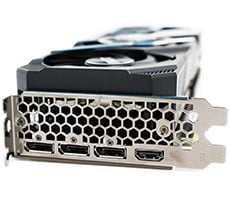
We're going to evaluate 2008's version of Quad-SLI technology with a pair of retail-ready graphics cards from ASUS, dubbed the EN9800GX2. ASUS' take on the GeForce 9800 GX2 is much like the reference design we showed you in our launch coverage, save for the custom decal affixed to the card's enclosure. And as is usually the case with their graphics cards, ASUS includes a robust accessory bundle with the EN9800GX2 complete with a CD / DVD wallet, a user's manual, a driver CD, another disc with a copy of Futuremerk's 3DMark06, and a full version of the DX10 game Company of Heroes: Opposing Fronts. In addition to the software, ASUS also thrown is DVI to VGA adapter, a dual-Molex to 6-pin PCI Express power adapter, a 6-to-8-pin PCI Express power adapter, and an S/PDIF audio cable to take advantage of the card's HDMI output.
The rest of the ASUS EN9800GX2's specifications are essentially identical to NVIDIA's reference design. The card's GPUs are clocked at 600MHz and its 1GB (512MB per GPU) of GDDR3 frame buffer memory is clocked at 1GHz (2GHz effective). |
| NVIDIA Quad-SLI Technology |
To implement Quad-SLI with a pair of GeForce 7950 GX2 cards, NVIDIA developed a rendering mode designed to leverage the power of the four GPUs powering the cards.
With a pair of GeForce 9800 GX2 cards, however, NVIDIA is now able to use AFR in many games for better scaling across the GPUs. AFR is the preferred mode because all of the 3D rendering workload is parallelized (pixel fill, raster operation, vertex transform, etc.) and each GPU can work on its own frame. AFR is not universally compatible with every application, but when it does work, performance is usually increased significantly. |
| Our Test Systems and 3DMark06 | ||||||||||||
HOW WE CONFIGURED THE TEST SYSTEMS: We have two sets of benchmark tests to discuss in this article. The first round of tests consist of five different motherboards compared using identical supporting hardware. In addition to the motherboard tests, we also tested all of the graphics cards used in this article on either an Asus nForce 790i SLI Ultra based Striker II Extreme motherboard (NVIDIA GPUs) or an Asus P5E3 Premium (ATI GPUs) powered by a Core 2 Extreme QX6850 quad-core processor and 2GB of low-latency Corsair RAM. The first thing we did when configuring these test systems was enter their respective BIOSes and set all values to their "optimized" or "high performance" default settings. Then we manually configured the memory timings and disabled any integrated peripherals that wouldn't be put to use. The hard drive was then formatted, and Windows Vista Ultimate was installed. When the installation was complete we fully updated the OS, and installed the latest DX10 redist and various hotfixes, along with the necessary drivers and applications.
According to 3DMark06's default benchmark, the various Radeon HD 3870 X2 CrossFireX configurations have an advantage over the GeForce 9800 GX2 and Quad-SLI in general. Why that is the case with this benchmark reveals itself if we look at the individual test results.
3DMark06's Shader Model 2.0 test is essentially CPU bound with all of the multi-GPU configurations, but the ATI powered configurations held onto a slight lead. In the Shader Model 3.0 / HDR test though, the ATI-powered rigs scaled to a larger degree, which boosted the overall results.
|
| Half Life 2: Episode 2 | ||||||
The ASUS EN9800GX2 Quad-SLI setup showed significant scaling in our custom Half Life 2: Episode 2 benchmark. At both resolution the Quad-SLI rig was significantly faster than a single GX2, and it was the fastest NVIDIA-based configuration. At 1920x1200, scaling wasn't terribly dramatic, but at 2560x1600 the delta was huge. Also note, the dual-Radeon HD 3870 X2 quad-CrossFireX setup held its own and took the lead at 1920x1200, but it fell behind by quite a bit once the resolution was increased to 2560x1600. |
| Unreal Tournament 3 | ||||||
Unreal Tournament 3 did scale on the ASUS EN9800GX2 Quad-SLI setup, but not by a very large degree. The Radeons on the other hand did very well here, and bested the Quad-SLI setup at the higher resolution. We did have a problem, however, with the quad-CrossFireX configuration. No matter what we tried, the game would crash at 1920x1200. But curiously, it worked fine at 2560x1600. |
| Enemy Territory: Quake Wars | ||||||
The dual ASUS EN9800GX2 powered quad-SLI rig kicked some serious butt in our custom Quake Wars: Enemy Territory benchmark. In this game, the quad-SLI rig scaled very well, and bested every other configuration by a large margin. Conversely, this game does not scale at all in the three and four-GPU CrossFireX configuration, hence the similar scores for all three Radeon powered data points. |
| Crysis v1.2 | ||||||
The quad-SLI test system showed some scaling in Crysis, and was the fastest system overall, but its victory over the next fastest system - powered by a pair of GeForce 8800 GTS 512 cards in SLI mode - wasn't dramatic. The Quad-SLI rig did, however, blow way past and of the Radeon CrossFireX configurations which didn't scale past three GPUs in this game. |
| Total System Power Consumption | ||||
Before we bring this article to a close, we'd like to cover a few final data points. Throughout all of our benchmarking and testing, we monitored how much power our test systems were consuming using a power meter. Our goal was to give you all an idea as to how much power each configuration used while idling and under a heavy workload. Please keep in mind that we were testing total system power consumption at the outlet here, not just the power being drawn by the motherboards alone.
Looking at these power consumption numbers, one thing is clear - if you're going to slap three or four GPUs into a single system, its going to sap some serious power. The dual ASUS EN9800GX2 powered quad-SLI rig consumed over 300 watts while idling at the Windows desktop (with Aero enabled) and over 550 watts when running with a full 3D rendering workload, which is about 40 and 135 more watts, respectively, than the GeFroce 8800 GTS 512 SLI configuration while idling and under load. Quad-SLI's power profile doesn't look so daunting next to CrossFireX, however. The Radeon-powered CrossFireX configurations consumed less power while idling, but under load the three GPU configurations consumption shot up to 511 watts, and the four GPU configuration to 648 watts. |
| Our Summary and Conclusion | ||||
Performance Summary: A pair of ASUS EN9800GX2 cards running in a quad-SLI configuration showed increased performance in every application we tested versus a single GeForce 9800 GX2. Overall, performance was extremely good and in the majority of tests the Quad-SLI configuration was the fastest of the bunch, occasionally by a large margin.
|