|
|
| Introduction |
For many HotHardware readers, the closest link most of you would share to the workstation graphics world, is that these high-end graphics cards are used by 3D artists, in both the game design and digital art industry. Workstation cards tend to focus on OpenGL as the API of choice, as the vast majority of modeling, CAD, and other various high-end workstation applications opt for it rather than Direct3D, the common API for gaming-level graphics on the desktop. Typically, the manufacturer performs very little modification to their base GPU (which typically sells for much less in a gaming-based card), but unlocks better performance with driver enhancements and workstation application validation alone. Professional graphics drivers really unleash what the GPUs can do with highly focused tuning in specific workload and software environments. Workstation cards also go through many stages of certifications from software tools providers to ensure compatibility, that gaming cards simply don’t have to. ATI FireGL V8650 2GB and QuadroFX 5600 1.5 GB Workstation Graphics Cards
The workstation graphics card market is booming. As developing nations rely more and more on computing power to solve certain engineering problems, all of these folks are going to be using applications that workstation cards are built for. While the gaming market does get the vast majority of the press and discussion online, the workstation market is equally as important to engineering and design companies in these countries abroad and state side. Workstation graphics products are highly valued in the market, as is evident with the two cards we’ll be looking at today, both with price tags in the four digit range. Today we'll be orchestrating a direct comparison of two of the most exciting graphics cards shipping in the market currently, AMD's ATI FireGL V8650 and NVIDIA’s QuadroFX 5600. The V8650 is a monster version of ATI’s R600 graphics processor with 2GB of frame buffer memory attached. The Quadro FX 5600 is the 1.5GB heavyweight workstation cousin of the GeForce 8800 Ultra, both of which use NVIDIA’s powerful G80 processor. Both cards are phenomenally large, as well. As you can see above, this is going to be interesting. |
| Specifications | ||
Before we start looking at these two cards close up and in detail, take quick glance at how they stack up on paper. We were actually surprised at how these two major companies have created such similar products, at nearly the same price point. Interesting to note that the original press photo of ATI's FireGL V8650 uses a green PCB, whereas the final shipping version uses a red PCB.
"Introducing the ATI FireGL V8650 workstation graphics accelerators from AMD with Unified Shader architecture – the markets first graphics accelerator with 2GB of memory and stereoscopic 3D display capabilities is the ultimate in performance expanding the possibilities when working with large datasets for Medical Imaging, Digital Content Creation (DCC) and simulation. The ATI FireGL V8650 delivers industry leading features and performance unparalleled in the market today." - AMD "A revolutionary unified architecture, NVIDIA Quadro FX 5600 and 4600 graphics boards deliver optimized application performance. Combining the industry's most advanced feature set, including largest frame buffers, with a C programming environment, Quadro solutions solve the most complex problems. The reference standard for Shader Model 4.0, Quadro FX 5600 and 4600 enables next generation applications with unprecedented image quality." - NVIDIA On paper alone, the FireGL V8650 looks like a stronger card with higher clock speeds, more memory, and more memory bandwidth. However, the efficiency of the GPU per clock cycle is far more important than raw clock speeds, so let’s not jump to any conclusions yet. Also keep in mind, even if a specific GPU shows excellent performance in a gaming scenario, like Crysis, a title such as this is only using a specific pathway through the GPU. Workstation applications take different or varying paths, which may really show the benefits of a specific chip architecture over another. While the same component could appear to be slow in one arena, it can be very fast in another. Many sites have already shown the NVIDIA G80 and ATI R600 GPUs in gaming environments – but you shouldn't take these numbers as a guide to how these GPUs will perform in the workstation world. |
| ATI FireGL V8650 | ||||
Starting off, we have ATI’s massive FireGL V8650 card. As of now, this is their current top-of-the-line workstation offering, powered by the R600 GPU with 320 stream processors. This particular board ships with a massive 2GB of GDDR-4 memory / frame buffer, double that of any other R600 based product currently on the market.
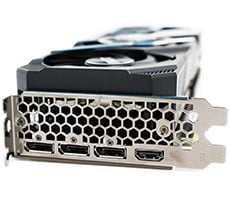
This two-slot card features an impressively large all-copper, dual-heatpipe cooler underneath its fan shroud, which makes up for the bulk of this card’s weight. The heatsinks are still cooled by ATI’s standard centrifugal embedded fan airflow system, which whisks hot air out of the chassis. Trust us, there’s a lot of heat which comes out of this card when it’s running at full tilt. To the right of the fan itself is a heavy duty aluminum alloy heatsink (anodized to be red) which covers the board’s power regulation components. The board also includes a black plastic holder, which can also lock into certain eATX cases for added stability. The board connects up via a standard PCI Express x16 connector to the PC. Under that massive heatsink, as we’ve mentioned before, is the ATI R600 graphics processor. R600 is based on a 80nm manufacturing process and in the case of the FireGL V8650, runs at a clock speed of 688 MHz. R600 is a unified shader design, much like Nvidia’s high-end GPUs, and the R600 has a full 320 stream processors. The GPU fully supports DirectX 10.0 (Shader Model 4.0) and OpenGL 2.1, and also supports 8/10/16-bit color for those who require such display fidelity. Linked to the GPU via a 512-bit "Ringbus" memory controller is 2 GB of GDDR-4 graphics memory spread out on the front and the back of the PCB. These memory modules run at 1.736 GHz clock speed, which allows for 108 GB/s of memory bandwidth for this card. The board is equipped with two dual-link DVI connectors which can handle 2560 x 1600 resolutions per connector, and the board fully supports ATI’s Hydravision multi-monitor suite. Sitting between them is an output port which can handle both HDTV output and act as a stereoscopic 3D output port. ATI also includes a single port on the top of the card which can be used to connect a Genlock/Framelock daughterboard, although one of these is not included by default with the board.
Also, sitting right next to that connector is a pair of Crossfire connectors on the top of the PCB. Sadly, ATI does not support Crossfire functionality for their workstation lineup at this time, so even if you do get two cards and connect them up, don’t expect to see any additional performance. Of course, this could change with a future software level release. ATI does say that you can use multiple FireGL cards in a single system if you want to drive multiple displays with high-performance graphics independent of each other. The FireGL V8650 is an impressive piece of technology, no matter what way you look at it. This card features more raw processing horsepower and memory compared to most people’s desktop PCs. It’s big, it’s somewhat loud and runs moderately hot (as you’ll see in the next pages), but if you need a huge frame buffer and a really powerful GPU to back it up, ATI has delivered a solid product with the FireGL V8650. |
| NVIDIA QuadroFX 5600 | ||||
NVIDIA’s QuadroFX 5600 card has been out on the market a little longer compared to ATI’s new FireGL lineup, but at the time of its release, it was just so far ahead of the rest of the FireGL lineup that it’s more the case that ATI is now catching up with NVIDIA’s feature set. The QuadroFX 5600 is still, just as it was when it was announced, an absolute monster in terms of graphics processing. The QuadroFX 5600 is more or less the workstation version of the GeForce 8800 GTX/Ultra, which is currently on top of the high-end gaming market.
The cooler which NVIDIA has used is fairly similar to those seen on the GeForce 8800 lineup. The huge cooler has a thick copper base connected to heatpipes which route heat away from the GPU. The heatpipes are connected to a series of heavy duty heatsink thin-fin fins, which work with the integrated blower fan to get the heat out of the chassis. NVIDIA’s cooler includes slits near the left side, which also help for additional heat removal away from the heatsink. Underneath this cooler is NVIDIA’s massive 480mm² G80 graphics processor, which consists of 680 million transistors and is still being manufactured with 90nm technology. NVIDIA clocks the G80 at 600 MHz for the QuadroFX 5600, which is just slightly less than the 8800 Ultra, which clocks in at 612 MHz. The GPU is based on a unified shader design, and fully supports all modern API’s like OpenGL 2.1 and DirectX 10 (Shader Model 4). Even though G80 has been on the market for a while, it’s still an incredibly exciting GPU, as it has a terrific feature set with a lot of raw power. The G80 GPU connects through a 384-bit memory interface to a mammoth 1.5 GB of GDDR-3 memory. NVIDIA chose to run the DDR memory modules a bit slower than their gaming cards, and slower than ATI’s card, by going with modules running at 1.6 GHz. This nets the card 76.8 GB/s of memory bandwidth, certainly nothing to sneeze at, but still significantly less than ATI’s card which hits 100 GB/s+. While it will likely void your warranty, potential buyers should know that these memory modules can hit 2.0 GHz+, and clock speeds can hit 8800 Ultra+ speeds by using NVIDIA’s nTune software, and performance did noticeably improve over stock speeds. Unlike ATI’s FireGL V8650, which we feel is running at the GPU's limitation of its possible speed, the G80 appears to have room to expand, and that NVIDIA was somewhat conservative with its stock clock rates. The board is equipped with a pair of dual-link DVI ports, which can handle screens up to 2560 x 1600 each, sitting alongside the workstation-card standard 3-pin stereoscopic connector. The board includes a connector on the top of the PCB for connecting a Genlock/Framelock or SDI card. The drivers include NVIDIA's excellent nView multi-monitor suite, which we feel is more robust in comparison to ATI's Hydravision at this time.
The Quadro FX 5600 is still an impressive piece of hardware, and we’re expecting it to remain NVIDIA’s top of the line workstation card for the foreseeable future. Since it’s been out for a little while already, we’ve already seen prices drop on it. Despite it’s being shown with a $3,000 MSRP, online retailers are already selling this card for a bit over $2,600, which undercuts the FireGL V8650’s launch price of $2,799. |
| Heat, Noise, and Power Consumption | |||||||
As you’ve seen, both of these cards are pretty strong in terms of specifications, but how are they to live with when working? This more or less boils down to heat production. If a card is producing excessive heat, the cooler must work harder to get it away from the GPU, which can lead to noisy systems.
The FireGL V8650 can also be noisy at times. During day to day tasks, the cooler is very quiet and will likely become inaudible once you learn to tune it out. However, when processing loads are piled on, the cooler can spin up quite quickly to full speed, which is significantly louder. If you were running long tasks on this GPU, we feel the extra noise would begin to hinder productivity for the user if this card was sitting nearby. The V8650 also takes longer to cool down and go into its low-noise mode compared to the FX 5600. This tells us that ATI’s cooling system is working hard to get the temperatures down against the heat created by the R600 GPU. The QuadroFX 5600 card performs much more favorably in this area. The card isn’t silent, but the noise which it does create is low pitched and easy to ignore. During our testing, we were able to kick the fan up to a high-speed mode, but the noise level wasn’t as irritating as ATI’s card. We also saw our GPU temperatures hit top levels of 75°C under sustained heavy loads. None of our applications were able to correctly monitor the temperatures of the FireGL V8650, but we are expecting it to run at higher thermal levels. The QuadroFX card also very quickly dropped into a low noise mode when processing sets were done, showing NVIDIA’s cooling system is a bit more in control of GPU temperature.
Comparing the QuadroFX 5600 to the FireGL V8650, the QuadroFX 5600 consumes less power at idle and full load. At idle, the high-end FX5600 card consumes the same amount of power as ATI’s mid-to-high-end V7600 FireGL product. At full load, the gap closes between the two high-end cards, but the V8650 consumes a bit more in the end. |
| Testbed and Cinebench | ||||||||
We also tested using Windows XP as both ATI and NVIDIA claim that Windows XP is still the dominant workstation operating system. Vista has barely made a dent in this market yet, as most workstation users are just making their way OFF of Windows 2000. Linux also has a big presence in the workstation market, but XP is still the leader. For the record, both cards now have full XP and Vista drivers for both 32-bit and 64-bit, so you certainly can run Vista if you like. However, many workstation applications aren’t certified for Vista usage yet.
The first performance tests, Cinebench’s OpenGL benchmark, showcases the QuadroFX in the lead. However, this is a synthetic test – let’s see how it performs against some real-world OpenGL applications. |
| 3D Studio Max 2008 and Maya 8.5 | ||||||||
Surprisingly enough, we see vastly different results between the two leading 3D production suites on the market today. The Spec APC 3D Studio Max test showed the best overall performance on the QuadroFX 5600 1.5 GB, holding a slight edge over our two competing FireGL products. Maya 8.5 shows a different story, as our two FireGL cards were able to plow through this benchmark without delay, virtually processing it in the same amount of time as each other. The QuadroFX 5600 fell quite far behind in this benchmark. This benchmark does coincide with our Spec ViewPerf Maya test in the following page. Maya simply appears to run better on the new FireGL lineup. |
| SPEC ViewPerf 10 | ||||
![]() ![]() ![]() ![]() Our first set of Viewperf 10 numbers look fairly mixed between our three high-end cards. For these tests, the extra memory capacities of these cards don’t make a huge difference, as seen by the architecturally similar V7600 and V8650 pushing very similar numbers. The QuadroFX 5600 puts up solid results, especially in Catia, where it has a solid lead over the ATI cards. ATI’s FireGL V8650 does put up the best performance in the all-important Maya benchmark, which coincides with the Maya benchmarks we ran prior. |
| SPEC ViewPerf 10 (Continued) | ||||
![]() ![]() ![]() ![]() Our second batch of tests is also somewhat mixed, with Nvidia winning two and ATI winning two. NVIDIA scores well in SolidWorks and ProEngineer, whereas the ATI card pushes better performance in TWX and much better performance in UGNX. Again, not much difference between the V7600 and V8650, despite the huge difference in price ($2,000). However, we haven’t put FSAA into the mix – let’s see if this will make any difference on the following page. |
| SPEC ViewPerf 10 (FSAA Tests) | ||||
![]() ![]() ![]() In most cases, the performance charts don’t change that much when FSAA gets into the mix. We only tested 0x/4x/8x, although the NVIDIA QuadroFX 5600 card reported scores up to 16x and 32x FSAA, which the FireGL V8650 card did not. The QuadroFX card shows better scaling with FSAA in Ensight and UGNX, although the FireGL shows better scaling in SolidWorks and Maya. All of the other tests scale roughly the same. Even at 8x FSAA, we see very little performance difference between the FireGL V7600 and V8650, with the exception of Maya. |
| GPGPU Computing | ||||
![]() ![]() ![]() General Purpose GPU computing is an important new market for workstation graphics cards to focus on. Our first set of tests show the QuadroFX 5600 delivering quicker computational performance compared to the V8650, by roughly about 13% for the most GPU intensive test. |
| GPGPU Computing (Continued) | ||||
![]() ![]() ![]() Our second round of tests show similar results, with the QuadroFX 5600 edging out slim victories across the board. |
| Gaming Performance | ||||||||
![]()
![]() While the FireGL V8650 card can hold its own in a workstation environment, it’s clearly outclassed in modern gaming engines. We see nearly a 2,000 point advantage in the default 3DMark06 test between the QFX 5600 and FGL V8650. Crysis goes from ~30FPS to ~40 FPS between these two cards. Both are certainly powerful enough to run most modern games without any issue, although if you’re a game developer, the gaming performance advantage with the QuadroFX 5600 might be an important aspect to consider. |
| OpenGL Effect Benchmarks | ||||||||
![]()
![]() We threw in these tests for good measure, as fur and soft shadows are two notoriously processing intensive situations which designers and developers constantly have to deal with. In these tests, we see a split, as the QuadroFX 5600 card provides about 20% better performance in the Soft Shadows test, whereas the FireGL V8650 takes the Fur test, giving about 13% better performance. |
| Conclusion | ||||||||
The missing piece to this puzzle (a less expensive card to compete with the FireGL V7600) just fell into place last week, with NVIDIA launching the QuadroFX 3700. This card has 512 MB of memory and is based on the same G92 GPU as the popular GeForce 8800 GT/GTS series. We’re expecting this card to retail for about $1,500, and it should perform similarly to the QuadroFX 4600, which we believe will be phased out as soon as the QuadroFX 3700 hits decent volumes. Even with this newer GPU out there, we still expect the QuadroFX 5600 to be the flagship Nvidia pro-graphics product for some time. It’s certainly possible that ATI will go a similar route with their new low-power 55nm RV670 GPU, which could help offset some of ATI’s heat related issues that we’ve felt with their current workstation lineup. While ATI is still missing something in terms of cooling, noise, and overall environmental marks, it would be short-sighted not to applaud ATI’s recent push forward in terms of their workstation lineup. They’re delivering better performing products to market in shorter time frames with competitive prices and feature sets. They are definitely keeping NVIDIA on their toes and raising some eyebrows with seasoned QuadroFX fans. So, the million dollar question – which would we rather have in our workstations? Looking at the cards side by side, we would give the nod to the NVIDIA card. In overall application performance, it simply is stronger and more pleasant to work with due to its lower noise and cooler thermal profile. However, if we were big Maya users, we would really be torn between these two products; especially since ATI is delivering larger framebuffers for lower MSRP’s and showing excellent performance numbers. It’s no longer clear-cut to just go with the QuadroFX; ATI’s FireGL lineup is really on their tails. While ATI’s R600 GPU really can’t keep up properly with the G80 in games, it’s definitely a different picture in the workstation market. If ATI could up their overall performance and smooth out the other lingering issues we noted, NVIDIA would have a face to face competitor right now. However, the QuadroFX 5600 is a quiet beast, its performance is very solid, it’s mature and has been shipping for a while, with prices falling down to below MSRP levels of the FireGL V8650. It also supports multi-GPU scaling and would definitely be a better choice for a GPGPU computing environment as well. Either way, workstation performance for both these cards is excellent. Neither would be a bad choice for a heavy duty workstation – just make sure you have adequate CPU power in order to back up these GPUs. Both of these GPUs can saturate a high end line system. And after all, if you’re buying such a high-end GPU, you should be able to afford a decent quad-core setup as well.
|