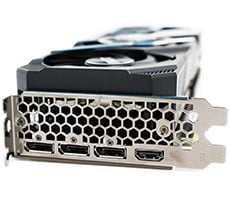
NVIDIA's GeForce GTX Titan: Yes, It CAN Play Crysis 3

If you haven’t already done so, we suggest checking out our initial preview of the GeForce GTX Titan. In our original piece, we outline the card’s specifications and cover its new features, like GPU Boost 2.0 and display overclocking, so we won’t be covering them again here. We do have lots of performance data though, including some GPGPU tests, and some overclocked scores too.
;)
The GK110-Based NVIDIA GeForce GTX Titan
 |
|
| Graphics Processing Clusters | 5 |
| Streaming Multiprocessors | 14 |
| CUDA Cores (single precision) | 2688 |
| CUDA Cores (double precision) | 896 |
| Texture Units | 224 |
| ROP Units | 48 |
| Base Clock | 836 MHz |
| Boost Clock | 876 MHz |
| Memory Clock (Data rate) | 6008 MHz |
| L2 Cache Size | 1536K |
| Total Video Memory | 6144MB GDDR5 |
| Memory Interface | 384-bit |
| Total Memory Bandwidth | 288.4 GB/s |
| Texture Filtering Rate (Bilinear) | 187.5 GigaTexels/sec |
| Fabrication Process | 28 nm |
| Transistor Count | 7.1 Billion |
| Connectors |
2 x Dual-Link DVI |
| Form Factor | Dual Slot |
| Power Connectors | One 8-pin and one 6-pin |
| Recommended Power Supply | 600 Watts |
| Thermal Design Power (TDP) | 250 Watts |
| Thermal Threshold | 95°C |
The GeForce GTX Titan’s specifications portend to the card’s immense horsepower. Not only is the GK110 at the heart of the GTX Titan twice the size of the GK104 used in the GeForce GTX 600 series, but it offers some new features as well, and it’s paired to a gigantic 6GB frame buffer. Yes, the GeForce GTX Titan’s TDP is lower than NVIDIA’s current flagship GeForce GTX 690 and the Titan is quieter too.

The Maingear SHIFT Super Stock with 3-Way GTX Titan SLI. PCs Don't Get Sexier Than This!
According to NVIDIA, “GeForce GTX TITAN was built to power the world’s fastest gaming PCs. From massively powerful 3-way SLI gaming supercomputers to super-fast and elegant small form factor rigs.” And that’s a big part of the Titan’s story. As you’ll see in the pages ahead, the card is extremely fast. But it doesn’t supplant the GeForce GTX 690. What it does do, however, is allow NVIDIA and its system partners—like Maingear—to offer new ultra powerful gaming PCs and quiet, small form factor rigs with much higher performance than they could before.
We’ve got a couple of a systems in house already that we’ll be showing you soon enough. For now though, we’re sure many of you are wondering just how well the GeForce GTX Titan performs. So without further delay, here are the benchmarks you’ve been itching to see…