|
|
| Introduction | ||||||
About a month ago, we had the privilege of reviewing HIS' Radeon X1950 Pro, a mainstream oriented graphics card that performed well, but we felt ultimately came up short against the similarly priced GeForce 7950 GT. The model we received was outfitted with an oversized cooler dubbed the IceQ3 Turbo, came overclocked by default, and supported CrossFire natively using internal ribbon cables, much like SLI with NVIDIA's cards. Although we found much to praise regarding the performance of the X1950 Pro, we found that the lack of availability of HIS products in the reseller market, combined with the possibility of DirectX 10 becoming much more important on the horizon, put a small damper on things. For the time-being however, we're sold on the fact that, in the here and now, the HIS Radeon X1950 Pro is a good investment in a quality product. In today's review, we take another look at some products from HIS, this time focusing on the lower end of mainstream graphics with the Radeon X1650 XT iSilence II and Radeon X1650 XT IceQ Turbo. Each card comes with its own main selling points. The iSilence II, as its name suggests, is completely silent and devoid of any moving parts in its integrated cooling solution. The IceQ Turbo, on the other hand, sheds silence for speed, coming in with higher clock speeds on both GPU and RAM and a hefty HSF cooler to keep temperatures in check. In essence, we will be pitting these two cards against each other, but we've thrown in some other cards for proper comparisons reference points.
It's actually quite rare to have two such cards in the labs at the same time from the same company. These days, cards have much shorter shelf lives, and it's not uncommon to see graphic cards arrive that are little more than the original reference design with the logo of the manufacturer quickly slapped on top of the heatsink (in fact, twice in the past year, said logo was haphazardly placed, allowing us to see the original ATI or NVIDIA graphics beneath it). HIS deserves a bit of praise here, as they have sought out two differing aspects of the market - those looking for moderate performance but a quiet system, and those simply looking for some good performance without getting two pricey. Over the past couple of months, we've seen that HIS has been very busy covering all angles, from the lower end X1650 Pro that Jeff looked at back in November, to the powerful X1950 XT Michael covered just a couple of weeks ago. |
| HIS Radeon X1650 XT IceQ Turbo | ||||
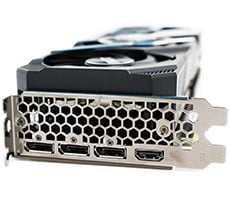
Compared to the iSilence II, the IceQ Turbo steers into a new direction. HIS' engineers took basically the same basic card as the iSilence II, but then raised the core speed from 575MHz to 630MHz and also boosted the memory from 690MHz to 770MHz. That's close to a 10% increase on both components. In order to do so, HIS scrapped the passive heatsink and went with a solution from Arctic Cooling. This type of cooler uses a fan mounted on the far end of the card to suck in air from the front side of the card and then push that air over the heatsink and fins, exhausting out the other end and out of the chassis. So, maybe it's not a completely different direction, just a more active one. The oversized cooler found on the IceQ Turbo will also take up two slots, as the plastic sheath covers some larger sized radiator fins underneath. Thankfully, this setup does not add as much noise as might be expected. The box rates the unit as operating at around 20db, and it's a fair guess that they are correct, as we didn't notice any significant noise emanating from the card during our testing. The only thing that raises a question here is how at 575/690 no active cooling was deemed necessary, yet at 630/770 HIS went with a relatively large cooler. We might have been just as happy with a single-slot cooler like the one ATI used in our original look at the X1650 XT. Much of the rest of the design stays the same, even keeping the memory under individual heatsinks. The cooler, being active, does require power from a small plug to the card itself, but all power is supplied by the PCI-E slot and no other external connections are necessary. Finally, as with the iSilence II, the IceQ Turbo sports two CrossFire connections along the top. To recap, currently CrossFire requires that both sets of edge connectors are connected by the bridges that come with each card, unlike the single connection of two GeForce cards in SLI. It's a thought that somewhere down the road ATI may allow users to daisy-chain more than two cards, but that's only speculation at this point.
![]()
There's nothing truly different to be said concerning the bundle of this card as well, as it mirrors what we saw with the iSilence II with the addition of a bracket to cover the opening of the HSF channel. The collection of software and other goodies isn't bad; it just doesn't live up to the hype of a "Platinum Pack". Dungeon Siege is the only full game included, but this title might only be useful in our opinion, for playing the remake of Ultima V: Warriors of Destiny, found for free on the Lazarus website. |
| Testing System and 3DMark06 | ||||||||||||||
HOW WE CONFIGURED THE TEST SYSTEM: We tested the HIS Radeon X1650 XT iSilence II and X1650 XT IceQ Turbo on the Gigabyte GA-8N-SLI - an nForce 4 Intel Edition SLI X16 chipset-based motherboard - powered by an Intel Pentium 4 550 processor and 1GB of Corsair XMS2 DDR2 memory. The first thing we did when configuring this test system was enter the BIOS and loaded the "High Performance Defaults." The hard drive was then formatted and Windows XP Professional with SP2 was installed. When the installation was complete, we installed the latest nForce 4 chipset drivers, installed all of the other necessary drivers for the rest of our components, and removed Windows Messenger from the system. Auto-Updating and System Restore were then disabled, the hard drive was defragmented, and a 1536 MB permanent page file was created on the same partition as the Windows installation. Lastly, we set Windows' Visual Effects to "best performance," installed all of the benchmarking software, and ran the tests.
For starters, we want to point out that the Radeon X1950 Pro was included solely for proper placement of the Radeon X1650 XT in the current crop of ATI products. We don't actually expect the two to perform on comparative levels, and won't nitpick on the X1650 XT as such. The 7600 GT is what should be considered as the competition and for the better part of all three 3DMark06 scores, the cards from HIS outperform it (albeit not by much). The largest gap between the two cards occurs during the SM3.0 testing, where the X1650 XT out-paces the 7600 GT by 10% with the default clocked iSilence II and 20% with the Turbo model. |
| Splinter Cell: Chaos Theory | ||||||
The X1650 XT iSilence II and the GeForce 7600 GT go head to head in this benchmark, each card nudging out the other at the standard tests, but ending up with an authoritative whopping of the 7600 GT with AA and Aniso enabled. The X1650 XT is not as affected by these settings which winds up giving it an 18-25% lead over the 7600 GT. As expected, the IceQ Turbo variant was just faster than the iSilence II, typically gaining from 4-5 frames per second in each of our runs. |
| Prey | ||||||
The 7600 GT and X1650 XT are once again paired quite closely in this round of testing, and I know we said we wouldn't do it, but it is interesting to note that the X1950 Pro with anti-aliasing and anisotropic filtering enabled is running much faster than even the overclocked X1650 XT at non-optimized settings. Prey was much more forgiving when we got to cranking up the settings, as both camps received the same performance hit. It's a crapshoot deciding which company's card is the best here, but we will take the free overclock on the Turbo model any day of the week. |
| F.E.A.R. | ||||||
After some mostly close or slightly lower scores for the 7600 GT, there's finally a little something to smile about for prospective GeForce buyers when using F.E.A.R. as the benchmark. During the standard test runs, the 7600 GT was performing more on overclocked X1650 XT levels rather than the standard clock speed version. This was short-lived, however, as both X1650 XT cards pulled back ahead of the 7600 GT when applying AA samples. |
| Half Life 2: Lost Coast | ||||||
The extra bump of the core and memory speeds on the X1650 XT IceQ Turbo provide little improvement over the standard clock speeds of the iSilence II in the Half Life 2 benchmarks. In fact, there's actually little difference between these two cards and the more powerful X1950 Pro at both resolutions, but only without AA and Aniso. The X1950 Pro gets to flex its muscles there with minimal performance loss, whereas the two X1650 XTs wound up dropping from 25 to 30 frames each but still edging out the GeForce 7600 GT easily. |
| Quake 4 | ||||||
With Quake 4, as with Doom 3 before it, we can usually predict that Geforce cards will perform quite well and the 7600 GT didn't let us down here. It's the first clear-cut victory of sorts for the NVIDIA GPU-based cared when compared to the duo of X1650 XTs from HIS. The IceQ Turbo does manage to gain back that ground in the 4xAA/8X Aniso tests, however, turning the 10 fps deficit into a slight lead. The iSilence II also staged a bit of a comeback, but ultimately fell short of the 7600 GT's frame rates. |
| Need for Speed: Carbon | ||||||
The Need for Speed: Carbon demo put the greatest hurt on our test systems and the results clearly show the frame rates as much lower than what we've become accustomed to seeing. Even the semi-powerful X1950 Pro struggled to get as high as 35 fps, and that's at our lowest resolution. From there, it's a direct line down to the two X1650 XTs, first the higher clocked IceQ Turbo and then the iSilence II. The GeForce 7600 GT and X1600 Pro cards are a distant fourth and fifth place, operating at almost half of the levels of the X1650 XTs. That said, this game title certainly doesn't require nearly the same frame rate as say Quake 4 does, in order to feel fluid and playable. |
| Overclocked Results | ||||
The default core and memory clock speeds for the Radeon X1650 XT are 575 MHz and 690MHz respectively, and this is what the iSilence II model is set at. At these speeds, HIS found that they could use a completely passive cooling mechanism. On their IceQ Turbo, they cranked up the speeds to 630/770 and slapped on a big, honking cooler to get the job done. That left us with two cards, one standard and the other pre-overclocked. Using the ATI tray tool we set out to see how far each card could be pushed. We had the highest hopes with the iSilence II, since we already know that the threshold should be at least what we saw with the IceQ Turbo. Indeed, the core topped out at a similar speed, 631 MHz, while we were able to continue with the RAM as high as 837MHz. The IceQ Turbo had less overhead left available, and after some tweaking we settled for a 654 MHz clock on the GPU and 851 MHz on the memory.
As can be expected, the overclocked iSilence II results were just a bit better than the stock speeded IceQ Turbo. While the core clock speed was almost identical, the 837 MHz that we reached with the memory allowed us to gain just over 100 points in 3DMark06, and an extra frame in F.E.A.R. By the same token, we were able to push up the IceQ Turbo from 630/770 MHz to 654/851 MHz and get even more improved scores. In neither case we weren't able to really come close to the X1950 Pro, which is a shame since the price point of all three cards will certainly become a factor in our final judgment. |
| Performance Summary and Conclusion | ||||||||
Performance Summary: The two X1650 XTs that we received from HIS performed well against the main competition from NVIDIA, which at this time should be considered the 7600 GT. In much of our testing, the stock speeds of the iSilence II were more than up to the challenge, beating or matching the 7600 GT in head-to-head comparisons, and performing even better when anti-aliasing techniques were enabled. Of course, the higher default speeds of the IceQ Turbo model provide a bit of a boost in the benchmarks.
HIS Radeon X1650 XT iSilence II - We will start with the iSilence II, if only because it comes at the same core and memory speeds that were set by ATI. Performance, as we spoke about above, is solid for this price range as it was able to handle much of our high-resolution testing with playable frame rates. The real selling points of this card come down to the purely passive cooling methodology and thus its silent noise output. True, it will take up two slots to accommodate the cooling apparatus, but many cards nowadays come with this size requirement. Finding this card might be the real challenge, however, as we weren't able to find many resellers carrying this product currently. When you can, expect to pay about $150 U.S., which is a good value for this kind of performance.
HIS Radeon X1650 XT IceQ Turbo - Which brings us to the IceQ Turbo. Although the same basic structure as the iSilence II, the core and memory speeds have both been tweaked, realizing some extra performance along the way. To accomplish this feat, HIS has added the oversized Arctic Cooler HSF, but it begs the question - how did we go from passive cooling to this huge setup? Still, we won't deny that the card runs faster and probably looks cooler while doing it. Expect to pay an extra 33% or so more for the X1650 XT IceQ Turbo. It retails for about $190-200. Running two of these cards in CrossFire with the internal connection could be a great path to follow, but the pricing might get you in the end. The X1950 Pro is already nearly double as fast, and a single card costs as little as $220 on some sites.
Get into HotHardware's PC Hardware Forum Right Now And Discuss!
|