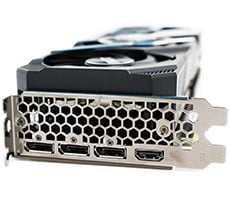
ATI Radeon X1650 XT with Native CrossFire


About two weeks ago, ATI launched the Radeon X1950 Pro, a new mainstream graphics card with a host of new features. This graphics card was equipped with a single-slot cooler, a relatively low-power GPU that was manufactured on TSMC's 80nm fabrication process, and in a first for ATI, native CrossFire support. Native CrossFire support meant there would be no more confusion over CrossFire Master and Slave cards, and the clunky external dongle previously associated with CrossFire was no longer a necessity.
In our evaluation of the X1950 Pro, we praised ATI for producing a high-performance, affordable, single-slot solution, with a more elegant approach to multi-GPU technology than their previous offerings. Although availability of the Radeon X1950 Pro is just now starting to ramp up and we've only been able to locate a single card that comes close to ATI's MSRP (which even they were unable to hit for some reason), it's clear that the X1950 Pro is a solid product in the mainstream market segment.
Today, ATI is adding yet another member to the Radeon X1K family of products, the Radeon X1650 XT. While its name suggests the X1650 XT is nothing more than a higher clocked variation on the barely 2-month old Radeon X1650 Pro, that's actually not the case. The Radeon X1650 XT is based on a new GPU, formerly code-named RV560, that is much more powerful than anything else in the X16x0 family. Take a look...

|
ATI Radeon X1650 XT |
| Features & Specifications |
|
Features - 80nm fabrication process - 24 pixel shader processors - 8 vertex shader processors - Up to 256-bit 8-channel memory interface - Native PCI Express x16 bus interface Ring Bus Memory Controller - Internal ring bus for memory reads - Fully associative texture, color, and Z/stencil cache designs - Hierarchical Z-buffer with Early Z test - Lossless Z Compression (up to 48:1) - Fast Z-Buffer Clear - Optimized for performance at high display resolutions, including widescreen HDTV resolutions Ultra-Threaded Shader Engine - Support for Microsoft DirectX 9.0 Shader Model 3.0 programmable vertex and pixel shaders in hardware - Full speed 128-bit floating point processing for all shader operations - Up to 512 simultaneous pixel threads - Dedicated branch execution units for high performance dynamic branching and flow control - Dedicated texture address units for improved efficiency - 3Dc+ texture compression o High quality 4:1 compression for normal maps and two channel data formats - High quality 2:1 compression for luminance maps and single-channel data formats - Complete feature set also supported in OpenGL 2.0 Advanced Image Quality Features - 64-bit floating point HDR rendering supported throughout the pipeline o Includes support for blending and multi-sample anti-aliasing - 32-bit integer HDR (10:10:10:2) format supported throughout the pipeline o Includes support for blending and multi-sample anti-aliasing - 2x/4x/6x Anti-Aliasing modes o Multi-sample algorithm with gamma correction, programmable sparse sample patterns, and centroid sampling o New Adaptive Anti-Aliasing feature with Performance and Quality modes o Temporal Anti-Aliasing mode o Lossless Color Compression (up to 6:1) at all resolutions, including widescreen HDTV resolutions - 2x/4x/8x/16x Anisotropic Filtering modes o Up to 128-tap texture filtering o Adaptive algorithm with Performance and Quality options - High resolution texture support (up to 4k x 4k) |
Avivo Video and Display Platform - High performance programmable video processor o Accelerated MPEG-2, MPEG-4, DivX, WMV9, VC-1, and H.264 decoding and transcoding o DXVA support o De-blocking and noise reduction filtering o Motion compensation, IDCT, DCT and color space conversion o Vector adaptive per-pixel de-interlacing o 3:2 pulldown (frame rate conversion) - Seamless integration of pixel shaders with video in real time - HDR tone mapping acceleration o Maps any input format to 10 bit per channel output - Flexible display support o Dual integrated dual-link DVI transmitters o Dual integrated 10 bit per channel 400 MHz DACs o 16 bit per channel floating point HDR and 10 bit per channel DVI output o Programmable piecewise linear gamma correction, color correction, and color space conversion (10 bits per color) o Complete, independent color controls and video overlays for each display o High quality pre- and post-scaling engines, with underscan support for all outputs o Content-adaptive de-flicker filtering for interlaced displays o Xilleon TV encoder for high quality analog output o YPrPb component output for direct drive of HDTV displays o Spatial/temporal dithering enables 10-bit color quality on 8-bit and 6-bit displays o Fast, glitch-free mode switching o VGA mode support on all outputs o Drive two displays simultaneously with independent resolutions and refresh rates - Compatible with ATI TV/Video encoder products, including Theater 550 CrossFire - Multi-GPU Technology - Four modes of operation: o Alternate Frame Rendering (maximum performance) o Supertiling (optimal load-balancing) o Scissor (compatibility) o Super AA 8x/10x/12x/14x (maximum image quality)
|

We have a plethora of information related to today's launch available on our site that will help you get familiar with the GPU architecture and key features employed on the new Radeon X1650 XT cards we'll be showcasing here. The Radeon X1650 XT has a number of features in common with some other members of the Radeon X1K family of products. And we've detailed the features of the Radeon Xpress 3200 chipset and ATI's CrossFire multi-GPU technology in a few past articles as well.
- Radeon X1950 Pro with Native CrossFire
- Radeon X1950XTX & X1900 XT 256MB Refresh
- AMD & ATI Merger: Questions and Answers
- ATI CrossFire Xpress 3200 Chipset Evaluation
- Radeon X1K Family Review
- ATI Crossfire Multi-GPU Technology Preview
If you haven't already done so, we recommend scanning through our CrossFire Multi-GPU technology preview, the CrossFire Xpress 3200 chipset evaluation, the X1K family review, and the Radeon X1950 Pro with Native CrossFire articles. In those four pieces, we cover the vast majority of the features offered by the Radeon X1650 XT. There is quite a bit of background information in these articles that lays the foundation for what we're going to showcase here today.