|
|
| Getting Down With the AIW X1900 | ||||
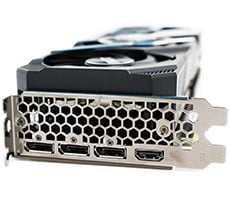
With the exception of the gold shielding over the silicon tuner and the various outputs on the card's backplane, the All-In-Wonder X1900 looks much like any other high-end ATI based graphics card. Both the All-In-Wonder X1900 and the other high-end X1800s/X1900s feature Volterra's multi-phase voltage regulator underneath a thin, red, aluminum heatsink at the far end of the PCB, and the AIW X1900 has the same single-slot, variable-speed cooling apparatus as the X1800 XL.
The Radeon X1900 GPU at the heart of the All-In-Wonder X1900 is manufactured using TSMC's .09 micron process and is composed of roughly 384 million transistors. The GPU features ATI's new "Ultra-Threaded architecture" with Shader Model 3.0 support, AVIVO, and fast dynamic branching. As we mentioned earlier, the Radeon X1900 GPU has 48-pixel shader processors, but it also has 8-vertex shader processors, and is equipped with a 256-bit, 8-channel memory interface. The card's core is clocked at 500MHz and its 256MB of GDDR3 memory is clocked a 480MHz (960MHz DDR). At these clock speeds, a large-single slot cooler is sufficient to keep core and memory temperatures in check. Unlike the standard Radeon X1K family of cards in ATI's current line-up, the All-In-Wonder version sports a purple PCB with gold and red accents. The All-In-Wonder X1900 also differs from the standard Radeons in that it has only one dual-link DVI output, along with F-Type FM and TV inputs, and a custom dongle connector on its backplane. The All-In-Wonder X1900 does have a second monitor output for multi-monitor support as well, but it is situated on a separate dongle and not on the card itself. An integral component of the All-In-Wonder X1900 is the Microtune IC 2121; a small chip situated underneath the gold shielding at the upper-corner of the card. The Microtune IC 2121 gives the All-In-Wonder X1900 its TV and FM tuning capabilities. ATI switched to a silicon tuner a while back to reduce power consumption and free-up precious PCB real estate. The Microtune IC 2121 has much lower power requirements when compared to the older, and much larger, "tin-can" tuners found on early All-In-Wonder cards. ATI claims the Microtune 2121 reduces power consumption by up to 11% over previous AIW products, with the tuner consuming only 1.5 watts of power. Working in conjunction with the Microtune 2121 tuner is ATI's own Theater 200 chip. The Theater 200 sports dual 12-bit ADCs (Analog to Digital Converters), and handles all of the signal conversions from the card's TV/FM tuner and various inputs. During the conversion process from an analog to a digital signal, the signal is passed through a 2D comb filter in the Theater 200 chip, and a video downscaler optimizes the output for your screen. The Theater 200 is also responsible for demodulating and decoding audio streams into separate left and right channels. Although ATI has had the newer, more powerful Theater 550 in their arsenal for some time, it has yet to be integrated into an All-In-Wonder product. |
| MMC & The Remote Wonder Plus | |||||||||||||||
Like previous products in ATI's All-In-Wonder line-up, the All-In-Wonder X1900's multimedia features are accessed using the company's Multimedia Center software suite. To evaluate the All-In-Wonder Radeon X1900, we installed version 9.13 of Multimedia Center, which was included on our installation CD. Multimedia Center incorporates the applications necessary to access all of the card's various multimedia features.
TV Tuning: The tuner app also has Multiview capabilities that give users the ability to display two separate channels simultaneously, should a second ATI-based TV tuner card be installed in the system. One thing we noticed while working with the AIW X1900, is that tuning TV channels takes a bit longer than it would on previous AIW cards that used the larger Philips tuner. We experienced the same type of delays with the AIW X800 XT and X1800 XL as well. Just like the other AIW cards that are equipped with the newer Microtune silicon tuner, the AIW X1900, took a second or two to lock onto a channel. FM Tuning: Other Creature Comforts:
Another major component of the All-In-Wonder X1900's accessory bundle is the Remote Wonder Plus. This is the third revision to ATI's Remote Wonder, and definitely the best in our opinion. The Remote Wonder Plus is much smaller than the original Remote Wonder and Remote Wonder II, but all function in a similar manor. The Remote Wonder Plus features a multitude of customizable buttons to control various applications, at a range of up to 60 feet. And the buttons can be mapped for use with Windows XP MCE 2005 as well. The stand-out feature on the Remote Wonder Plus is its mouse control knob. Using it takes a bit of getting used to if you've only worked with standard mice, but after working with the Remote Wonder Plus for only a few minutes, we were very comfortable using it to perform some basic tasks on the system, like launching / closing applications or stepping through songs in the CD player. We have to admit though, that we've used the Remote Wonder Plus before and have gotten somewhat used to its "feel". Configuring the Remote Wonder Plus is very simple, thanks to ATI's easy to use programming software. Assigning functions to each of the remote's customizable buttons is as easy as selecting an item from a drop-down menu. And for more extensive programming, users can install plug-ins for many popular applications as well. ATI ships the Remote Wonder Plus pre-configured to work with their Multimedia Center software and includes plug-ins for Guide+, PowerPoint and WinAMP. However, a multitude of other plug-ins are available from numerous third-party sources as well. |
| Adobe Application Bundle & Guide+ | ||||
As we mentioned earlier, ATI is no longer bundling Pinnacle Studio with their All-In-Wonder cards. Starting with the All-In-Wonder X1800 XL we reviewed a few weeks back, ATI starting including full versions of Adobe's Photoshop Elements 4 and Premiere Elements 2 with their All-In-Wonders.
The screenshots above should give you all a glimpse of the Adobe applications that will be included with the All-In-Wonder X1900. Basically, Photoshop Elements 4 and Premiere Elements 2 are "lite" versions of Adobe's very powerful Photoshop CS and Premiere Pro applications. Photoshop Elements 4 is an image editing and creation applications, and Premiere Elements 2 is for video editing and authoring. While these versions may not feature all of the tools incorporated into the professional versions of these applications, Photoshop Elements 4 and Premiere Elements 2 should by no means be considered limited. They both incorporate the most commonly used features found in Photoshop CS and Premiere Pro. They simply lack some of the more powerful features geared for professional users. The last of the applications included with the All-In-Wonder X1900 we'll be showing you is Gemstar's Guide+. This application has been bundled with ATI's All-In-Wonder products for quite some time, and adds a lot of value to the product. Guide+ essentially acts like a digital TV-Guide, and presents users with a comprehensive list of programming specific to the user's locale. Upon installation, users have to input their zip code, and then select their cable provider from a list. Then a few moments later, after downloading the appropriate listings, a visual representation is available on-screen. Simply click on a listing to view it, or even schedule it to be recorded. The listings are also fully searchable by category, title, or even actor. Guide+ is very easy to use, and is a perfect compliment to the All-In-Wonder X1900. And perhaps best of all, there is no subscription fee for All-In-Wonder owners and updates are free. |
| Our Test System & HQV | ||||||||||||
HOW WE CONFIGURED THE TEST SYSTEMS: We tested our NVIDIA based cards on an Asus A8N32-SLI nForce 4 SLIX16 chipset based motherboard, powered by an AMD Athlon 64 FX-55 processor and 1GB of low-latency Corsair XMS RAM. However, the ATI based cards were tested on an ECS KA1 MVP Extreme motherboard based on the Radeon Xpress 200 chipset, but with the same processor and RAM. The first thing we did when configuring these test systems was enter each BIOS and load the "High Performance Defaults." The hard drive was then formatted, and Windows XP Professional with SP2 was installed. When the installation was complete, we installed the latest chipset drivers available, installed all of the other necessary drivers for the rest of our components, and removed Windows Messenger from the system. Auto-Updating and System Restore were also disabled, the hard drive was defragmented, and a 768MB permanent page file was created on the same partition as the Windows installation. Lastly, we set Windows XP's Visual Effects to "best performance," installed all of the benchmarking software, and ran the tests.
For our first test, we used the HQV DVD video benchmark from Silicon Optics. HQV is comprised of a number of video clips and test patterns that have been specifically designed to evaluate a variety of interlaced video signal processing tasks, including decoding, de-interlacing, motion correction, noise reduction, film cadence detection, and detail enhancement. As each clip is played, the viewer is required to "score" the image based on a predetermined set of criteria. The total scores listed below are the sum of the scores for each section. We played the HQV DVD using the latest version of NVIDIA's PureVideo Decoder on the GeForce 7800 GT, and as recommended by ATI, we played the DVD on the ATI All-In-Wonder X1900 using Intervideo's WinDVD 7 Platinum, with hardware acceleration enabled.
ATI has done an excellent job improving the video playback quality of the X1K family of products. When they were first introduced back in October '05, X1K cards scored in the high 30s in this test, which was well below what NVIDIA could do with the GeForce 7 series. But now, with the latest Catalyst drivers installed, ATI dominates in this test, breaking the 100 point barrier and besting NVIDIA by a wide margin. |
| CPU Utilization with HD Content | ||||||||||||||||||
Windows Media Video 9 Acceleration: Microsoft's Windows Media Video 9 (WMV9) HD format was accepted by the SMPTE HD-DVD consortium as a new HD format. The Windows Movie Maker software, which comes bundled with Windows XP, makes it easy for consumers to edit and save their favorite videos. These videos are saved in the .WMV format. Most of today's high-end GPUs include dedicated hardware to accelerate the playback of WMV and WMV-HD content for fluid full frame rate video even on systems with entry-to mid level CPUs. Previous generations of GPUs were not able to support WMV9 decode acceleration, so often times HD WMV9 content would drop frames when being played back on legacy hardware.
To document CPU utilization when playing back WMV HD content, we used the performance monitor built into Windows XP. Using the data provided by performance monitor, we created a log file that sampled the percent of CPU utilization every second, while playing back the 1080p versions of the "MP10 Digital Life" and "The Rules of Attraction" videos available on Microsoft's WMVHD site. The data was then imported into Excel to create the graphs below. The graphs shows the CPU utilization for a GeForce 7800 GT and the All-In-Wonder X1900 using Windows Media Player 10, patched using the DXVA update posted on Microsoft's web site (Update Available Here), and using ATI's own player that is included in the MMC software suite.
The latest set of Catalyst drivers available for testing did a great job at increasing ATI's video playback quality in the HQV benchmark, but they also seem to have increased CPU utilization. We ran a similar set of tests to the ones above in our evaluation of the All-In-Wonder X1800 XL a few months back, and at that time, the X1800 and GeForce 7800 GT traded victories. Each card performed within a couple percentage points of the other in that article. This time around though, the GeForce card has lower CPU utilization while playing back both videos. We thought this could have been an issue with WMP10 and the new X1900, so we ran two sets of tests using Windows Media Player and the ATI Player included with the Multimedia Center Software suite, but NVIDIA came out on top each time, sometimes by as much as 8%. |
| 3DMark06 v1.0.2 | ||||||
The 3D performance tests from this point forward in this article are going to tell and interesting story. For one, we're going to see how the Radeon X1900 GPU performs when clocked much lower than the XTX or XT models. We're also going to get to see how the smaller, lower clocked frame buffer on the All-In-Wonder X1900 affects overall performance. 3DMark06 has the AIW Radeon X1900 performance at about the same level as a Radeon X1800 XT or 256MB GeForce 7800 GTX, but well behind the flagship X1900 cards. Slashing the frame buffer to 256MB and lowering the core and memory clock speeds to 500MHz/480MHz caused the AIW X1900 to fall behind an X1900 XT by about 1000 points here.
We saw a similar spread in 3DMark06's Shader Model 2.0 tests, with the new All-In-Wonder trailing all of the other cards by margins as small as 69 points, to as large as 754 points. The All-In-Wonder's scores in this particular tests seems to pay homage to that days of the Commodore 64. Ahh...those were the days. :)
3DMark06's Shader Model 3.0 test shows the power of the X1900's 48 pixel shader processors. Here, the All-In-Wonder Radeon X1900 outpaces the X1800 XT and the GeForce 7800 GTX. Only the much higher clocked Radeon X1900 XTX and X1900 XT were about to beat the latest All-In-Wonder in this test. |
| FarCry v1.33 | ||||||
The All-In-Wonder Radeon X1900 was plenty powerful for FarCry, but it did trail all of the other cards at both resolutions, regardless of whether or not any additional pixel processing was used. The All-In-Wonder Radeon X1900's smaller frame buffer and lower core and memory clock speeds make it perform much like a 256MB GeForce 7800 GTX in FarCry, but not quite on the same level of an X1800 XT or either of the high-end X1900 cards. |
| Half Life 2 | ||||||
All of the cards we tested had absolutely no problem tearing through Half Life 2. At both resolutions, both with and without anti-aliasing and anisotropic filtering enabled, every card we tested posted triple-digit frame rates. The All-In-Wonder Radeon X1900 hung right alongside its high-end counterparts at the lower resolution, where the test system was essentially CPU bound. At the higher resolution, with AA and Aniso disable, the AIW Radeon continued to perform on par with the higher-end cards, but with anti-aliasing and anisotropic filtering enabled, it dropped in behind the GTX at the rear of the pack. |
| F.E.A.R. v1.02 | ||||||
The All-In-Wonder Radeon X1900 performed like a cross between the Radeon X1900 and GeForce 7800 GTX in the F.E.A.R. benchmark. Without any additional pixel processing, the latest All-In-Wonder performed at a level somewhere between the X1800 XT and GTX at both resolutions. With anti-aliasing and anisotropic filtering enabled the same basically holds true, but the AIW's smaller frame buffer and decreased memory bandwidth due to its lower clock speed resulted in a significant performance decrease at the higher-resolution. |
| Quake 4 v1.0.5.2 | ||||||
Our custom Quake 4 benchmark proved to be a challenge for the All-In-Wonder X1900. The card's smaller frame buffer, in conjunction with its lower core and memory clock speeds, translates to much lower performance than all of the other cards we tested here, regardless off resolution or whether or not additional pixel processing was enabled. |
| Our Summary & Conclusion | ||||
Performance Summary: Obviously, with a 256MB frame buffer, and much lower core and memory clock speeds than the other cards in ATI's Radeon X1900 line-up, the All-In-Wonder X1900 isn't a contender for the 3D performance crown. But that is not what this "jack of all trades" video card is tartgeted at. Throughout our testing, the new All-In-Wonder X1900 performed much like a 256MB GeForce 7800 GTX, except in Quake 4 (OpenGL), where the AIW X1900 was clearly outpaced by the other cards we tested. Overall though, the All-In-Wonder X1900's 3D performance should be considered very solid by today's metrics, thanks to its 48 pixel shader processors. The card's performance in the HQV benchmark was second to none. However, CPU utilization while playing back HD content was a bit higher than we had expected based on our experience with the All-In-Wonder Radeon X1800 XL. Perhaps future driver updates will remedy this situation.
***Update May 4, 2006: ATI dropped the price of All-In-Wonder X1900 from USD$499 to USD$449. ATI seems to have taken two steps forward, and one step backward with the All-In-Wonder X1900. We like the fact that ATI was able to introduce a new All-In-Wonder based on their latest flagship R580 GPU so quickly. And we also like that a side effect of introducing new All-In-Wonders based new GPU architectures, is higher 3D performance and more features for these multimedia powerhouses. But ATI seems to have gone back to the "cut down" All-In-Wonder philosophy with the AIW X1900. With the All-In-Wonder X800 XT and X1800 XL, these cards had the same specifications as their "standard" desktop counterparts. With the All-In-Wonder X1900 though, the desktop parts are clocked much higher, have more memory, and as such offer much better 3D performance. Although the All-In-Wonder Radeon X1900 is technically the most powerful All-In-Wonder yet, we wish ATI kept its specifications more on par with its standard counterparts. Then again, perhaps the All-In-Wonder X1900 is a precursor to an as yet unannounced, lower-priced, X1900 based desktop derivative and ATI simply fast-tracked the AIW X1900 to bolster the launch of the GPU? Time will tell. At a $499 MSRP, the All-In-Wonder X1900 is the least expensive product in the Radeon X1900 line-up, despite its wealth of multimedia features. Couple that with the fact that the Radeon X1900 is arguably the most feature-rich GPU on the market, and you can't help but like the All-In-Wonder X1900. 3D performance wasn't awe inspiring, and we would have preferred a 512MB frame buffer, but thanks to the AVIVO video engine, video playback quality is excellent and the card's multimedia features are currently unmatched by any competing products. We wanted a little more 3D horsepower, yes, but in the end the AIW X1900 is still the most capable and feature-rich All-In-Wonder yet. We're giving the All-In-Wonder X1900 a solid 8.5 on the Heat Meter.
|