|
|
| Introduction | |||||||
Currently, if you're in the market for a video card, there are two great options that will get you premium performance without blowing your budget: the Radeon X800XL from ATi and the GeForce 6800GT from nVidia. Sure, there are more powerful cards, namely the X850XT and GF 6800 Ultra, but the price of these cards alone can sometimes be greater than an entire entry-level system purchase. In our past reviews, we've seen that the X800XL and 6800GT create a gamer's dilemma - their similar performance leads to a virtual stalemate. What might be the 6800GT's major advantage (at least the PCI Express based version) then, is the ability to run in SLI (Scalable Link Interface) mode, by connecting two similar cards thereby increasing performance. This, of course, requires a motherboard that supports SLI configurations. And of course, in addition to the nForce 4 SLI for AMD platforms, the introduction of the nForce 4 SLI Intel Edition boards will finally bring this much-hyped about technology to the Intel crowd. Today, we will have a look at just one of the many 6800GTs to hit the market, this one from MSI called the NX6800GT-T2D256E. Take note of the long model name, because word is there is another similarly named card from MSI, the NX6800GTX, which will come with only 12 pipelines instead of the GT's 16. The NX6800GT is one of the cards that MSI has labeled with their "Game with MSI" slogan, and based on the oversized packaging, colorful artwork, and in-your-face game adverts, it looks like we're in for a show.
MSI is no slouch when it comes to providing superb add-ons to their products, and it was no different with the NX6800GT-T2D256E. Power consumption is a bit higher than other cards, more than can be supplied by the PCI-e slot, so the first piece we came across was a 6-pin PCI-Express power cable. There were two MOLEX power splitters that can be used with the power cable if needed. One DVI-to-VGA connector is provided in the package, although the card sports two DVI ports. Thus, a second one must be purchased for dual VGA setups, which are quite rare anyway. Two univeral guides are included in the package, and even though they cover the basics well, they are geared to cover MSI's entire line of GeForce 6 products in general rather than solely reflect on the NX6800GT-T2D256E. Included software consisted of a number of utilties, some of which one wouldn't normally expect to see with a video card. These included a Virtual Drive 7 package, Restore It 3, and a Foreign Language Learning Machine. More typical CDs such as DVD-player software, a drivers disc, and SE versions of Photoshop rounded out the collection. As we pointed out earlier, MSI has gone all out in creating a gamer's package, self-titled the "Best Game Bundle of 2004" (well, 2005), and we can hardly argue with them. The first thing you'll see in this kit are pictures from four top-selling games, XIII, Prince of Persia - Sands of Time, Splinter Cell - Pandora Tomorrow, and URU - Ages Beyond Mist. Unfortunately, there's only three of these in the package. Depending on where the card is purchased, you will get Prince of Persia OR Splinter Cell, but not both. Still, that's three full games to choose from, worth at least $100-150. In addition, there's a demo CD that contains another 14 game demos. It's quite a collection of software to be had, and they'll show off the NX6800GT-T2D256E's graphics strength well.
|
| Main Features of the MSI NX6800GT | ||||
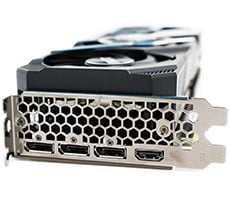
The NX6800GT is a lengthy card, built on red PCB, which is a hallmark of many of MSI's products. While many of today's higher-end cards can run extremely hot, requiring larger, louder heatsink/fan combos, the NX6800GT employs a single-slot copper heatsink that covers both the GPU and memory. As you can see, keeping with the "Game with MSI" motif, the fan and heatsink are both adorned with the same kind of catchy graphics we saw on the packaging. Along the top of the card is a small notch with a connector that's to be used for SLI. Generally speaking, it's preferable for two identical cards to be used, but in today's review we will be forgoing any kind of SLI testing, so we won't have to worry about that. The memory consisted of 256MB of Samsung GDDR3 BGA DRAM, all of which is situated on the front of the card. This leaves the back of the card mostly nude, save for a bracket used to screw down the heavy copper cooler. There's really not much to comment on until you reach either end. On the far end is the PCI-Express 6-pin power connector and on the other we've got dual DVI connectors as well as a S-Video out port. According to the website, an S-Video cable was intended to be included in some packages, but we did not find one in ours.
The cooler is called CopperUltra by MSI, and they claim that it should cool off the core about 15-20 degrees better than nVidia's reference design. It's heavy to be sure, but it uses low-temperature soldering and di-oxidized technology to ensure the best cooling method while running nearly silent. In it's default mode, the UltraGear fan runs along at 2800rpm at 30db. Using a slider along the top of the cooler allows the user to put the card into Ultra Mode, which is 4000rpm, but with 33% more noise, now operating at 39db. It's a good idea to allow this kind of user interaction, but we have one small issue with this idea. Placed directly on the card, it requires opening the chassis to move the slider. It might have been better to have a switch placed on the outer edge of the card, or allow for software control. One final strip of copper was placed over the circuitry on the end of the board, providing further cooling and stability.
|
| Testing Configuration | ||||||
|
HOW WE CONFIGURED THE TEST SYSTEM: We tested the MSI NX6800GT on our current test bed consisting of a 925XE-based motherboard powered by a 3.4GHz Pentium 4 550 and 1GB of Corsair XMS2 Pro DDR2 memory, all housed in the Shuttle SB95P XPC. The first thing we did when configuring this test system was enter the BIOS and loaded the "Optimal Performance Settings." We left the memory timings set by SPD (4-4-4-12), and set the AGP aperture size to 256MB. A Seagate Barracuda was formatted, and Windows XP Professional with Service Pack 2 was installed. When the installation was complete, we installed the latest Intel chipset drivers. Then we installed all of the necessary drivers for the rest of our components and removed Windows Messenger from the system. Auto-Updating, System Restore, and Drive Indexing were disabled, the hard drive was defragmented, and a 1536 MB permanent page file was created on the same partition as the Windows installation. Lastly, we set Windows XP's Visual Effects to "best performance," installed the benchmarking software, and ran all of the tests.
Installing the NX6800GT into the Shuttle SB95P originally caused us to pause and assess the situation. First, the card was easily the largest of the three in our testing suite and we weren't originally sure that it would fit. Luckily, it ended up just shy of the ventilation ductwork coming off of the CPU. Using a Small Form Factor system as the testbed base can always create issues of this sort, so we can't hold MSI responsible. However, buyers will have to take some of this into consideration if purchasing the NX6800GT for their own setups.
|
| 3DMark05 and Final Fantasy Benchmarks | ||||||||||||
The NX6800GT outpaced the 6600GT by nearly 50%. The 6600GT may have a speed advantage on the GPU, but it only has half the pipelines and memory bandwidth. The Asus Radeon AX800XL is a much better comparison - the specs for both cards are much more comparable. With these two cards, the difference in scores was just under 200 points, with the NX6800GT outperforming the AX800XL by just over 4%.
The lead changed in the Final Fantasy Benchmark. This time, we had the AX800XL leading the NX6800GT by just over 200 points, again equalling about a 4% difference. The 6600GT finished in dead last, which was what we had expected. It's still early, but our expectations are that the Radeon X800XL and 6800GT cards will be jockeying back and forth for the lead in the upcoming tests. |
| Halo 1.06 | ||||||
MSI's NX6800GT kept the lead in Halo in both tests, with increasing margins as the resolution was rasied. The difference between this card and the AX800XL at 1024x768 was minor, with just over a frame per second separating the two cards. This gap widened considerably at 1600x1200. At this resolution, the NX6800GT outpaced the AX800XL by over 10 percent, and ran nearly 47% faster than the 6600GT.
|
| Splinter Cell 1.2 | ||||||
Splinter Cell also seemed to favor the MSI NX6800GT over the Radeon X800XL. There was close to a six frame difference between the top two cards at 1024x768, although this slipped to only three frames at 1600x1200. The 6600GT was mostly a non-competitor in this benchmark, regularly putting up frame rates that were almost half of the other two cards.
|
| Aquamark 3 | ||||||
All of our AquaMark 3 results were led by the Asus AX800XL. At the lower resolution, the differences between the cards weren't all that large, with 2 or 3 frames separating the AX800XL and NX6800GT, and the 6600GT putting up some relatively decent numbers. Even at 1600x1200, the NX6800GT was still only a few frames behind. When we added some anti-aliasing samples, however, the performance delta really begin to swing more into the Radeon's favor. Here, the AX800XL led the NX6800GT by nearly a third with 4xAA with 8x Aniso enabled.
|
| Unreal Tournament 2004 | ||||||
In Unreal Tournament 2004, we finally have the 6600GT being competetive with the other two cards. All three cards placed in the mid to high 90's at 1024x768, with expected dropoffs when turning on the driver optimizations. Moving on to 1600x1200 results, we originally have the NX6800GT leading the pack by a large margin. Enabling 4xAA with 8x Aniso made quick work of the GeForce based cards, where the frame rates dropped nearly in half. The Radeon card was much less affected, dropping only about a quarter of its performance. |
| Far Cry 1.3 | ||||||
The demanding Far Cry engine was handled well by the NX6800GT and X800XL cards, with frame rates of nearly 60fps or better in almost every run. The 6600GT quickly fell off of the pace of the other two, starting off with a bang at 70.9 fps, yet ending up with a whimper, barely eeking by at 16.44 fps when everything was set to the max. Again, we had the X800XL as the hands-down winner of each head-to-head matchup, regularly beating the 6800GT based card by 10 frames or more.
|
| Half Life 2 | ||||||
HalfLife 2 was another benchmark that started out with all cards performing at similar rates, but ended up with a vast disparity between the "haves" and the "have-nots". The NX6800GT and the X800XL fall in with the former group - their larger number of pixel pipelines keeps frame rates going strong, even at levels that would have all but crippled cards from a year or two ago. Both cards put up frame rates that were in the high 70's to 80's at 1600x1200 with driver optimizations enabled. The overall edge has to go to the AX800XL, which maintained the highest frame rates throughout our testing. |
| Doom 3 - Single Player | ||||||
Id's reliance on OpenGL for its engine is a boon to GeForce users, especially for 6800GT owners. Completely opposite of the Unreal Tournament 2004 and Far Cry benchmark results, Doom 3 has the NX6800GT up by 10 frames per second over the Asus Radeon card in all but the final run. The 6600GT originally started off on the right foot, but just can't keep up with the big boys at 1600x1200. The 6800GT is doubling the 6600GT's production at this resolution.
|
| Doom 3 - Multi-Player | ||||||
Our initial few runs at 1024x768 produced a much closer grouping of the cards when using our custom multi-player demo. We're topping out at just over 120 frames per second at this resolution, with even the 6600GT coming in at 116.6 fps. The placement of the cards remained the same at the higher resolution, although the gap between the AX800XL and NX6800GT widened by a large amount. Although 3 frames originally separated the two cards, this difference increased to over 16 frames at 1600x1200. The 6800GT is performing well in Doom 3, so much so that even when enabling AA and Aniso, its frame rates are challenging the 6600GT without AA or AF enabled. |
| Overclocking Results | ||||
Using NVTweak, we enabled the panel for controlling clock frequencies in the ForceWare drivers. We started slowly, only raising the speed of the GPU and RAM in small increments and testing our results. When we reached a point where artifacts appeared or where the system became unstable, we backed off until we were sure that everything was operating normally. Our final overclock was 421MHz for the core and 557MHz (1.14GHz effective) for the RAM. The boost in RAM was modest, but the GPU overclock was an impressive 20%. To see how this affected our frame rates, we went back to Doom 3 and Aquamark 3 and re-ran them at 1600x1200 with 4xAA and 8x Aniso while overclocked.
As expected, we got immediate returns in both benchmarks. Over five frames per second were gained in Aquamark 3, also this still wasn't enough to catch up to the Asus AX800XL. A similar performance gain was seen in Doom 3, where the NX6800GT simply increased it's lead over the other cards. The differences between the frame rates before and after was close to, but not exactly, the 20% increase that we obtained when overclocking the GPU. During this period, we kept the card's fan set to the maximum speed, but noise levels were still kept within tolerable limits.
|
| Performance Analysis and Conclusion |
|
Benchmark Summary: Performance and feature-wise, the X800XL and 6800GT are close to equals. They both handle today's game engines with ease, only slowing down when we reach the highest resolutions, and even then usually only after applying image quality optimizations. Judged on it's own, the NX6800GT is a perfect choice for someone who doesn't necessarily want to spend the money for an Ultra version, but is seeking something better than the lower-end 6600GT. As we saw in the benchmarks, the 6600GT starts off well, but had its output nearly doubled by the NX6800GT under more stringent conditions.
While the performance of the MSI NX6800GT was great overall, we don't want to overlook the fact that the card runs nearly silent. Even when we set the UltraGear fan to it's highest function, we barely heard the fan over the rest of the system noise. The card also overclocked well, which may help placate some buyers with dispensible income who have to have the "fastest" card out there. Rather than plunk down the extra coinage on a GeForce 6800 Ultra, which are starting to get harder to find, all one needs is to get the NX6800GT and raise the speed to "Ultra" levels, or faster. Better yet, with SLI configurations now available to both the Intel and AMD crowd, simply get the NX6800GT now and save up for another to get the best of both worlds. The MSI NX6800GT really lived up to the expectations set forth by the gamer in us: great performance, quiet operation, and a stellar collection of games and applications. We're giving it a 9 on the HotHardware Heat Meter.
|