Logo   Banner   TopRight
TopUnder
Transparent
NVIDIA's GeForce 6800 Ultra - NV40 Debuts
Transparent
Date: Apr 14, 2004
Section:Graphics/Sound
Author: HH Editor
Transparent
NVIDIA's GeForce 6800 Ultra - Page 1

The GeForce 6800 Ultra
NVIDIA's NV40 Debuts...

By, Marco Chiappetta
April 14, 2004

NVIDIA is poised to fire the first shot in the next battle of the war for 3D supremacy with today's official unveiling of their new NV40 GPU.  The past two years have been especially hard fought.  Both NVIDIA and ATI have been introducing new products every few months in their continuing effort to "one-up" the other in the eyes of influential enthusiasts, casual gamers, and budget conscious consumers looking for the best return on their investment.  We've seen a myriad of new high-end, mid-range, and budget GPUs from NVIDIA and ATi, with each one designed to offer its own unique features and benefits at its specific price point.  We saw the performance lead change hands between ATi and NVIDIA at the low and mid-range market segments a few times over the past couple of years, but ever since the introduction of the Radeon 9700 Pro back in August of 2002, ATi has held onto the top spot with a firm grasp in the sought after enthusiast segment.  The R300, and the evolution of high-end "enthusiast-class" products based on its core technology, essentially remained one step ahead of NVIDIA's flagship NV3x products for all of 2003.

This put NVIDIA in the unfamiliar position of playing "catch-up", which did not sit well with their outspoken CEO, Jen-Hsun Huang.  When asked about ATi's ability to snatch the performance crown from NVIDIA he responded with, "Tiger Woods doesn't win every day. We don't deny that ATI has a wonderful product and it took the performance lead from us. But if they think they're going to hold onto it, they're smoking something hallucinogenic.''  With what we know today, the confidence, and perhaps brashness, Jen-Hsun exuded with this statement seems to have stemmed from his knowledge of NVIDIA's next-gen GPU architecture, codenamed NV40.  With the NV40, NVIDIA's goals were to dramatically improve performance and image quality, while adding support for the latest DirectX feature set.  The culmination of their efforts resulted in the new GeForce 6 Series of products powered by the NV40.

The video card we'll be looking at today on HotHardware is NVIDIA's latest flagship product, the GeForce 6800 Ultra (yes, the FX moniker is gone).  With the GeForce 6800 Ultra, NVIDIA strives to erase all of the NV3x's shortcomings, while emphatically building upon its strengths.  The result is a product that doesn't simply outperform the previous generation - it destroys it...

Specifications & Features of The GeForce 6800 Ultra
NVIDIA's Newest Flagship GPU

                    
CLICK ANY IMAGE FOR AN ENLARGED VIEW

CINEFX 3.0 SHADING ARCHITECTURE
  • Vertex Shaders
    ° Support for Microsoft DirectX 9.0 Vertex Shader 3.0
    ° Displacement mapping
    ° Vertex frequency stream divider
    ° Infinite length vertex programs*
  • Pixel Shaders
    ° Support for DirectX 9.0 Pixel Shader 3.0
    ° Full pixel branching support
    ° Support for Multiple Render Targets (MRTs)
    ° Infinite length pixel programs*
  • Next-Generation Texture Engine
    ° Up to 16 textures per rendering pass
    ° Support for 16-bit floating point format and 32-bit floating point format
    ° Support for non-power of two textures
    ° Support for sRGB texture format for gamma textures
    ° DirectX and S3TC texture compression
  • Full 128-bit studio-quality floating point precision through the entire rendering pipeline with native hardware support for 32bpp, 64bpp, and 128bpp rendering modes

NVIDIA HIGH-PRECISION DYNAMIC-RANGE (HPDR) TECHNOLOGY

  • Full floating point support throughout entire pipeline
  • Floating point filtering improves the quality of images in motion
  • Floating point texturing drives new levels of clarity and image detail
  • Floating point frame buffer blending gives detail to special effects like motion blur and explosions
  • New rotated-grid anti-aliasing removes jagged edges for incredible edge quality

INTELLISAMPLE 3.0 TECHNOLOGY

  • Advanced 16x anisotropic filtering
  • Blistering-fast anti-aliasing and compression performance
  • Support for advanced lossless compression algorithms for color, texture, and z-data at even higher resolutions and frame rates
  • Fast z-clear
  • High-resolution compression technology (HCT) increases performance at higher resolutions through advances in compression technology

ULTRASHADOW II TECHNOLOGY

  • Designed to enhance the performance of shadow-intensive games, like id Software?s Doom III

ADVANCED ENGINEERING

  • Over 220m transistors
  • Designed for PCI Express x16
  • Supports PCI Express high-speed interconnect (HSI) technology for bidirectional interconnect protocol conversion
  • Full support of AGP 8X including Fast Writes and sideband addressing
  • Support for the industry?s fastest GDDR3 memory
  • 256-bit advanced memory interface
  • 0.13 micron process technology
  • Advanced thermal management and thermal monitoring
  • 40 mmx40 mm, BGA flip-chip package

Architecture Characteristics of the GeForce 6 Series

Pixel pipelines 16
Superscalar shader Yes
Pixel shader operations/pixel 8
Pixel shader operations/clock 128
Pixel shader precision 32 bits
Single texture pixels/clock 16
Dual texture pixels/clock 8
Adaptive anisotropic filtering Yes
Z-stencil pixels/clock 32
ADVANCED VIDEO AND DISPLAY FUNCTIONALITY
  • Dedicated on-chip video processor
  • MPEG video encode and decode
  • WMV9 decode acceleration
  • Advanced adaptive de-interlacing
  • High-quality video scaling and filtering
  • Integrated NTSC/PAL TV encoder supporting resolutions up to 1024x768 without the need for panning with built-in Macrovision copy protection
  • DVD and HDTV-ready MPEG-2 decoding up to 1920x1080i resolutions
  • Dual integrated 400 MHz RAMDACs for display resolutions up to and including 2048x1536 at 85Hz.
  • Dual DVO ports for interfacing to external TMDS transmitters and external TV encoders
  • Microsoft® Video Mixing Renderer (VMR) supports multiple video windows with full video quality and features in each window
  • VIP 1.1 interface support for video-in function
  • Full NVIDIA® nView? multi-display technology capability

NVIDIA® DIGITAL VIBRANCE CONTROL? (DVC) 3.0

  • DVC color controls
  • DVC image sharpening controls

OPERATING SYSTEMS

  • Windows XP
  • Windows ME
  • Windows 2000
  • Windows 9X
  • Macintosh OS, including OS X
  • Linux

API SUPPORT

  • Complete DirectX support, including the latest version of Microsoft DirectX 9.0
  • Full OpenGL, including OpenGL 1.5

* The operating system or APIs can impose limits, but the hardware does not limit shader program length.


The Chip

 
Substrate & Die

 
A Wafer & The Official Badge


Physically, the GeForce 6800 Ultra looks much like the GeForce 5950 Ultra, but don't let initial impressions fool you.  The GeForce 6800 Ultra incorporates some cutting-edge technology, and has quite a few new and useful features.  If it's not entirely clear in these photos, the GeForce 6800 Ultra's cooling solution is still a two-slot design; the model we have here does encroach on the first PCI slot.  The blower and shroud are designed to pull air in through the front, and blow it across the heatsinks mounted over the GPU and RAM.    When operating at full speed, we found the fan to be somewhat louder than the ones installed on most of the retail-ready 5950 Ultras we have reviewed, but we expect NVIDIA's AIC partners will come up with some innovative cooling solutions of their own design.  We wouldn't be surprised if a few single-slot, near silent models hit store shelves in the coming months.

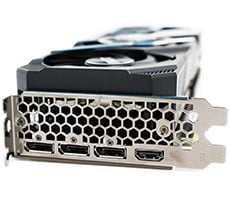
Also notice that our sample was equipped with two DVI connectors, for those looking to run dual-independent digital displays (or dual analog displays using DVI-to-DB15 adapters).  Dual-DVI cards have been few and far between, but we're told that not all 6800 Ultras will be dual-DVI, so don't get too excited just yet.  Some will ship with one DB15 and one DVI connector.  The next aspect of the GeForce 6800 Ultra that may catch your eye are its dual Molex power connectors.  This NV40 core is built using a .13 micron manufacturing process, and is comprised of roughly 222 million transistors.  If you're keeping track, that's approximately 25% more transistors than a P4 Extreme Edition CPU, which makes the NV40 an extremely complex (and large) ASIC.  As such, it demands a lot of power.  NVIDIA is recommending 480W power supplies be used with the GeForce 6800 Ultra.  When connecting the power cables, they can't be split from a single connection either.  The GeForce 6800 Ultra requires connections from two supplemental power rails.  Keep this in mind if you think a GeForce 6800 Ultra is in your future, as a power supply upgrade may be in order as well.  The need for this kind of "external" power stems from a limitation within the AGP spec.  AGP slots can provide a maximum of only 25W of power to the video card.  PCI Express should help alleviate the situation a bit, as the PCI Express standard calls for 60W.


We also disassembled the cooling hardware mounted on our GeForce 6800 Ultra, to get a closer look at the underlying PCB, memory and the NV40 chip itself.  Once we had the card apart, It was interesting to find that the heatsinks used on the card were constructed of aluminum, instead of copper.  During conversations with NVIDIA, we were told that although the NV40's die is larger and requires a lot of power, it runs cooler than NV38 because of tweaks made to the manufacturing process and its slightly lower clock speed.  We haven't done extensive testing, but our experience with the card so far seems to back up this claim.  At idle we witnessed core temperatures hovering around 36°C.  After a few hours of benchmarking though, temperatures climbed into the upper 40s.  With more elaborate (and expensive) copper coolers, however, temperatures could be brought down even lower.

It was also interesting to find that all 256MB (8x32MB) of the RAM installed on the card, was mounted to one side of the PCB.  Samsung's GDDR3 chips (K4J55323QF - more information here) are available in higher densities than standard DDR RAM, which eliminates the need to mount chips on the backside of the card, unless NVIDIA plans to increase the RAM over 256MB.

Right in the center of the PCB you'll see the massive NV40 itself.  The die is so large because NVIDIA has designed the NV40 to have far more pixel shading performance than last generation's high-end parts.  The NV38 (GeForce FX 5950 Ultra), for example, is a 4x2 or 8x0 (Z-only, no color data) architecture.  In most real-world gaming scenarios, this means it can process 4, dual textured pixels per clock cycle which equates to a theoretical peak fillrate of 3.8GTexels/s.  The NV40, on the other hand, is a 16x1 or 32x0 architecture.  The NV40 has four times the number of pixel pipelines as the NV38, which accounts for a large number of the transistors that comprise the core.  NVIDIA didn't only increase the number of pipelines, but they have also incorporated a second pixel shader unit per pipe and have brought the number of vertex units up to 6 as well.

Although we'll be shining the spotlight on the GeForce 6800 Ultra today, NVIDIA is also announcing the 6000 "non-Ultra".  The GeForce 6800 is based on the same NV40 architecture, but it will have "only" 12 pixel pipelines, as opposed to Ultra's 16.  NVIDIA hasn't disclosed final clock speeds just yet, but they have informed us that the base GeForce 6800 will be a single-slot design (like the card pictured at the very top of this page), and it will require only one Molex power connection.  As more solid information about the GeForce 6800 comes in, we're sure we'll be able to tell you more, but for now, lets move on to some of the GeForce 6800 Ultra's other key features...

New Features & The Drivers

Transparent
NVIDIA's GeForce 6800 Ultra - Page 2

The GeForce 6800 Ultra
NVIDIA's NV40 Debuts...

By, Marco Chiappetta
April 14, 2004

With the GeForce 6800 Ultra, NVIDIA is not only the first company to introduce GDDR3 equipped video cards and 16 pixel pipelines in a single chip, but they've expanded the feature set of their GPUs to fully support the relatively new Shader Model 3.0 as well.  The GeForce 6800 Ultra also has a new video engine built-into the chip,  a new anti-aliasing method, and a beefed up version of NVIDIA's proprietary UltraShadow technology...

New Feature Spotlight: GeForce 6800 Ultra
Wider is Better  |  Più largamente è migliore

CineFX 3.0 & Shader Model 3.0:

Shader Model 3.0, which will be available upon the release of DirectX 9.0c, basically builds upon Shader Model 2.0 by increasing the maximum number of Vertex and Pixel shader instructions that can be executed by the GPU, and by raising the minimum level of shader precision required to be compliant.  The GeForce 6 Series can process an infinite number of pixel and vertex shader instructions, which far exceeds the minimum specification of 65,536.  The GeForce 6 Series also has support for Displacement mapping, Vertex Texture Fetch, Pixel Shader Subroutines, Loops & Branches and Dynamic Flow control.  Support for these specifications make the NV40 act more like a general purpose CPU, giving it the ability to process instructions with more flexibility, which in-turn gives developers more freedom when programming complex shaders.


TRADITIONAL NON SCALAR SHADER: ONE SHADER UNIT


GEFORCE 6 SERIES SHADER: WITH SECOND SHADER UNIT

The NVIDIA GeForce 6 Series also has a new shader architecture that can double the number of operations executed per clock cycle.  Each of the NV40's pipelines is now equipped with a second shading unit (right).  Traditional shaders (left) generally have a single shading unit that can process up to 4 operations per pixel, per clock cycle.  By adding a second shading unit to each pipeline the NV40 architecture delivers a twofold increase in the number pixel operations that can be processed per clock cycle.  This "superscalar" architecture, as NVIDIA calls it, is capable of up to four instructions and eight operations per pixel, compared to just two instructions and four operations in traditional architectures.

UltraShadow II:

As games and their underlying game engines get more complex, and have to use multiple passes to render shadows from different light sources, the need to process these shadows efficiently and quickly gets increasingly more important.  With the NV3x architecture, NVIDIA introduced a proprietary technology called "UltraShadow" that helps render complex shadows relatively quickly, when compared to products without UltraShadow.  NVIDIA pointed to ID's upcoming game Doom 3 as one of the titles that benefit greatly from their UltraShadow technology.  Back in June '03 we spoke to NVIDIA about this technology, and asked how it gives them a performance advantage.  Basically, what UltraShadow does is cull shadows that fall outside of a defined depth bound - if a shadow falls outside of the boundary it is not rendered.  This saves processing time, and bandwidth, which ultimately increases performance.  With the GeForce 6800 Ultra, NVIDIA is introducing UltraShadow II, and extension of their technology which offers up tp 4x the performance of the NV35.

Intellisample 3.0 & Rotated Grid Anti-aliasing:

NVIDIA has also revamped their anti-aliasing engine with the GeForce 6 series.  Cards based on the NV3x used a four sub-pixel pattern that was sampled in a two-by-two grid for each pixel.  By slightly rotating the grid into somewhat of a diamond shape (similar to ATI's technique with the R3x0 architecture), the resulting pattern of the four sub-pixels samples four values for the horizontal and vertical sub-pixel positions. Using samples that are essentially closer to the original pixel results in more accurate colors at the polygon's edge.  The more accurate the colors, the less prominent jaggies will appear in any given frame, which gives the overall appearance of fewer jaggies in the scene.

NVIDIA HPDR (High Precision Dynamic Range):

The GeForce 6 Series is capable of Studio-Quality, HDR (High Dynamic Range) rendering that complies with the OpenEXR format developed by Industrial Light & Magic (ILM) of Lucasarts fame.  ILM developed the OpenEXR format in response to the demand for higher color fidelity in the visual effects industry.  In scenes with a very bright light source in conjunction with extremely dark shadows, there tends to be color banding in the dark portions of the scene where the eye can better perceive slight differences in color.  NVIDIA's HPDR technology, which is completely implemented in hardware, solves the problem of high dynamic-range rendering by providing 16-bit floating point formats for storage, blending, shading, texturing, and filtering during the light transport phase. It also allows for the use of the sRGB format in the tone mapping and color and gamma correction phases. For more details, and in-depth explanations as to how HDR rendering can affect an image, we strongly suggest checking out the examples on the OpenEXR website - as they say, a picture is worth a thousand words.

On-Chip Video Processor:

The NV40 also sports an on-chip programmable video processor designed to improve the quality and performance of video playback on the PC.  NVIDIA's on-chip video processor incorporates a high-quality adaptive de-interlacing engine, along with better filtering and scaling techniques, video de-blocking capabilities and an integrated TV-encoder.  The NV40's on-chip video processor is also a complete HDTV solution as well, with the ability to output HDTV streams in all of the popular formats (720P, 1080i, 480P, CGMS).  It also has PVR (Personal Video Recorder) functionality, with hardware audio / video synchronization, hardware MPEG 1 / 2 / 4 encoding and decoding, and WMV9 decode acceleration.

Eye Candy: NVIDIA's Demos
Showing Off the Features...


Sailing with NVIDIA, Dr. Timbury and the lovely Nalu...

Upon the introduction of a new architecture, NVIDIA always produces a few spectacular demos designed to highlight the product's key features and performance.  At a recent press event we got to see all three of the demos pictured above running live on the NV40, and can say these screen captures do not do them justice.  The Sailing demo especially looked much better live and in motion.  It seems like these shots were taken with an early build of the demo, as the one we were shown had the water splashing up on the sides of the ship as it crashed into the waves.  The Dr. Timbury demo, was also fairly impressive.  We weren't too fond of the "cartoon-like" look, but when the camera was positioned to show the NV40's HDR rendering at work, the light bloomed around, and reflected off his shiny head, in a very realistic fashion.  Then we have Nalu.  Nalu is the mermaid cousin, of Dusk & Dawn - the NV3x nymphs.  Nalu has evolved to have much more realistic looking skin, translucent shader effects for her "clothes" and fins, and her hair is comprised of 10,000 individually animated strands.  The overall effect was very realistic, especially when she spun and turned to show its movement.

The Drivers: Forceware v60.72
Without The Software, The Hardware is Useless


Information
 

Color Correction
 

Clock Frequencies
 

Performance & Quality
 

NVRotate
 

Screen Adjustment
 

Overlay
 

Display Timing
 

Temperature
 

Tying all of the hardware's features to the operating system is NVIDIA's Forceware drive suite.  Release 60 of the Forceware drivers add support for the GeForce 6 series of products, as well as NVIDIA's PCI Express products based on the NV3x architecture.  Unified Compiler performance has been improved approximately 10% - 35%, an optimized PS3.0 complier has been added, and support for NV4x's video engine has been incorporated as well.  Release 60 also integrates all of the new features first introduced with the Forceware 55 release, like a built in pop-up blocker, application specific profiles and auto overclocking (on supported products).  We've already covered these new features in more detail in a previous article, so we don't spend too much time on them here.  But if you'd like to read up on them, head on over to this page.  Release 60 is designated as beta at the moment, and should be ready for public consumption at the end of May.

Anti-Aliasing Image Quality

Transparent
NVIDIA's GeForce 6800 Ultra - Page 3

The GeForce 6800 Ultra
NVIDIA's NV40 Debuts...

By, Marco Chiappetta
April 14, 2004

We followed a similar procedure to evaluate the effect of the GeForce 6800 Ultra's anisotropic filtering technique on a given scene.  The screenshots below are of frame 1300 of the Aquamark 3 benchmarking tool.  We've again compared similar settings using the 6800 Ultra, 5950 Ultra and the Radeon 9800 XT.

Anisotropic Filtering With The GeForce 6800 Ultra
Clean Up Those Blurry Textures!
 

GeForce 6800 Ultra
No Aniso


GeForce 6800 Ultra
No Aniso (400% Zoom)


GeForce 6800 Ultra
8X Aniso


GeForce 6800 Ultra
8X Aniso (400% Zoom)


GeForce 6800 Ultra
16X Aniso


GeForce 6800 Ultra
16X Aniso (400% Zoom)

Enabling anisotropic filtering with the GeForce 6800 Ultra changed the overall look of the scene dramatically.  In the "No Aniso" shot, the textures on the pillar and on the ground along the edge of the mountain show the characteristic blurring associated with trilinear filtering.  With 8X anisotropic filtering enabled, however, almost all of the blurring disappears.  The ground, the mountain, and the surface of the pillar all seem much sharper and more defined.  Cranking the aniso up to 16X further sharpens the scene, but the difference is very subtle.  The sprouts on the ground are a touch clearer, as is the base of the pillar.  You'll only be able to see the differences if you switch between the two images quickly...


GeForce FX 5950 Ultra
No Aniso


GeForce FX 5950 Ultra
No Aniso (400% Zoom)


GeForce FX 5950 Ultra
8X Aniso


GeForce FX 5950 Ultra
8X Aniso (400% Zoom)

We only took two screen shots with the GeForce FX 5950 Ultra because the maximum anisotropic filtering setting available was only "8X".  The "No Aniso" shot looks much like the 6800 Ultra's and the Radeon 9800 XT's, except that it is slightly sharper.  The difference between the 8X anisotropic settings with the 5950 Ultra and the other cards is like night and day, however.  The pillar and sprouts along the ground get cleaned up quite a bit with 8X aniso enabled, but the ground and mountain hardly change at all.  We think this is an issue with the 5950 Ultra and the new Forceware 60 drivers though, because anisotropic filtering on the GeForce FX series of cards has been one its strong suits.


ATi Radeon 9800 XT
No Aniso


ATi Radeon 9800 XT
No Aniso (400% Zoom)


ATi Radeon 9800 XT
8X Aniso


ATi Radeon 9800 XT
8X Aniso (400% Zoom)


ATi Radeon 9800 XT
18X Aniso


ATi Radeon 9800 XT
16X Aniso (400% Zoom)

Directly comparing the Radeon 9800 XT to the GeForce 6800 Ultra yields some interesting results.  Without any anisotropic filtering enabled, we'd give a slight advantage to the Radeon - the image is slightly less blurred (the differences are most visible on the mountain).  At the 8X and 16X aniso settings though, the GeForce 6800 Ultra clearly does a better job at sharpening the textures.  This is especially noticeable if you again pay special attention on the mountain when switching between the shots.  NVIDIA has definitely made some progress with regard to their in-game image quality.  With anti-aliasing and anisotropic filtering enabled, we're of the opinion that NVIDIA has surpassed ATi...at least for now...

In-Game Screenshots With The GeForce 6800 Ultra
FarCry - The Tropical Shooter


GeForce 6800 Ultra  |  1024x768  |  4XAA  |  16X Anisotropic Filtering

There are only so many enlarged screen captures you can look at without going crazy, so once we were done evaluating the GeForce 6800 Ultra's image quality, we fired up a few games and unwound a bit.  We've only had the card for a short while, so we couldn't spend too much time gaming and still get this article done, but we were able to squeeze in a couple of hours of FarCry and Unreal Tournament 2004.  Multiplayer UT 2004 is always fun, but FarCry is simply awesome.  We had been playing FarCry on a Radeon 9800 XT and found that cranking up all of the in-game settings caused some slowdowns in certain areas.  The GeForce 6800 Ultra, however, had no such problem.  We patched FarCry so it would properly support the NV40, and snapped off a few shots at 1024x768 with 4X AA and 16X anisotropic filtering enabled to give you an idea as to what this game actually looks like with a high-end piece of hardware like the 6800 Ultra.  It seemed like anti-aliasing wasn't being applied to every surface, but the game still looked great.  Once Direct X 9.0c ships, we expect FarCry will look even better.  The current v1.1 patch already adds Pixel Shader 3.0 support and fixed a few fog and lighting issues.  NVIDIA tells us a few other Shader Model 3.0 enabled titles are in the works as well.  Games like Lord of the Rings: Battle For Middle-earth, STALKER: Shadows of Chernobyl, Vampire: Bloodlines, Splinter Cell X, Tiger Woods 2005 and Madden 2005 to name a few...

The Test System & Some Benchmarks

Transparent
NVIDIA's GeForce 6800 Ultra - Page 4

The GeForce 6800 Ultra
NVIDIA's NV40 Debuts...

By, Marco Chiappetta
April 14, 2004

HOW WE CONFIGURED THE TEST SYSTEM:

We tested the NVIDIA GeForce 6800 Ultra, and the GeForce FX 5950 Ultra and ATi Radeon 9800 XT, on an i875P based DFI LANPARTY Pro875B motherboard, powered by an Intel Pentium 4 3.2CGHz CPU. The first thing we did when configuring this test system was enter the BIOS and loaded the "High Performance Defaults". Then we set the memory to operate at 200MHz (in dual-channel mode), with the CAS Latency and other memory timings set by the SPD, and then we set the AGP aperture size to 256MB. The hard drive was then formatted, and Windows XP Professional with SP1 was installed. When the installation was complete, we installed the Intel chipset drivers and hit the Windows Update site to download and install all of the available updates. Then we installed all of the necessary drivers for the rest of our components and removed Windows Messenger from the system altogether.  Auto-Updating, System Restore, and Drive Indexing were then disabled, the hard drive was de-fragmented and a 768MB permanent page file was created. Lastly, we set Windows XP's Visual Effects to "best performance", installed the benchmarking software and ran all of the tests.  Throughout our testing, NVIDIA's and ATi's drivers were configured for maximum visual quality.  Their respective "Fastest" or "Performance" modes were not used.

HotHardware's Test Setup
Intel Powered - 3.2GHz System
Hardware:

Processor -

Mainboard -
   

Video Cards -


Memory -


Audio -

Hard Drive -


Optical Drive -

Other -


Intel Pentium 4 3.2GHz

DFI LANPARTY Pro875B
i875P "Canterwood" Chipset
 
NVIDIA GeForce 6800 Ultra
NVIDIA GeForce FX 5950 Ultra
ATi Radeon 9800 XT

 
1024MB Kingston HyperX PC3500
CAS 2
 
Integrated C-Media Audio
 
Western Digital "Raptor"
36GB - 10,000RPM - SATA
 
Lite-On 16X DVD-ROM

3.5" Floppy Drive

Software:

Operating System -

Chipset Drivers -

DirectX -

Video Drivers -


Windows XP Professional SP1 (Fully Patched)

Intel INF v5.1.1.1002

DirectX 9.0b

NVIDIA Forceware v60.72
ATI Catalyst v4.4

Performance Comparisons With ShaderMark v2.0 (Build 1e)
Strict High Level Shading Language


ShaderMark v2.0

For most of our recent reviews, we've stuck to using games, or benchmarks based on actual game engines,  to test video cards.  The problem with using this approach, is that some advanced 3D features may not be fully tested, because game engines sometimes tend to lack the newest features available with cutting edge graphics hardware.  In an effort to reveal raw shader performance, which is nearly impossible to do with the games on the market today, we've incorporated ToMMTi-System's ShaderMark v2.0 into our benchmarking suite.  ShaderMark is a Direct 9.0 pixel shader benchmark that exclusively uses code written in Microsoft?s High Level Shading Language (HLSL).


Detailed ShaderMark v2.0 Results

ShaderMark v2.0 attempts to run 22 different shaders of varying complexity, hence the extremely large graph above.  Please note that some of the shaders would not run on the NVIDIA powered cards, because floating point texture shaders aren't supported yet in NVIDIA's Forceware driver package.  For the visual learners reading this, it's clear that the GeForce 6800 Ultra offers massive performance improvements for shaders written in HLSL.  The Radeon 9800 XT significantly outperformed the GeForce FX 5950 Ultra, but the GeForce 6800 Ultra was simply in a league of its own.  The table to the left is the exact ShaderMark v2.0 performance breakdown between the three cards tested here.  When compared to NVIDIA's previous flagship part, the GeForce 6800 Ultra outperformed it by a minimum of 347.8% and by as much 520%.  The ATi Radeon 9800 XT fared much better, but it too wasn't even competitive.  The GeForce 6800 Ultra's performance advantages over the 9800 XT ranged from a minimum of 47% to a maximum of 194.1%.  It seems NVIDIA took the NV3x's shortcomings to heart and made enormous strides with the NV40.  Its shader performance in vastly improved.

Aquamark 3 & Halo  

Transparent
NVIDIA's GeForce 6800 Ultra - Page 5

The GeForce 6800 Ultra
NVIDIA's NV40 Debuts...

By, Marco Chiappetta
April 14, 2004

Performance Comparisons With Aquamark 3
DX8 and DX9 Shader Ops


Aquamark 3

Aquamark 3 comes to us by way of Massive Development Massive's release of the original Aquanox in 1999 wasn't very well received by the gaming community, but it was one of the first games to implement DX8 class shaders, which led to the creation of Aquamark 2 - a benchmark previously used by many analysts. Since the Aquamark benchmarks are based on an actual game engine, they must support old and new video cards alike.  Thus, the latest version of Aquamark, Aquamark 3, utilizes not only DirectX 9 class shaders, but DirectX 8 and DirectX 7 as well.  We ran this benchmark at resolutions of 1024x768 and 1600x1200 with no anti-aliasing, with 4x AA, with 4X AA and 8X anisotropic filtering and lastly with 4X AA and 16X aniso.

From this point forward, you'll notice quite a few "N/A"s listed in our graphs associated with the GeForce FX 5950 Ultra.  The GeForce 6800 Ultra and Radeon 9800 XT both have a "16X" anisotropic setting available, but the GeForce FX 5950 Ultra maxes out at 8X.  Due to this limitation, the 5950 Ultra could not run the 16X aniso tests, thus the "N/A"s.

In Aquamark 3, regardless of the resolution, or levels of AA and aniso used, the GeForce FX 6800 Ultra outran the competition.  It was between 23% and 42% faster than the GeForce FX 5950 Ultra, and 28% to 38% faster than the 9800 XT at 1024x768.  At 1600x1200 the GeForce 6800 Ultra's massive fillrate and improved shader performance help extend its leads over the 5950 Ultra and 9800 XT by 43% to 63%, and by 47% to 55%, respectively.

Benchmarks With Halo
Halo - All Patched & Ready To Go!


Halo

For many gamers, the release of Halo marked the end of a long wait, since it was originally released as an Xbox exclusive a few years back.  No additional patches or tweaks are needed to benchmark with Halo, as Gearbox has included all of the necessary information in their README file.  The Halo benchmark runs through four of the cut-scenes from the game, after which the average frame rate is recorded.  We patched the game using the latest v1.04 patch and ran this benchmark twice, once at 1024x768 and then again at 1280x1024.  Anti-aliasing doesn't work properly with Halo at the moment, so all of the test below were run with anti-aliasing disabled.

The GeForce 6800 Ultra significantly outperformed the competition in the Halo benchmark.  With their new Catalyst v4.4 drivers, ATi still maintains a lead over the GeForce FX 5950 Ultra, but the 6800 Ultra simply crushed them both.  At 1024x768 the 6800 Ultra was 50% faster then the 9800 XT and 57% faster than the 5950 Ultra.  Bump the resolution up to 1280x1024 and the 6800 Ultra's advantage over the 9800 XT jumps to 77%, and its lead over the 5950 Ultra increases to over 90%.

Unreal Tournament 2004 & Splinter Cell

Transparent
NVIDIA's GeForce 6800 Ultra - Page 6

The GeForce 6800 Ultra
NVIDIA's NV40 Debuts...

By, Marco Chiappetta
April 14, 2004

Head-to-Head Performance With Unreal Tournament 2004
Epic's Next Smash Hit!


Unreal Tournament 2K4

Epic's "Unreal" games have been wildly popular, ever since the original Unreal was released in the late '90s.  Unreal, Unreal Tournament, and then Unreal Tournament 2003, rapidly became some of our favorites, for both benchmarking, and for killing a few hours when our schedules allowed it!  Epic recently released the latest addition to the franchise, Unreal Tournament 2004.  We used the demo version of the game to benchmark these cards at resolutions of 1024x768 and 1600x1200, without any anti-aliasing, with 4x AA, with 4X AA and 8X anisotropic filtering and lastly with 4X AA and 16X aniso.

We ran a timedemo that uses the "Colossus" map on all three of the cards.  Unfortunately, the lower-resolution benchmark doesn't yield much useful information because the test was CPU limited on both GeForces and the Radeon, regardless of whether or not anti-aliasing or anisotropic filtering was used.  When we upped the resolution to 1600x1200, however, things got a little more interesting. The GeForce 6800 Ultra was still CPU bound, until we enabled 4X AA and 8X aniso concurrently.  The Radeon 9800 XT's and GeForce FX 5950 Ultra's frame-rates, on the other hand, dropped off quite a bit once we enabled AA and aniso at the higher resolution.
 
Performances Comparisons With Splinter Cell
Stealthy Combat


Splinter Cell

Splinter Cell's version 1.2 patch includes three pre-recorded demos and incorporates a previously unavailable benchmarking tool.  The demos included with the patch are somewhat limited by CPU performance, however, so we opted for the custom Oil Rig demo created by the folks at Beyond 3D to test with this game.  Beyond 3D's demo removes two CPU intensive routines while increasing dependence on Pixel Shader performance.  Shaders are used to render realistic looking ocean water surrounding an Oil Rig in the demo, as well as simulating a night vision effect for a brief period.  Also note that anti-aliasing doesn't work with Splinter Cell.  Due to this fact, we do not have any AA scores listed in the graphs below.

Score another decisive victory for the GeForce 6800 Ultra.  In the Splinter Cell benchmark, the GeForce 6800 Ultra, yet again, outclassed the previous generation's high-end cards.  At 1024x768, the 6800 Ultra outperformed the 9800 XT by about 61% and it smoked the 5950 Ultra by over 87%.  With the resolution set to 1600x1200, the GeForce 6800 Ultra's lead over the 9800 XT increased to 78% and its lead over the GeForce FX 5950 Ultra swelled to over 105%!

Final Fantasy XI & Tomb Raider: AoD

Transparent
NVIDIA's GeForce 6800 Ultra - Page 7

The GeForce 6800 Ultra
NVIDIA's NV40 Debuts...

By, Marco Chiappetta
April 14, 2004

Performances Comparisons With Final Fantasy XI Benchmark 2 v1.01
A Classic Console Franchise On The PC


Final Fantasy XI

The Final Fantasy franchise is well known to console gamers, but Squaresoft has since made the jump to the PC with a MMORPG version of this classic. The Final Fantasy XI benchmark runs through multiple scenes from the game and displays a final score every time a full cycle of the demo is completed. Although the demo is meant the check an entire system's readiness to play the game, the number of frames rendered scales when different video cards are used. Lower scores indicate some frames were dropped to complete the demo in the allotted time. The scores below were taken with the demo set to its "High Resolution" option (1024x768), with anti-aliasing disabled.

Have you started to see a pattern yet?  Even though these are some of the smallest deltas we've seen thus far, once again, the GeForce 6800 Ultra posted the highest score of the bunch.  At 5823 frames, the 6800 Ultra finished about 5% ahead of the Radeon 9800 XT and over 13% ahead of the GeForce FX 5950 Ultra.  Keep in mind that this test was run at a relatively low resolution, if we had the ability to raise the resolution to anything higher than 1024x768, the GeForce 6800 Ultra's performance would probably have been much more dominant, as fill rate limitations for the other cards would have begun to make an impact on the numbers.

Head-to-Head Performance With Tomb Raider: AOD
The Anti-Greatest!


Tomb Raider: AOD

Although Tomb Raider: Angel of Darkness won't be winning any "Game of the Year" awards, it is one of the more advanced DirectX games currently available. We've recorded a custom demo of Lara jogging through an indoor garden area in the "Prague3" map. When using the Pixel Shader 2.0 code path, this area of the game utilizes a DOF (depth of field) blurring effect to enhance the sense of depth and size. We ran our custom demo at a resolution of 1024x768 and then again at 1600x1200, using both the Pixel Shader 1.4 and 2.0 code paths (with and without 4x anti-aliasing in the PS 2.0 tests).

Historically, NVIDIA's GeForce FX line of cards haven't performed very well in this test when using the PS 2.0 code path, especially when compared side-by-side with ATi's R3x0 GPUs.  In the PS 1.4 tests, they worked fine, but PS 1.4 is based on the older DirectX 8 specification.  With the GeForce 6800 Ultra however, NVIDIA not only catches ATi, but they blow past them with some authority.  In the PS 1.4 tests, the 6800 Ultra's leads over the 5950 Ultra and 9800 XT peaked at over 152% at 1600x1200.  In the PS 2.0 tests, the 6800 Ultra did even better, finishing as much as 161% faster than the competition.  It seems like NVIDIA's previous performance issues when running DirectX 9 class games are eliminated on the GeForce 6 series of cards.

Comanche 4 & Wolfenstein

Transparent
NVIDIA's GeForce 6800 Ultra - Page 8

The GeForce 6800 Ultra
NVIDIA's NV40 Debuts...

By, Marco Chiappetta
April 14, 2004

Performances Comparisons With Novalogic's Comanche 4
Combat Helicopter Sim


Comanche 4

To give you sim fans a small taste of what these cards can do, we used Novalogic's combat helicopter simulator Comanche 4 for our next batch of DirectX tests. Comanche 4 uses DX8 class pixel and vertex shaders to produce some of the realistic visuals used throughout the game. Unlike some of the previous tests though, this benchmark is heavily influenced by CPU and system memory performance, especially at lower resolutions. However, when the resolution is raised and anti-aliasing and anisotropic filtering are enabled, the current crop of 3D accelerators tend to slow down quite a bit.

Like the Unreal Tournament 2004 demo, the GeForce 6800 Ultra was CPU bound when the resolution was set to 1024x768 in the Comanche 4 benchmark.   However, the Radeon 9800 XT's and the GeForce FX 5950 Ultra's performance dropped by about 10% at 1024x768 when AA and aniso were enabled.  With the resolution cranked up to 1600x1200, performance begun to scale accordingly and the GeForce 6800 Ultra proceeded to thump the competition yet again by margins ranging from about 5% to 60%.

Benchmarks / Comparisons With Wolfenstein: Enemy Territory
Q3 Engine Based Freebie


Wolfenstein: ET

We also ran through a batch of timedemos with the OpenGL game Wolfenstein: Enemy Territory. Wolfenstein: ET is a free, standalone multiplayer game that is based on the excellent Return to Castle Wolfenstein, that was released a few years back. It uses a heavily modified version of the Quake 3 engine, which makes it a very easy to use benchmarking tool.  We created our own custom demo and used the built-in timedemo feature to check each card's frame-rate. The tests below were run at 1024x768 and again at 1600x1200, without anti-aliasing, with 4X AA, with 4X AA and 8X aniso and lastly with 4X AA and 16X anisotropic filtering enabled concurrently.

The GeForce 6800 Ultra pummeled the competition, when we tested it with Wolfenstein: Enemy Territory and our custom timedemo. Without any anti-aliasing or anisotropic filtering enabled, the 6800 Ultra was between 3% and 35% faster than the GeForce FX 5950 Ultra at 1024x768, and about 9% - 29% faster then the Radeon 9800 XT. With AA and Aniso enabled however, the GeForce 6800 Ultra's lead increases to over 40% in some test configurations.  Notably, ATi seems to have fixed the performance issues they had in this game with their latest drivers, but no amount of driver tweaking would have helped them catch the 6800 Ultra here.

Overclocking & Our Final Thoughts

Transparent
NVIDIA's GeForce 6800 Ultra - Page 9

The GeForce 6800 Ultra
NVIDIA's NV40 Debuts...

By, Marco Chiappetta
April 14, 2004

We were very interested to see just how high our GeForce 6800 Ultra sample would overclock, considering how large the core is and that it's using a relatively new memory technology. We installed NVIDIA's registry hack called, "CoolBits" (yes it still works with the Forceware v60.xx drivers) and raised the core and memory clock speeds on the 6800 Ultra until we started to see visual anomalies on-screen during our benchmarks...

Overclocking The GeForce 6800 Ultra
There Is Always Some Wiggle Room...

When all was said and done, we were able to take the core up from its default 400MHz clock speed to 449MHz, an increase of over 12%. The Samsung GDDR3 memory on the card didn't overclock very well though.  We were only able to take the memory up to 1.14GHz DDR, an increase of only 40MHz.  At anything higher than 1.14GHz, the card would fail the stability / quality test built-into NVIDIA's Forceware drivers.  To demonstrate the benefit of overclocking the card, we re-ran the Aquamark 3 benchmark at 1600x1200 with 4X AA and 8X anisotropic filtering enabled.  In the end, we saw roughly an 11% increase in performance.  Not bad considering the GeForce 6800 Ultra was already the fastest video card we have tested to date.

Following a long steady succession of incremental upgrades, it was refreshing to test a product like the NVIDIA GeForce 6800 Ultra.  After evaluating its in-game image quality and benchmarking it versus the previous generation of flagship products, we're reminded of ATi's release of the Radeon 9700 Pro back in August of 2002, or dare we say even the 3Dfx Voodoo 2.  It has been quite a while since we have seen such  dominant performance from a new product in this market.  Thanks to its new rotated-grid anti-aliasing sampling algorithm and excellent anisotropic filtering techniques, the GeForce 6800 Ultra's in-game image quality is vastly improved over the GeForce FX as well.  In our opinion NVIDIA has even surpassed ATi's image quality this time around - the 6800 Ultra's AA seemed just a bit more crisp, and its anisotropic filtering was a tad better as well.  The GeForce 6800 Ultra's performance is obviously a strong point also.  We tested the card in 43 different configurations using 9 different benchmarks, and in all but a few CPU limited circumstances, the GeForce FX 6800 Ultra was the dominant performer, in some cases more than quadrupling the performance of the previous generation.

Its image quality and performance are great, but what about pricing and availability?  Well, NVIDIA will be setting the MSRP of the GeForce 6800 Ultra at exactly the same level as the 5950 Ultra, $499.00 US.  While 500 clams isn't exactly cheap, expect street prices to drop rather quickly.  The GeForce FX 5950 Ultra isn't quite 6 months old and they can be found for less than $370 at a few on-line resellers.  The 12-Pipe 6800 "non-Ultra" will be priced at a much more palatable $299 at launch.  However, without knowing its final shipping clock speeds and testing the card, we can't attest to its performance just yet.  We also don't know exactly when to expect cards to hit the retail shelves, although we're told late next month, or early June is likely.

The last unknown is what the folks at ATi have up their sleeves.  Rumor has it, their next generation high-end GPUs will also be 16 and 12 pipeline parts.  If they can hit similar clock speeds and improve upon the efficiency and quality of the R3x0, ATi may be still be able to retain the 3D performance crown, but lets not speculate.  We're sure ATi will show their hand shortly, and we don't want to steal any of NVIDIA's thunder.  They are to be commended for producing a killer product in the GeForce 6800 Ultra.  Those of you that waited to upgrade your video card recently made a wise choice.  This generation appears to be an order of magnitude faster than the last.  Just be prepared to upgrade your power supply as well.


Get Into HotHardware's PC Hardware Forum!
Tweaked, Overclocked & Ready to Rock!


Transparent
NVIDIA's GeForce 6800 Ultra - Page 10
Unknown Title


Content Property of HotHardware.com