Logo   Banner   TopRight
TopUnder
Transparent
Asus V8420 Deluxe GF4 Ti4200
Transparent
Date: Oct 19, 2002
Section:Graphics/Sound
Author: HH Editor
Transparent
The Asus V8420 Deluxe GF4 Ti4200 - Page 1

Asus V8420 Deluxe GeForce 4 Ti 4200 Review
A Ti 4200 For Gamers & Video Aficionados...

By - Robert Maloney
October 16, 2002

The Asus V8420 Deluxe is a bit of a paradox at first glance.  It could be assumed that this is a budget package.  After all, it does contain a card built on the NVIDIA GeForce 4 Ti 4200 chipset, technically the "low man on the totem pole" of the three cards in the GF4 Titanium series.  A closer examination reveals that Asus didn't just give you any board based on the Ti 4200 but a faster and more powerful version than most competitors. Then they threw together a bundle unmatched by most other companies. You want games?  How about two full versions of popular titles, plus another CD with 6 demos.  What about output options?  Asus includes a breakout box for video in and out that could be used for connection to a television and a splitter cable to use the DVI port for a second VGA monitor.  As if all this wasn't enough, you also get a set of stereoscopic glasses to make your gaming experience complete.

Have we gotten your attention yet?  We bet Asus did, so let's check out the nitty-gritty details and see if the actual product lives up to the feature bullet list.

Specifications and Features of the Asus V8420 Deluxe GF4 Ti4200
The gold at the end of the rainbow

     
CLICK ANY IMAGE FOR AN ENLARGED VIEW.

Asus V8420 Deluxe

  • 260MHz GeForce 4 Ti GPU
  • 15-pin VGA, S-Video In/Out, DVI-I
  • 256-bit Graphics Architecture
  • AGP Interface ? 4x/2x support

NVIDIA nfiniteFX II Engine:

  • Dual programmable Vertex Shaders, fast Pixel Shaders and 3D textures give developers the freedom to program a virtually infinite number of custom special effects never seen before and gives you the power to play true-to-life characters in hyper-realistic environments.

Lightspeed Memory Architecture II:

  • With 128-bit DDR Lightspeed Memory Architecture II provides nearly double the memory bandwidth of GeForce3.

Accuview Antialiasing Engine:

  • High-performance and stunning visual quality at high frame rates.

Output Jacks:

  • Standard 15-pin VGA
  • S-video jack - allows you to play on any size TV in your house with an s-video connector.
  • DVI-I port
  • Input jack for stereoscopic glasses

Cooling solution:

  • On-board active heat-sink cooling fan

Specifications:

  • Controller: NVIDIA GeForce4 Ti 4600
  • Memory 128MB 3.3ns Etrontech DDR  
  • Core Clock 260MHz
  • Memory Clock 550MHz
  • 350MHz internal RAMDAC
  • API Support Direct-X, Open GL ICD for Windows
  • Connectors VGA, DVI, S-Video In/Out
  • 4 Billion Texels/sec Fill Rate
  • 113 Million Vertices/sec
  • 8 GB/sec memory bandwidth

Features at a Glance:

  • AGP 4x compatible with fast writes
  • 256-bit 3D and 2D graphics accelerator
  • NVIDIA nView display technologies
  • Lightspeed Memory Architecture II
  • Accuview Antialiasing
  • High Definition Video Processing Engine
  • TV Out connector
  • DVI connector
  • Stereoscopic glasses for 3D gaming

Package Contents:

  • Asus V8420 GeForce 4 Ti 4200 video adapter
  • Stereoscopic 3D Glasses
  • "Breakout" box with video in/out options
  • DVI to DVI and VGA splitter cable
  • Aquanox and Midnight GT/Rage Rally CDs
  • Demo CD with 6 games
  • Driver & Utilities CD, Asus DVD 2000, Intervideo WinCoder, CyberLink VideoLive Mail
  • Manual


OK, I mentioned that this wasn't your run-of-the-mill GF4 Ti 4200. Let me explain. To begin with, the Core clock is set to 260MHz by default, 10MHz over the usual 250 that we have seen with other Ti 4200s. Next, instead of including 64MB of DDR memory, or even 128MB of "slower" RAM, they placed 128MB of 3.3ns Etrontech BGA DDR!  All of this was placed on a 8-layer purple PCB board that looks exactly like its big brothers, the 4400 and 4600. In fact, to the naked eye, one would be hard pressed to find a difference, as the layout is exactly the same. The snazzy looking gold-anodized heatsink with clear blades was a nice contrast from the purple PCB, and was attached to the card with two clips and what looked to be a perfect application of thermal paste.

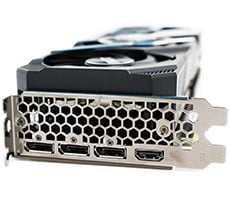
As one can expect, on the bracket we found the usual kinds of ports, one for a VGA monitor, an S-Video connection, as well as DVI.  There is another input however, that is used for the Stereoscopic 3D glasses, which are included in the package. To use these glasses,  one must use the Asus enhanced 29.42 drivers found on the driver CD.   I guess that means that if you want to keep using these glasses, you would have to wait for Asus to update their video drivers rather than using the more frequent releases found on NVIDIA's site. NVIDIA does offer reference 3D Stereo drivers on their website, but we did not test them in this review. 

For the sake of testing, we installed the 29.42s from the CD, and then launched Aquanox, which is included in the package. I really must admit that the 3D glasses do enhance the 3D "feel" of the game, although I could only stand playing with them on for shorts periods of time.  We also watched one of the Comanche 4 demos with these glasses, but did not get the same 3D effect I felt in Aquanox.  There are tweaks to be mastered in the settings for these glasses, but for now I was satisfied.

Setup and Screen Shots 

Transparent
The Asus V8420 Deluxe GF4 Ti4200 - Page 2

Asus V8420 Deluxe GeForce 4 Ti 4200 Review
A Ti 4200 For Gamers & Video Aficionados...

By - Robert Maloney
October 16, 2002

Setup and Installation of the Asus V8420 Deluxe GF4 Ti4200
Is that your video card, or are you just happy to see me
 
With regards to the installation, there isn't much new here to note.  We didn't run into any major issues. It basically came down to inserting the V8420 into a vacant AGP slot. Once done, we booted into a fresh installation of Windows XP with Service Pack 1, which automatically installed a Microsoft approved version of NVIDIA's reference drivers.  We removed those, and installed Version 40.41. One re-boot later and we were up and running. If you're not familiar with NVIDIA's Detonator XP series of drivers, check out our recent article here.  We've covered these drivers before, so we won't go in-depth within this article.


Checking what was available on the other CDs included with the V8420, we found Asus DVD 2000, Intervideo WinCoder and WinProducer, and Cyberlink VideoLive Mail, as well as two full versions of Aquanox and Midnight GT/Rage Rally.  On the Driver CD, there are a few interesting utilities that I wanted to point out. Besides the Asus Enhanced drivers, needed to use the 3D glasses, I also found Asus' Tweak Utility, VideoSecurity and SmartDoctor. The Tweak Utility is an overclocking tool, which allow users to individually change the speed of the core and memory clocks. The VideoSecurity program lets you detect intruders or monitor a specified area using a video camera. Basically you define the area of a video stream you want "watched" and VideoSecurity will record the snapshot image files from the video stream that can be viewed later. SmartDoctor is a utility usually reserved for motherboards; it monitors the GPU temperature, fan speed, and voltage, and will notify the user should the fan malfunction. It also can be used to forcibly cool down the GPU while idle, ostensibly extending the chip's lifetime.

Screenshots
An quick appetizer before the main meal

     
THESE IMAGES ARE VERY LARGE - MODEM USERS BEWARE

For these screen shots we chose EA Sports' FIFA World Cup 2002, and The Thing, by Vivendi Universal. Each game was set up for play at a resolution of 1600x1200 with 32-bit color, and we cranked the Anti-Aliasing settings up to 4X.  Most games won't let you utilize these settings, but what we wanted to point out here was the benefits of turning the AA on at such a high resolution. For example, take a look at the crossbar in the FIFA picture. Perfectly straight, as it should be. The netting of the goal is shown in crisp, white lines with no blurriness. Then, check out the detail in The Thing. If you look close, you can see individual hairs in the main character on the left and can count the bullet holes that I put in the helicopter. It's this level of detail that brings games closer and closer to the graphical quality of CGI movies.

Test Setup, Quake 3 With and Without AA and Anisotropic Filtering

Transparent
The Asus V8420 Deluxe GF4 Ti4200 - Page 3

Asus V8420 Deluxe GeForce 4 Ti 4200 Review
A Ti 4200 For Gamers & Video Aficionados...

By - Robert Maloney
October 16, 2002

More Quake 3 - 4XAA & Anisotropic Filtering
Quake 3 testing is never really done

 
Anti-Aliasing Tests Continued:

Once again, the GF4 Ti 4600 and the Ti4200 from Asus lead the pack, and were the only two cards with which we could complete a benchmark at 1600x1200. The others dropped out due to insufficient free RAM for high-res antialiasing, or a lack of support in the drivers, which was the case with the Radeon. At the higher resolutions with 4xAA enabled, the framerates were getting too low to be considered playable.

Anisotropic Filtering:

Anisotropic Filtering is another filtering method used to clean up image quality by filtering textures in order to prevent "fuzziness" on sloped surfaces. A in-depth dissertation on AF can be found on ExtremeTech's website, right here.  Anisotropic filtering takes a toll on the video card's performance, more so for NVIDIA's GeForce line then for ATI's Radeons. We should also mention that what NVIDIA calls 32-Tap Anisotropic filtering (4X in their drivers) is not what ATi calls 32-Tap Anisotropic filtering (8X in their drivers). Another thing to consider is that the Radeon 8500 we used for testing can't do trilinear filtering when Anisotropic filtering is enabled. The differing methods and capabilities traditionally gave ATi a huge performance advantage over NVIDIA.

As we alluded to earlier, the Radeon 8500 took first place in each test, but with a marginal lead at best over the Ti 4600. NVIDIA's newer drivers seem to finally be boosting anisotropic filtering performance. The Asus card repeatedly remained 3 frames over the other Ti 4200, yet was firmly entrenched in third place behind the Radeon 8500 and the Ti 4600.

Using 64-tap aniso, there isn't much else new to say, although the gap between the Radeon and the GeForce line has widened some. Once again, however, let me point out that Trilinear filtering is not supported in AF on the Radeon, and using Bilinear filtering for the GeForce cards would raise the numbers to more competitive levels.

Serious Sam & Comanche 4...

Transparent
The Asus V8420 Deluxe GF4 Ti4200 - Page 4

Asus V8420 Deluxe GeForce 4 Ti 4200 Review
A Ti 4200 For Gamers & Video Aficionados...

By - Robert Maloney
October 16, 2002

Since I consider myself as a "hardcore gamer", I am always more interested in real-world scores with current games, that Q3 numbers or synthetic benchmarks. I like something that gives us a more precise showing of what kind of performance to expect with today's games. To do so, I used Serious Sam and Jedi Knight 2 for OpenGL testing, and Comanche 4 for DirectX.

Serious Sam: The Second Encounter
Move over Duke Nukem, the new Alien-bashing king has arrived

 
First on my list was Serious Sam: The Second Encounter. Still hung up at the cliffhanger end of the first game, I wanted to see what I could expect when playing the second one with these new video cards. I configured the game to use OpenGL and ran the "Little Trouble" demo using the "Maximum Quality" script, created by the folks at Beyond3D, to max out the texture and filtering quality.  We use these scripts because the game will actually try to optimize the engine for whichever card you are using. By using this script, we used the same parameters for all tests...

All cards produced nice results, and the Radeon overtook the GeForce 3. Once we moved up to the higher resolutions, the performance delta between the Ti 4600 and the 4200s begins to truly manifest itself, although the difference between the two 4200s is minimal, 3fps at best. The Radeon and the GF3 cards really start to drop off at 1600x1200.

Novalogic's Comanche 4 Benchmark
Direct 3D Testing on a leading edge Flight Sim

Next up was Novalogic's Comanche 4 Demo. Comanche 4 makes use of DirectX8 Pixel and Vertex shaders, and is a useful tool for testing performance under DirectX 8. As the demo comes with built-in benchmarking routines, it is very easy to use and truly one of the better demos to watch, especially after running so many tests. (Ed. Note: After almost 4 years watching Quake 3 timedemos, a variety in benchmarks is welcome.)

In the first graph, all three of the GF4 cards ran neck and neck, and it's obvious that at 1024x768 the limiter is probably not the video card, but instead the CPU.  Once we start running the demo at higher resolutions, however, we can see where the faster core speed, and the more ample RAM on the Asus card really make a difference. At 1600x1200, the Asus Ti 4200, with 128MB, has the Best Data Ti 4200, with only 64MB, beat by over 6 frames per second.  The Ti 4600 ruled the roost though.

Jedi Knight & Max Payne

Transparent
The Asus V8420 Deluxe GF4 Ti4200 - Page 5

Asus V8420 Deluxe GeForce 4 Ti 4200 Review
A Ti 4200 For Gamers & Video Aficionados...

By - Robert Maloney
October 16, 2002

Lucasart's Jedi Knight 2 Benchmark
"Which one of these buttons calls your parents to pick you up?"


Jedi Knight 2 is another OpenGL game that I personally am particularly interested in, being a consummate Star Wars fan. This game is based on a heavily modified version of the Quake 3 engine, and fully supports advanced shaders as well as high texture resolutions and effects. With some modifying of the multiplayer shortcut, you can use the built-in DEMO to produce some benchmarks.

At 1024x768, all cards are within 3 FPS of each other, and no clear-cut winner can be determined. Even at 1280x1024, the differences of the top 4 are negligible, although the GeForce 3 starts to drop off by 10 FPS. Only at 1600x1200 can we really make an observation of the differences in performance. For the second straight OpenGL game, the Radeon has shown some impressive scores, and actually takes first place, albeit at 0.1FPS over the GF4 Ti 4600. The two Ti 4200 cards are close behind, with the edge going to the Asus V8420.

Max Payne Benchmarks
No Payne...No Gain!

The last game I sunk my teeth into was Remedy's Max Payne. This is another graphically intensive game, and by applying a mod from http://www.3dcenter.de, we were able to get some DirectX 8.1 benchmarks using their custom VGA Demo.

We have the usual pattern from top to bottom in all three graphs here. At first, all but the Radeon have similar numbers, but the differences really begin to show at the higher resolutions. There simply is no way to keep up with the higher core speed of the Ti 4600. The slightly higher core speed and addition of 64MB of faster RAM keep the Asus card above the other Ti 4200.

 MadOnion's 3DMark 2001SE

Transparent
The Asus V8420 Deluxe GF4 Ti4200 - Page 6

Asus V8420 Deluxe GeForce 4 Ti 4200 Review
A Ti 4200 For Gamers & Video Aficionados...

By - Robert Maloney
October 16, 2002


Next, we ran MadOnion's 3DMark2001 SE (Build 330) at the benchmark's default resolution of 1024x768, at 1280x1024 and at 1600x1200. 3DMark2001 uses the "MaxFX" gaming engine, from the aforementioned Max Payne, to simulate an actual in-game environment. Like Comanche 4, 3DMark2001 also makes use of DirectX 8 Pixel and Vertex shaders. If you've ever looked at 3DMark2001's detailed results, you've seen that this benchmark is broken up into groups of "High" and "Low" quality tests. The final score is generated by taking the results of these tests and adding them together using this formula:
  • (Game 1 Low Detail + Game 2 Low Detail + Game 3 Low Detail) x 10 + (Game 1 High Detail + Game 2 High Detail + Game 3 High Detail + Game 4) x 20
MadOnion 3D Mark 2001 SE
Synthetic DirectX 8 Goodness

Respectable scores throughout, and the highest we have seen since upgrading this particular test machine to a P4 2.26. If we took way the numbers, you would see we could have used the same graph for all three tests. The performance delta is almost identical between any two cards, in any of the graphs. We like that, it shows consistency in this benchmark routine.

Anti-Aliasing Tests @ 2X:


Anti-Aliasing Tests @ 4X:

You may notice that 1600x1200 graphs were omitted for each round of Anti-aliasing testing. It's not that we got lazy, but these graphs had almost nothing to show. Each graph only had the Ti 4600 and the Asus Ti 4200 posting valid scores, as the three others could not produce scores, or gave us bogus results. Here we see the Ti4600 at the top, the two 4200s next in line, followed by the GeForce 3 and a the Radeon 8500LE. Using both 2xAA and 4xAA, the Asus V8420 maintained a marginal lead at 1024x768 over every card except the Ti4600, but really pulled away from the rest of the pack at 1280x1024 and above. As we mentioned earlier, it was also one of only two cards that could properly run this benchmark routine at 1600x1200 with AA enabled.

 Overclocking and The Rating

Transparent
The Asus V8420 Deluxe GF4 Ti4200 - Page 7

Asus V8420 Deluxe GeForce 4 Ti 4200 Review
A Ti 4200 For Gamers & Video Aficionados...

By - Robert Maloney
October 16, 2002

Overclocking The Asus V8420 Deluxe GF4 Ti4200
Where you really stretch those dollars

Overclocking with the Asus V8420 was an interesting venture to say the least. Although Asus does provide it's own tweak utility, we opted to use the Coolbits registry hack as we have done for previous reviews. The V8420's core clock speed is 260Mhz, with a 550MHz memory clock, which we know is conservative speed for 3.3ns DDR modules. We were expecting to reach the 300/600+ range, and we're happy to report, we were not disappointed. We upped the clock speed +5/+10MHz intervals until we reached a completely stable 300MHz / 630MHz core and memory clocks. Already impressed, we moved onward and finally locked up 3DMark at 310/650. We then started tinkering with these numbers and found that we maxed out the core clock at 308MHz, but the RAM still seemed to have some headroom. We kept pushing the speeds up, now in 5MHz increments until we maxed out Coolbits at 690MHz. Yes, you read that correctly. We then used PowerStrip and keep pressing on until we eventually ended up at 712MHz, 162Mhz over the original speed!  We obviously can't vouch that every overclocker will get the same results with their card, but this was definitely an impressive increase in clock speed!  We ran three sets of Quake 3 and three sets of 3DMark numbers while the card was overclocked, and then compared them to the original scores.

In Quake 3, we picked up from 20-30 frames per second by overclocking the Asus V8420. At 1024x768, the score was right behind the Ti4600, and the overclocked Ti4200 eclipsed the 4600 in the other two tests. The same pattern was repeated with 3DMark 2001SE. The scores increased nicely when overclocked, and pushed past the Ti4600 at higher resolutions. It's tough to justify spending extra money on a Ti4600 when you can get the extra performance for free?

What's not to like about the Asus V8420 Deluxe GeForce 4 Ti4200?  At a price as low as $200 (found on various price search engines) you get a top quality video card, two full games and a nice suite of programs and utilities. You also get all of the adapters necessary for connecting your PC to a second VGA monitor or a breakout box that can be used for playing games on a television.  Finally, as if there weren't enough goodies, there is a pair of 3D stereoscopic glasses, that really put the "3D" in three-dimensional gaming.  The card comes stocked with an ample amount of RAM for buffering those high-res textures, and the purple PCB looks great in a modded case. It was also an interesting endeavor finding out how high the V8420 would overclock.  In fact, it surpassed all of the previous Ti4200s we have reviewed.  Obtaining these speeds provides the performance of a card that is nearly twice its price and doesn't even take into account the bundle of hardware and software.  Asus didn't just allow us to raise the speeds with this card, they raised the bar for all other GeForce 4 Ti 4200 cards in our opinion...

  • Great overclocking ability
  • Ti4600 performance at Ti4200 price range
  • 128MB 3.3ns DDR RAM
  • Super bundle of games and utilities
  • Video In and Out with a break-out box
  • More expensive than other 128MB Ti4200 with ViVo capabilities


 Come Get Some In The Hot Hardware PC Hardware Forum, Right Now!


Transparent
The Asus V8420 Deluxe GF4 Ti4200 - Page 8
Unknown Title


Content Property of HotHardware.com