|
|
| Introduction | ||||||||||||||||||||||||||||||||||||||||||||||||||||||||||||||||||||
When we think about ECS and their product lines, we typically expect a budget-minded approach. Solid products at reasonable prices that don't exactly wow the consumer, but don't hit them hard in the wallet either. The ECS X48T-A motherboard that we looked at a few weeks ago was one of the first steps by ECS to change that image, although a few missteps with the construction as well as some overclocking issues didn't overly sway us to their new way of thinking. Thus, we were a bit surprised when we first heard about the ECS GeForce 9800 GTX+ Hydra - a twin pack of high-end graphics cards consisting of two GeForce 9800 GTX+ cards combined with liquid-cooling. The 9800 GTX+ is the upper level of the 9xxx series, with the plus denoting an extra bump in the clock speeds to get better peformance in the most demanding applications. Two of these used in an SLI configuration would be a gamer's dream, although the noise and heat output could be an issue. ECS has solved these problems by providing the customized liquid cooling unit from ThermalTake using the BigWater 760is. ECS hopes to make a big splash here with the Hydra pack, possibly the first of its kind to include all three components in one box. First, we'll take a look at the specs of the GeForce 9800 GTX+ and then move onto a closer look at ECS' take on it and finally the BigWater 760is.
GPU Engine Specs:
Memory Specs:
Feature Support:
Display Support:
Standard Graphics Card Dimensions:
Thermal and Power Specs:
Note that we included the basic specifications of the GeForce 9800 GTX+ above because ECS hasn't changed anything here. In our eyes, we see that as a bit of a let-down. With the availability of more advanced cooling methods, ECS could have really put out a killer product spec with the Hydra. Combining the power of running two of these cards in SLI and having a faster clocked product that's running along significantly cooler and quieter than the rest, would have put ECS and the Hydra more prominently on the map. Of course, we can always set out on our own to overclock these cards, and we do later on in this review. However, we'd like to see ECS as well as other manufacturers put their own engineering skills to the test as well. |
| ECS N9800GTX+512MX |
It's almost hard to believe the size of the ECS Hydra box, which almost as big as a small ATX case. The front is adorned with a huge metallic Hydra logo, although there is much more emphasis on the graphics than the product details. For example, we feel that the SLI aspect of the setup isn't promoted well enough - something that should be prominently displayed to a would-be buyer. A sticker does mention that a full retail version of the game Rainbow Six: Vegas 2 is included.
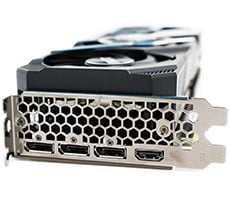
Inside the box is an oversized Quick Installation Guide that covers the basics of the entire setup, from installing the cards themselves to operating the water-cooling kit. The manual is generic and outdated with 6800 GT screens taken from a Windows XP box, and doesn't cover anything specific regarding the setup of the water-cooling kit. This is relegated to the Quick Installation Guide, but we feel that a kit like this deserves better. Thermaltake's online manual does the job for the most part, but is more geared towards CPU blocks rather than graphics and the onus is on ECS to make the user feel more comfortable and knowledgeable about their installation, especially when water and electricity are involved. GeForce 9800 GTX+ cards are as long as it gets, with two 6-pin power connectors at the end, and dual DVI-I ports with S-Video at the other. Although lengthy, the cards are deceivably light thanks to the ThermalTake TMG ND4 VGA Coolers that were used, consisting of a small copper block and quiet 60mm fan. A clear plastic shroud with a small impeller fan lit by a blue LED pushes some air over the top of the copper block and out the vent at the end, although the plastic shaft does not reach all the way to the end of the case, allowing air to remain inside the case. Water cooling consisted of a large copper plate sitting atop the GPU with adhesive pads between it and the memory and two marked rubber hoses protruding from each block, clearly labeled as IN or OUT. An issue that most users will run into is the total number of power connectors that the Hydra needs to run properly. Each card requires two 6-pin power connectors, while most modern PSU's probably only have two. To get the other two, you'll wind up using the power cables provided in the bundle. Each of these takes up two MOLEX plugs, four in total. Then add in the two fan cables and finally one more for the BigWater itself and you're looking at a total of 7 4-pin MOLEX and two 6-pin power cables. This is on top of any other fans or devices that are being powered. The 9800 GTX+ supports two SLI connectors, allowing for 3-Way SLI (or more) with a compatible motherboard and drivers. A small cable runs from the card to the bracket, to light a small LED there alerting the user that the card is powered. A major problem we found when inspecting the cards concerned the front end of the copper plate. Seen on both cards, the plate curls away slightly towards the front, lacking any contact with the chips at all. |
| Thermaltake Bigwater 760is |
Thermaltake's BigWater series of coolers has been commerically available for some time now, and has generally received some high marks for its cooling capabilities. Although adding in water-cooling to a system is not a novel idea, typically the base of the unit remains external. The BigWater 760is included with the Hydra has the advantage of being installed internally, using two empty 5 1/4" bays.
The main unit consists of a pump, reservoir, radiator and top-mounted 120mm fan, that is illuminated by a blue LED when powered. All of this is masked by a black front plate with a small mesh ventilation opening used for air intake. Air is pushed downwards by the fan through the all-aluminum radiator, which uses dimpled tube technology, swirling the coolant within the radiator in order to increase thermal transfer. While we liked the HYDRA labeling and the blue glow emanating from the vent, we once again feel that there's a missed opportunity here. So much of the space is used for company or product logos when it could have been used for temperature readouts or other controls. We're also a bit concerned that the warm air, once expelled downwards and out from the BigWater radiator, has nowhere else to go but rise back upwards into the unit. At the rear of the BigWater 760is we find the P500 pump and reservoir, which should hold up to 130cc of coolant. The P500 uses ceramic bearings which should extend the lifespan of the pump and has a maximum pumping capacity of 500L/hr. Like everything else, it needs a 4-pin power connector to run properly, and also comes with a three-pin motherboard connector and speed control dial that will allow the user to monitor and adjust the fan speed as they like. As stated before, we would have preferred to be able to control the fan speed externally, such as lowering the fan speed during low-performance usage in order to keep noise output down. The way it stands now, you would need to open the case each time you want to change speed settings. The entire kit contains the Thermaltake BigWater 760is with two sets of UV-reactive neon-green tubing attached to the pump, a 500cc bottle of ethylene glycol based coolant, and a plastic squirt bottle used to transfer said coolant from storage to the reservoir. Each tube is marked either "out" or "in" to prevent confusion when attaching them to the 9800 GTX+ cards, and are fitted with medical-grade "Y" splitters. While the current configuration is meant to be connected to these two cards only, the Thermaltake BigWater 760is can easily support additional cooling components, such as CPU or Northbridge water blocks. Additional units can be purchased directly through Thermaltake on their website. |
| Installing the ECS GeForce 9800 GTX+ Hydra |
Thermaltake recommends installing the unit in the upper bays of a case in order to keep the reservoir higher than the waterblocks, but with a full assortment of drives already installed, we had to think otherwise. Thus, we removed the top one of the two drive cages in the Nine Hundred to seat the BigWater 760is - a tedious routine that we clamored about in our earlier review. This led us to our first problem: the length of the BigWater plus the length of the 9800GTX+ cards made installation along the middle cage impossible. We decided to try the bottom cage and also ran into similar issues with the BigWater running into the motherboard's headers there. Blue LEDS on both cards and the BigWater plus UV-reactive coolant can really add some bling to even the most tricked-out PC, but we have to say that a kit like this really isn't for the faint of heart. Between installation conflicts and the concerns dealing with water-cooling, you really have to ask yourself if it's really worth all of the hassle. |
| Test System and 3DMark06 Results | ||||||||||||||
|
HOW WE CONFIGURED THE TEST SYSTEM:
We tested all of the graphics cards used in this article on either an ASUS Striker II Formula nForce 780i SLI motherboard powered by a Core 2 Duo E6800 dual-core processor and 2GB of low-latency Corsair RAM. The first thing we did when configuring the test system was to enter their BIOS and set all values to their "optimized" default settings. Then we manually configured the memory timings and disabled any integrated peripherals that wouldn't be put to use. The hard drive was then formatted, and Windows Vista Ultimate and the latest DX10 update was installed. When the installation was complete, we then installed the latest chipset drivers available, and installed all of the other drivers necessary for the rest of our components. Auto-Updating and System Restore were also disabled and the hard drive was defragmented.
A single ECS GeForce 9800 GTX+ card seems to be running along well enough on its own as it meets the performance of Sapphire's Radeon HD 4870 head-on, and only behind the lead GeForce GTX 260 by 600 Marks. Throw in that second card in SLI, and ECS grabs the top spot all for itself. The SLI numbers are ~1300 Marks higher than a single card mustered - roughly a 10% increase in overall performance.
In the individual shader models scoring, we see that the 9800 GTX+ is still sitting pretty with the second highest numbers in Shader Model 2.0 testing, yet only fourth best with the Shader Model 3.0 benchmarks. It was quickly surpassed by the two latest higher-end releases from ATI - the Radeon HD 4870 and the more similarly priced HD 4850. Back to SLI testing, we saw little if any improvement in the SM2.0 results, but SM3.0 really took off blowing well past the HD 4870 and GeForce GTX 260 numbers, and topping out just shy of 8000 Marks. |
| 3DMark Vantage | ||||||
Both NVIDIA and ATI find their latest generation of cards handling the Vista-only 3DMark Vantage much better than previous ones. Unfortunately for ECS, the 9800 GTX+ falls in with the latter, and while it does take the lead amongst the 88xx/98xx cards as well as the HD 38xx series, its performance was far off that of the HD 4800 series of cards as well as the GTX 260. On the bright side, this is the Hydra were talking about here, so its assumed that you'll be running two 9800 GTX+ cards in tandem. In doing so, the results were greater than a 50% increase over original scores, just nipping the GTX 260 for the overall lead.
The individual GPU tests don't really tell us anything new about the performance of our cards that the overall score didn't. From bottom to top, we've got the Radeon HD 3800 series, followed by a close grouping of 8800 and 9800 cards. Out of this stack, the 9800 GTX+ reigns supreme, but doesn't make much of a dent against the HD 48xx cards, nor the GTX 260. Once we got to the SLI testing, we saw some dramatic increases in the frame rates - pretty much double the original scores. |
| Half-Life 2: Episode 2 | ||||||
In the first non-synthetic benchmark, a single GeForce 9800 GTX+ ran numbers in Half Life 2 that were almost on par with an overclocked HD 4850 from HIS, with only a frame or two per second separting the two. The biggest concern for these two cards would be the 25% percent hit that they took when we switched over to the higher resolution. When running in SLI, the performance at 1280x1024 didn't scale all that well, as we were only able to pick up and additional 5 fps, but it did lessen the gap between a single card and the GTX 260 or HD 4870. Better yet, there wasn't the same pronounced dropoff when running at 1600x1200, where the ECA Hydra setup and GTX 260 were running at a virtual tie. |
| Company of Heroes: Opposing Fronts | ||||||
|
ATI's cards, whether they be the older 38xx series or the newer 48xx series just don't seem to handle Company of Heroes titles very well. This is not new news, although even we were surprised by the HD 4870 getting handily beat by the plain jane GeForce 9800 GT - at least at 1280x1024. What we weren't expecting was the way the 9800 GTX+ handled this game, whether or not we had them running in SLI. A single 9800 GTX+ card was able to beat or meet the GTX 260, depending on the resolution, and two cards offered a significantly higher frame rate. |
| Crysis | ||||||
Crysis restored at least part of the lost faith in the set of Radeon cards, as the HD 4870 rebounded to the point of being directly competetive with the GeForce 9800 GTX+ and GTX 260 cards. At 1600x1200, the frame rates of the 9800 GTX+ took a severe hit, falling well off the pace set by the HD 4870 resulting in performance numbers more along that of the HD 4850. SLI testing once again proved to be a great boon for the ECS Hydra Pack. Performance numbers went up appreciably, with frame rates at 1600x1200 better than any other single card could achieve at 1280x1024. |
| Enemy Territory: Quake Wars | ||||||
|
ET: Quake Wars shows a clear progression moving from the HD 3850 up to the HD 4870, but a much thigns were murkier on NVIDIA's side. The "newer" 9800 GT came in behind the others, our overclocked 8800 GT nudged past the 8800 GTS 512, and the 9800 GTX+ and GTX 260 each came out on top, depending on what resolution settings we had tested at. The gains we attained while running two 9800 GTX+ cards in SLI were mostly negligible at 1280x1024, where me may be getting more CPU- than GPU-bound, but at 1600x1200 we picked up an additional 20fps. That's close to a 30% swing in our favor, and almost exactly the same frame rate that we had recorded at the lower resolution. |
| Overclocking Results | ||||
We set out to raise each speed until we reached any kind of instability, benchmark crash, or other artifacting noticeable on screen. Starting out at 740 MHz, 1836 MHz, and 1100MHz, respectively, we bumped the speeds up one component at a time until we either crashed or saw graphic anomalies in the benchmark routines. With the extravagant cooling provided on the ECS Hydra, we hoped for some big numbers since temperatures would be held in check. With our overclocked cards running stable, we decided to give 3DMark Vantage another run-through to see what kind of frame rate increases we might be looking at.
3DMark Vantage's GPU tests showed over a 4 frame per second advantage while overclocked, - roughly equivalent to a 12% increase in overall performance. We also measured temperatures while running at idle (37 degrees F) and while under load during our overclocking routines (44 degrees F), and saw only a 7 degree difference. Conclusion: We're running some of the fastest numbers in our benchmarks with the ECS GeForce 9800 GTX+ Hydra without the extra thermal challenges associated with higher clock speeds. |
| Power Consumption and Thermals | ||||
|
We'd like to cover a few final data points before bringing this article to a close. Throughout all of our benchmarking and testing, we monitored how much power our test systems were consuming using a power meter. Our goal was to give you an idea as to how much power each configuration used while idling and under a heavy workload. Please keep in mind that we were testing total system power consumption at the outlet here, not just the power being drawn by the motherboards alone.
You would have to expect that two cards plus the BigWater pump plus all of those MOLEX connectors we plugged in would add up. At idle, the total system draw was at 217 Watts, well over all of the other cards except the Radeon HD 4870, which is a mere 20W back. Under load, however, the total consumption rate nearly doubles, sucking down a hefty 384 Watts. Clearly, purchasing the ECS GeForce 9800 GTX+ Hydra will not only cost you up front, but will continue to draw power, and money, from you down the road.
One of the main selling points, other than pure performance, would have to be the quieter, cooler operation of the two 9800 GTX+ cards and the Hydra didn't disappoint. Idle temps were a chilly 37 degrees Fahrenheit, and when measured again while under load only raised to 44 degrees. That's close to the same temperature as the two other GeForce cards while at idle. Looking at ATI's camp, the HD 4870's temps nearly double that of the ECS Hydra. If there's one thing that might detract from this is the noise output of the Thermaltake BigWater 760is. Even on the low setting, the fan does make a bit more noise than a single card's cooler might produce, although probably not as much as two cards could have. It's a small price to pay for this kind of performance. |
| Performance Summary and Conclusion | ||||
Performance Summary: A single GeForce 9800 GTX+ isn't bad to have around - its performance puts it more or less on terms with an AMD Radeon HD 4850, a card that comes with a similar price tag. Put two of these together in SLI and you've got more than a match for just about any single GPU based card out there, and even more so after bumping up the core, shader, and memory clock speeds. 3DMark Vantage overall scoring was spot-on with the GeForce GTX 260, while individual GPU Test frame rates were close to 25% better with the ECS Hydra. Most, if not all, of the gaming benchmarks were heavily skewed in the Hydra's favor as well with the delta between it and the closest runner-up ranging from 10% in ET: Quake Wars up as high as 33% in Company of Heroes.
Our Final Verdict: In short, we love the performance of the ECS GeForce 9800 GTX+ Hydra, yet we just can't abide by all of the little nuances that take away from making this a "break-out" product. Innovation is one thing, but quality control must be at the forefront of the minds at ECS if they truly want to compete with the upper-tier enthusiast-class manufacturers. |