|
|
| Introduction and Features |
It is hard to believe that it has been almost two full years since NVIDIA released a new flagship chipset for the AMD platform. Since the nForce 590i SLI's official release in May of 2006, NVIDIA has introduced a handful of mid-range and more affordable chipsets for the AMD-platform, but the 590i SLI was it at the high-end, despite AMD's release of their quad-core Phenom processors and competing 7-series chipsets. Early this year while out at CES, we told you about NVIDIA's plans to mix things up at the high-end of their AMD chipset line-up with the IGP-equipped nForce 780a SLI, but it has taken quite a bit of time to bring that to market. Today, we present to you three nForce 780a SLI-based motherboards (two from Asus and one from MSI), that are sure to pique the interest of all of the AMD fans out there and maybe a few mainstream system builders as well. For the first time since the Phenom launch, AMD fans will now be able to pair up NVIDIA's flagship graphics configurations with an AMD CPU and exploit all of the features inherent to both. Today isn't just about the nForce 780a SLI, however, as NVIDIA is also disclosing more details regarding other members of the nForce 700a family as well.
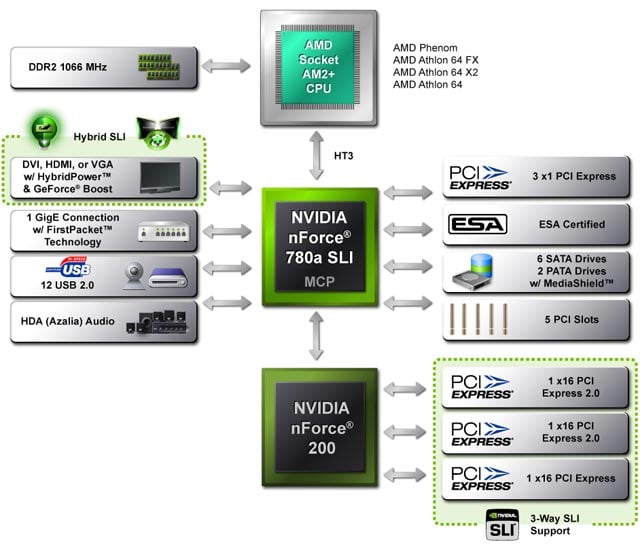
As we've already mentioned, the flagship model in the nForce 700a series of chipsets is the 780a SLI. We've got a high-level overview of the chipset below and then we'll talk a bit about the nForce 750a SLI as well.
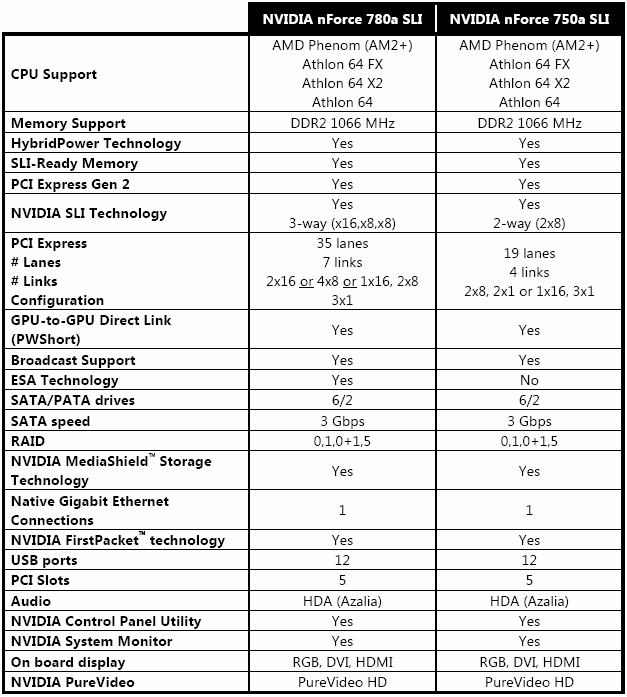
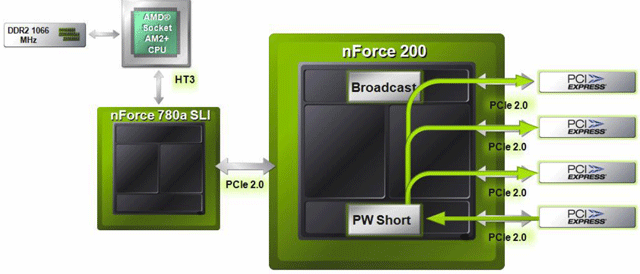
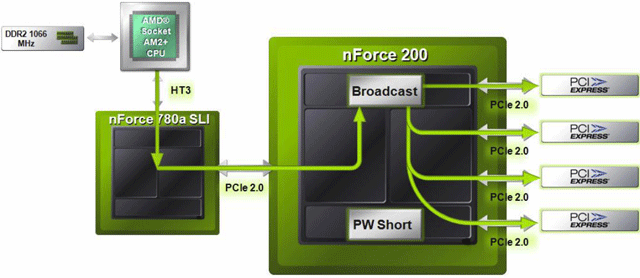
In terms of features, the nForce 780a SLI and nForce 750a SLI don't differ very much. Basically, the only differences between the two chipsets are in their total number of PCI Express lanes / links and support for ESA. This means the nForce 750a only two-way SLI, which is plenty for the vast majority of users, but other than that the two chipsets are quite similar. As we've noted in previous articles, NVIDIA is utilizing their NF200 chip to bring PCI Express 2.0 support to a few of their high-end chipsets. In addition to offering 32 PCI Express lanes, however, the NF200 chip also features some proprietary NVIDIA technologies dubbed PW Short and Broadcast. Essentially, what NVIDIA has done with the NF200 is build-in a couple of "fast paths" inside the switch device, dedicated and tuned to optimizing mulit-GPU SLI transaction performance, both back to the root CPU complex and peer-to-peer between GPUs Broadcast Mode and PW Short: |
| Asus M3N-HT Deluxe |
We got our hands on three new retail-ready nForce 780a SLI-based motherboards for the purpose of this round-up, the Asus M3N-HT Deluxe shown here, the Asus CrossHair II Formula, and the MSI K9N2 Diamond.
|
| Asus CrossHair II Formula |
|
| MSI K9N2 Diamond |
The K9N2 Diamond is MSI's flagship socket AM2+ motherboard. Like the Asus M3N-HT Deluxe and CrossHair II Formula, the K9N2 Diamond supports 3-way SLI and exploits all of the features inherent to the nForce 780a SLI chipset, but MSI definitely took a different approach than Asus in the design of this board. MSI includes a nice assortment of accessories with the K9N2 Diamond. Along with the board, MSI also throws in a variety of SATA and other drive cables, including an eSATA case bracket with power and data cables. The usual manuals, drivers, and custom I/O shield were included as well, along with a case bracket with additional USB and Firewire ports and a trio of soft SLI bridge connectors. Perhaps the most interesting accessory, however, was the MSI branded SoundBlaster X-Fi Extreme audio card. This MSI-branded X-Fi card uses the same native PCI Express CA0110 audio chip as Creative's X-Fi Extreme Audio retail cards. The MSI K9N2 Diamond's BIOS is fairly extensive and falls somewhere in between the M3N-HT Deluxe and CrossHair II Formula in terms of options. There are a myriad of overclocking related tools listed in the Cell Menu section of the BIOS, which include voltage, frequency and multiple adjustments, and options for tuning memory and integrated peripherals are available as well. |
| PCMark Vantage | ||||
We ran all three of the nForce 780a SLI based motherboards we showed you earlier, through Futuremark’s latest system performance metric built especially for Windows Vista, PCMark Vantage, using both a discreet graphics card and the 780a SLI's IGP. PCMark Vantage runs through a host of different usage scenarios to simulate different types of workloads including High Definition TV and movie playback and manipulation, gaming, image editing and manipulation, music compression, communications, and productivity. Most of the tests are multi-threaded as well, so the tests can exploit the additional resources offered by a quad-core CPU.
PCMark Vantage told a very interesting story. According to this benchmark suite, the nForce 780a SLI is a few percentage points faster or right on par with the AMD 790FX chipset in every test with the exception of 'Communications' where the nForce boards blew everything out of the water. Usually this particular test scales with CPU performance, but it ran exceptional well on the nForce platform for some reason. Also note, system performance using the IGP isn't adversely affected in most tests. Only the 'Gaming' (which is to be expected) and the 'Memories" tests show a sharp drop off with the IGP. |
| LAME MT and Kribibench | ||||||||
In our custom LAME MT MP3 encoding test, we convert a large WAV file to the MP3 format, which is a popular scenario that many end users work with on a day-to-day basis to provide portability and storage of their digital audio content. LAME is an open-source mid to high bit-rate and VBR (variable bit rate) MP3 audio encoder that is used widely around the world in a multitude of third party applications.
In this test, we created our own 223MB WAV file (a hallucinogenically-induced Grateful Dead jam) and converted it to the MP3 format using the multi-thread capable LAME MT application in single and multi-thread modes. Processing times are recorded below, listed in seconds. Once again, shorter times equate to better performance.
For this next batch of tests, we ran Kribibench v1.1, a 3D rendering benchmark produced by the folks at Adept Development. Kribibench is an SSE aware software renderer where a 3D model is rendered and animated by the host CPU and the average frame rate is reported. We used two of the included models with this benchmark: a "Sponge Explode" model consisting of over 19.2 million polygons and the test suite's "Ultra" model that is comprised of over 16 billion polys.
The two Kribibench tests we used told us two things - the three nForce 780a SLI-based motherboards we tested all perform similarly with, and without, the IGP, and using the IGP lowers performance by a fraction of a frame per second. |
| Cinebench R10 and 3DMark06 | ||||||||
Cinebench R10 is an OpenGL 3D rendering performance test based on Cinema 4D. Cinema 4D from Maxon is a 3D rendering and animation tool suite used by 3D animation houses and producers like Sony Animation and many others. It's very demanding of system processor resources and is an excellent gauge of pure computational throughput.
This is a multi-threaded, multi-processor aware benchmark that renders a single 3D scene and tracks the length of the entire process. The time it took each test system to render the entire scene is represented in the graph below, listed in seconds. Cinebench R10 showed very little variation between the AMD-powered systems. And, once again, using the IGP had only a marginal - if any - impact on performance.
3DMark06's built-in CPU test is a multi-threaded DirectX gaming metric that's useful for comparing relative performance between similarly equipped systems. This test consists of two different 3D scenes that are processed with a software renderer that is dependent on the host CPU's performance. Calculations that are normally reserved for your 3D accelerator are instead sent to the CPU for processing and rendering. The frame-rate generated in each test is used to determine the final score.
3DMark06 tells essentially the same story as Cinebench and the Kribibench results on the previous page. The various nForce 780a SLI boards we tested all performed similarly, as did the AMD 790FX. And using the IGP had very little impact on performance - at least in this test. |
| Gaming: Crysis and F.E.A.R. | ||||
For our next set of tests, we moved on to some in-game benchmarking with Crysis and F.E.A.R. When testing motherboards or processors with Crysis or F.E.A.R., we drop the resolution to 800x600, and reduce all of the in-game graphical options to their minimum values to isolate CPU and memory performance as much as possible. However, the in-game effects, which control the level of detail for the games' physics engines and particle systems, are left at their maximum values, since these actually do place some load on the CPU rather than GPU.
There are two things we can ascertain from the results above. While using a discreet graphics card, the nForce 780a SLI put up slightly better scores than the AMD 790FX. We suspect coupling an NVIDIA graphics card with an NVIDIA chipset, which usually increases performance somewhat, is the root cause of the increases seen here. We also see that the nForce 780a SLI IGP is able to run, and put up respectably frame rates, in both games at these relatively low settings. If you'd like to see how the IGP fared in more taxing situations, we're going to cover that in a couple of pages. |
| Video Playback Performance | ||||
We also did some quick testing of the nForce 780a SLI's video processing engine as it is implemented on the Asus M3N-HT Deluxe, in terms of both image quality and CPU utilization with some HQV and H.264 playback tests.
Next we conducted a test using an H.264 encoded movie clip which is available for download from NASA's HD showcase website. The CPU utilization data gathered during this testswas taken from Windows Vista's built-in Performance Monitor. The graphs show the CPU utilization for the nForce 780a SLI IGP while playing back the 1080i QuickTime clip.
|
| Hybrid SLI Testing: GeForce Boost | ||||
As we mentioned earlier, one of the nForce 780a SLI's main features is support for Hybrid SLI, when paired up with a compatible graphics card. The new modes available with Hybrid SLI are "GeForce Boost" and "Hybrid Power". With GeForce Boost, an entry level graphics card (currently the 8400 GS or 8500 GT) can be paired up with the nForce 780a SLI IGP for increased performance, or a high-end graphics card (currently the 9800 GTX or 9800 GX2) can be used for more demanding 3D applications while the IGP is used in less taxing scenarios.
GeForce Boost with the 8500 GT seemed to work quite well for increasing 3D performance. As you can see in the results above, pairing the discreet card and IGP together resulted in significantly increased performance in F.E.A.R. and 3DMark06. Crysis showed a slight gain, but that was likely due to the benchmark's margin of error and not GeForce Boost mode in and of itself.
For increased power savings, NVIDIA recommends users connect their display to the nForce 780a SLI IGP's video output even when a more powerful graphics card is installed in the system. The frame buffer from the more powerful card is copied over to the IGP's shared memory, where it is then output to the screen. NVIDIA claims there is only a very minor performance penalty associated with the process, so we decided to do a quick test to see for ourselves. As the results above show, there is a small hit when using the motherboard's video output. We should note, however, that there is also a significant power savings using the motherboard's output, as we'll show you next. |
| Hybrid Power, Power Consumption | ||||
Before we bring this article to a close, we'd like to cover a few final data points. Throughout all of our benchmarking and testing, we monitored how much power our test systems were consuming using a power meter. Our goal was to give you all an idea as to how much power each configuration used while idling and under a heavy workload. Please keep in mind that we were testing total system power consumption at the outlet here, not just the power being drawn by the motherboards alone.
|
| Our Summary and Conclusion | ||||
Performance Summary: All three of the motherboards we tested based on NVIDIA's new nForce 780a SLI chipset performed well throughout our entire battery of tests. The Asus M3N-HT Deluxe, CrossHair II Formula, and MSI K9N2 Diamond all put up scores on-par with or better than a Gigabyte motherbaord based on AMD's own 790FX chipset. The nForce 780a SLI IGP also performed well for an integrated solution and Hybrid Power and GeForce Boost worked as advertised. We saw solid scaling with GeForce Boost enabled and idle power consumption dropped considerably with Hybrid Power mode enabled.
NVIDIA may be a little late to the socket AM2+ game with the nForce 780a SLI chipset, but they have produced a solid high-end offering with some innovative features, nonetheless. Although we've had a relatively short time to pull this article together and haven't had as much experience with the boards as we would have liked, we think the nForce 780a SLI is going to be solid chipset for the AMD platform. We did experience some minor issues related to display detection when switching between the IGP and a discreet graphics card, but we suspect they'll be ironed out in short order with future BIOS and driver revisions.
|