|
|
| The Gigabyte GeForce 8600 GTS with Silent Pipe 3 | ||||||
|
DVI Output
Adapter/Cable Bundled
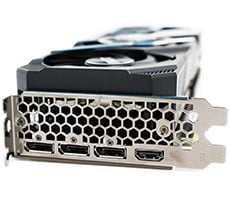
Features The GIGABYTE GV-NX86S256H is built around a NVIDIA GeForce 8600 GTS GPU. GIGABYTE keeps their version of the GeForce 8600 GTS clocked at reference specifications, running the GPU at 675MHz and the memory clock at 1.008GHz. The card comes with 256MB of DDR3 memory with a 128-bit interface that delivers a maximum bandwidth of 32GB/s. The GV-NX86S256H is a Dual DVI-I solution that supports a peak resolution of 2560x1600. There is also a connection that marries up to the included HTDV/Video Out block to deliver Y, Pb, Pr and S-Video outputs to accommodate various TV-Out environments. Upon closer inspection, you may have also noticed that this card was designed with no supplemental power requirements even though a power adapter was provided in the retail package. During normal testing, we encountered no issues with the GV-NX86S256H drawing all of its power from the PCI Express slot, however, when we dropped it into an ASUS M2N32 WS Pro motherboard along side a primary GeForce 8800GTX card, the system would not POST and the power alarm of the 8800GTX was triggered. We're confident our Tagan 1000w power supply was having no issues powering the system, so we suspect a power drain across the two PCI Express slots was causing the issue. We encountered no issues when we installed either MSI card nor a GeForce 7600GT, so we have to wonder if it would have been best for the GB 8600GTS to come with a supplemental power option. As a noiseless graphics solution, GIGABYTE had to equip the card with an adequate sink that will keep the components running within normal thermal limits. In this case, they utilized their Silent-Pipe III which combines heat-pipe technology into a hefty heat-sink assembly that appears up to the task. Essentially, the dual-slot solution ports itself outside the rear of the case, utilizing flat fingers to wick cooler air into the case and along the cooler's surface. Using a unique pattern of notches and bends, the design encourages the airflow to be stirred up or become more turbulent, which is supposed to increase circulation across the surface area. For maximum cooling potential, the Silent-Pipe 3 was designed so 90% of the surface area is connected with the heat-pipe. |
| The MSI NX8500GT TD256E | ||||||
|
NVIDIA UltraShadow II Technology
NVIDIA PureVideo Technology The MSI NX8500GT TD256E is a budget class GeForce 8 series card with a GeForce 8500GT GPU at its core. MSI sticks close to the reference model, clocking the GPU at an expected 450MHz and the 256MB of DDR2 at 400MHz (800MHz DDR). The card comes with a small circular cooler and sports no additional ramsinks. The card is equipped with a single DVI-I port and a VGA port. The card requires no supplemental power, drawing all of its power from the PCI Express x16 slot. With a 128-bit interface, the NX8500GT TD256E provides a maximum bandwidth of 12.8GB/s, while the GPU sports a fill rate of 3.6 billion pixels/s. The NX8500GT TD256E fully supports DirectX 10, however, bridged SLI is not an option. Teaming two of these budget cards together requires scene data to be sent over the PCI Express interface. This model supports a maximum resolution of 2048x1536 over its VGA connection or 2560x1600 on DVI. |
| The MSI NX8600GT T2D256E | ||||||
|
NVIDIA UltraShadow II Technology The MSI NX8600GT T2D256E is a major step up from the NX8500GT TD256E, adding an overclocked GeForce 8600GT GPU to the mix as well as 256MB of GDDR3 memory. The GPU is clocked 40MHz higher than the reference design, running at 580MHz while the memory runs 200MHz higher at 1.6GHz (DDR). This gives the NX8600GT T2D256E a peak fill rate of 8.6 Billion pixels/s and a memory bandwidth of 25.6GB/s, both of which are a significant increase compared to the 8500GT. This model is a Dual-Link DVI solution that utilizes adapters to convert to VGA if needed. The card also sports TV-Out functionality for HDTV and Analog connections. The cooler is not beefy, but it does cover the RAM as well as the GPU, unlike the cooler provided on the NX8500GT TD256E. This model also supports DirectX 10 and SLI, for those looking to tag team two 8600GTs for added performance. |
| Performance Comparisons with 3DMark06 v1.1.0 | ||||||||||||
|
Hardware Used:
NVIDIA Forceware v93.71/158.22
Benchmarks Used:
DirectX
OpenGL
In all three segments of 3DMark06 testing, each card scaled similarly. The Gigabyte GeForce 8600GTS was the front runner, with the ATI Radeon X1950 Pro a close second in the Default and SM 3.0/HDR test. With SM 2.0 testing, the MSI NX8600GT took the second spot behind the 8600GTS, with the Radeon X1950 Pro easily topping the 8500GT and 7600GT. |
| Performance Comparisons with Half Life 2: Lost Coast | ||||||
|
With the built-in Half-Life 2: Lost Coast test, the Radeon X1950 Pro took the rest of the cards to task, with the Gigabyte GeForce 8600GTS taking a distant second spot. When comparing all of the NVIDIA based models, each card's performance scaled as we would have expected, with the NX8500GT being the slowest of the bunch, even behind the 7600GT. |
| Performance Comparisons with F.E.A.R | ||||||
With F.E.A.R.'s integrated test, the Radeon X1950 Pro continued to return the best results, topping the GIGABYTE GeForce 8600GTS by 10 FPS at 1280x960 and 7 FPS at 1600x1200. The MSI NX8600GT managed to top the GeForce 7600GT by an average of 4 FPS while the 7600GT topped the MSI NX8500GT by an average of 16 FPS. |
| Performance Comparisons with Prey | ||||||
With Prey, we continued to see the ATI Radeon X1950 Pro return the best results, this time topping the GIGABYTE GeForce 8600GTS by 10 FPS on average. The MSI NX8500GT and the GeForce 7600GT struggled the most, with the 7600GT nearly doubling the NX8500GT's results. |
| Performance Comparisons with Quake 4 | ||||||
With Quake 4 testing, the GIGABYTE GeForce 8600GTS managed to narrow the Radeon X1950 Pro's lead, but it couldn't quite make the top spot. This time the 8600GTS trailed the Radeon by roughly 4 FPS. Additionally, the GeForce 7600GT and MSI NX8600GT kept things close, with the NX8600GT averaging a 3 FPS lead. Predictably, the NX8500GT was the slowest of the group, barely breaking 20 FPS at 1280x1024. |
| Overclocking | ||||
Rounding out our testing, we tried our hand at some overclocking to see how each of these cards faired. Once the optimal settings were found, we ran our Quake 4 test once again to show what performance gains could be uncovered.
The GIGABYTE GeForce 8600GTS overclocked fairly well, managing to add 85MHz to the GPU clock and 84MHz to the memory. With a 12% gain in GPU speed and 8% gain in memory speed, we recorded performance increases of 10-11% at both resolutions. This brought the Gigabyte 8600GTS to the same performance level as the ATI Radeon X1950 Pro. The MSI NX8600GT also posted decent results, tacking on 70MHz to the GPU speed and 50MHz to the memory speed. This resulted in a 12% boost in GPU clock speed and closer to 6% in memory speed. Overall performance improvements equalled 9%, adding 3-4 FPS to each resolution tested, falling just shy of the GeForce 8600GTS' stock scores. Finally, we wrapped things up with the MSI NX8500GT adding a whopping 242MHz to the GPU clockspeed and 13MHz to the memory speed. In the end, this resulted in performance gains of 2-4 FPS, which equalled 17% at 1280x1024 and 14% at 1600x1200. |
| Performance Summary and Conclusion | ||||||||||||
|
Performance Summary: With FutureMark’s synthetic 3DMark06 benchmark, the GIGABYTE GeForce 8600GTS topped all of the cards tested, with the ATI Radeon X1950 Pro finishing a close second. However, the lead shifted to the ATI Radeon X1950 Pro exclusively with the remainder of our actual in-game tests. The biggest deltas were with Half-Life 2: Lost Coast, where the ATI Radeon X1950 Pro won by a wide margin, with the GIGABYTE GeForce 8600GTS trailing by an average of 40 FPS. With the rest of the benchmarks, the ATI Radeon X1950 Pro’s lead was more nominal, averaging 7-8 FPS overall. The MSI NX8500GT and MSI NX8600GT both performed predictably compared to the GeForce 8600GTS, however, the NX8500GT could not match the performance of the elder GeForce 7600GT.
GIGABYTE GV-NX86S256H Of the three GeForce 8 series cards tested, this was the highest performing, as expected. Additionally, it is also the highest priced, weighing in at $198.99. For that price, users get a premium gaming title in Supreme Commander, a Silent-Pipe III cooler and a card that can support DirectX 10 and SLI. However, with the current state of DirectX 10 gaming (ie nearly nonexistant), the ATI Radeon X1950 Pro is still an attractive option. The X1950 Pro was the decisive winner of all of the gaming benchmarks, supports CrossFire and comes in as low as $145.99 ($159.99 for the model we tested). Considering the added cost for a silent cooling solution and a current gaming title, some buyers may be better off with a model that follows NVIDIA’s reference design if DirectX 10 is a must, as that too will cost a bit less in the long run and users can apply that savings to a second if the need arises.
MSI NX8600GT T2D256E In regards to the MSI NX8600GT T2D256H, we find the same argument we made with the GIGABYTE GeForce 8600GTS applies here, perhaps even more so. This model was slower than the GeForce 8600GTS and often fell in slightly faster than a GeForce 7600GT. Factor in a price point of $156.99 and the ATI Radeon X1950 Pro still looks like a viable alternative at this stage of the game. If DirectX 10 is an absolute necessity, then both NVIDIA 8600 series models have something to offer, with the GT easily matching GeForce 8600GTS' performance when overclocked. However, if you are more along the lines of a casual gamer that doesn’t care too much about DirectX 10, higher performing alternatives exist at an excellent price.
MSI NX8500GT TD256E Clearly, the MSI NX8500GT TD256H is geared for basic gaming at lower resolutions. In each of our tests, this model was the slowest of the bunch, and stuggled to deliver playable frame rates at 1280x1024 with anti-aliasing and anisotropic filtering enabled. This card should do nicely with medium quality settings at 1024x768, however, which raises the question whether a DirectX 10 ready video card is really an advantage at this performance level. If users are not concerned that much about higher-levels of image quality and just want to enjoy an occasional game, DirectX 10 support probably won't factor into their buying decision at this point in time. With that said, a mere $6 more will get you a GeForce 7600GT which will deliver higher frame rates and should enable users to run slightly higher image quality settings as well.
In the end, it’s pretty clear that there is a lot to consider with all three of the cards we’ve looked at here today. It’s not a clear cut decision and price and features all need to be taken into account when deciding which card is right for you. What’s also unproven is how all of these cards will perform with a full-blown DX10 title, which is another factor to keep in mind. Overall, when assessing the performance, features and cost of the three GeForce 8 series cards tested, the MSI NX8600GT TD256E proved to offer the best bang for the buck, but don't forget about the ATI Radeon X1950 Pro if you're looking for better in-game performance at a similar price point. |