|
|
| Introduction and Product Specifications | |||||||
With Microsoft Vista and DirectX 10 poised to flood the mainstream market, those looking to take advantage of all of the new OS's capabilities will need a quality graphics solution to appreciate new graphical features and eventually next generation gaming. Currently, the only DX10 ready graphics cards available come in the form of NVIDIA's GeForce 8800 series, while ATI's DX10 solution is still looming off in the distance. At this stage of the game, NVIDIA's GeForce 8800 comes in two flavors, the high-end GeForce 8800GTX and the slightly scaled down GeForce 8800GTS. Some may balk that there are only two DX10 cards currently offered on the market today and normally we might agree that the more choices the better, however, after our in-depth coverage of the GeForce 8800's initial launch, it's hard not to be impressed with what NVIDIA has delivered, even if it is the only DX10 solution available at this time.
Today, we are going to take a look at ASUS's take on the GeForce 8800GTX, the EN8800GTX. Following closely with NVIDIA's reference design, ASUS brings a potent graphics solution to market that is complemented with a well rounded retail package to help feed those insatiable gaming desires. In the pages ahead, we'll take a closer look at the EN8800GTX and evaluate its performance compared to a number of high-end cards currently available. We'll also take an approach to performance based on a system with a mid-range CPU to help the average user ascertain whether the purchase of a premium video card will pay full dividends in the end.
The EN880GTX's accessory bundle and packaging is comprehensive. Along with the card itself, ASUS dropped in some essentials and extras to complement the card nicely. To start, ASUS provided two CDs, one with drivers and the other including proprietary ASUS utilities, such as GameFace and LiveShow, which are further covered in the specifications above. Additionally, ASUS included a copy of 3DMark06 for personal benchmarking as well as two games, Ghost Recon: Advanced Warfighter and GTI Racing. The package comes with power adapters to convert Molex 4-pin to 6-pin PCI power connections, which require a total of four Molex leads from the PSU. There was also a DVI to VGA adapter for connecting the card to an analog monitor and an component video cable was included as well to support other types of mainstream HDTV connections. |
| Close Up: ASUS EN8800GTX/HTDP/768M | ||||
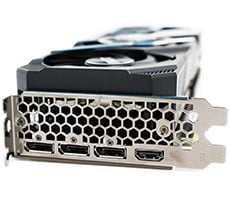
The ASUS EN8800GTX comes with a GeForce 8800GTX GPU (G80) at its core and doesn't deviate from NVIDIA's reference design. This PCI Express X16 based graphics card comes clocked at 576MHz and is backed by a hefty 768MB of GDDR3 memory. With the memory clocked at 1.8GHz (900MHz DDR), over its 384-Bit memory interface, the EN8800GTX can deliver an impressive 86.4GB per second of bandwidth. The power requirements of the EN8800GTX may be demanding for some, with a minimum of a 450W PSU being recommended that can deliver 30A to two 12V rails. With a peak draw of 185W, the EN8800GTX can consume as much power as a basic desktop PC, so a solid power source is key. If using the adapters included in the package, four Molex connectors are needed, which may pose an inconvenience to some with lesser PSUs. The PCB of the EN8800GTX is very long, measuring over 10" in length. This also can be a problem for those with a mid-ATX case as even larger cases can be a challenge with a card of this size. Case in point (no pun intended), when installing the EN8800GTX into larger tower such as the Thermaltake Tai Chi, installation of hard drives in the lower cage became an issue and all cabling needed to be removed in order to safely install the card without damaging it or surrounding components. It's not a huge issue, but extra consideration needs to be made before simply dropping the card into a system and firing it up. The EN8800GTX comes with two dual-link DVI connectors and also support for both TV and HD outputs as well. Another item of question, which we covered in our GeForce 8800GTX and GTS launch, was the card's two SLI connectors. At this stage of the game, either connector will work while the second is reserved for potential future technology where NVIDIA may implement enhancements that require a second bridge connection. We also recommend reviewing our launch article for full coverage of the GeForce 8800 series architecture, technology breakdown and vital statistics. |
| Performance Comparisons with 3DMark06 v1.1.0 | ||||||||||||
Starting with synthetic testing, we see that the ASUS EN8800GTX was the top performer of the single cards tested in each of the 3DMark06 components. With the Default test, the ASUS EN8800GTX even topped two GeForce 7900GTX's in SLI mode. In SM 2.0 testing, the scores were identical whether we were running one or two 8800GTX's in SLI with the GeForce 7900GTX SLI configuration trailing close behind. With SM 3.0 / HDR testing. the ASUS EN8800GTX was the clear winner, topping everything but the dual GeForce 8800GTX's in SLI mode. |
| Performance Comparisons with Half Life 2: Lost Coast | ||||||
Half-Life 2: Lost Coast proved to be a fairly level playing field for all of the cards tested. All scores were quite close, with the ASUS EN8800GTX coming in as the slowest of the bunch. Surely drivers will have an effect on the results, but what is more of a factor is CPU limitation. In all cases, each card had no real difficulty churning out the frames with this game. Surely, if our test monitors could exceed 1600x1200, we'd see more variations at higher resolutions. As it stand now, with a mid-range CPU, such as our Athon 64 X2 4600+, you won't gain much performance with this particular game unless you can push your monitor into much higher resolutions. |
| Performance Comparisons with F.E.A.R | ||||||
F.E.A.R. proved more taxing than Half-Life 2: Lost Coast at common resolutions, but we still saw limitations. In the single card configurations, the ASUS EN8800GTX was the top performer, rivaling dual GeForce 7900GTX cards in SLI mode. When we added a second GeForce 8800GTX to the mix for SLI testing, we saw very little measurable gains. At this juncture, if your LCD or CRT max resolution is 1600X1200, most current game engines won't be able to tax a pair of GeForce 8800 GTX cards in SLI. So unless, an LCD panel upgrade is in your future, save your pennies on that second GF 8800 GTX card, at least until higher-end DX10 titles hit the scene. |
| Performance Comparisons with Prey | ||||||
Our custom Prey demo proved the most taxing benchmark we've tested in this review thus far. With the ASUS EN8800GTX running solo, it ran over 20FPS faster that the GeForce 7950GX2 and topped the 7900GTX's in SLI mode by 3-7FPS. We managed to add an additional 22 FPS at 1280x1024 when running the ASUS EN8800GTX in SLI mode and 31FPS at 1600x1200, which still doesn't scale to its 2X potential and further demonstrates a degree of CPU limitation in this test. |
| Performance Comparisons with Quake 4 | ||||||
With our custom Quake 4 demo, we continued to see a similar trend, where the ASUS EN8800GTX was the faster card of all models tested. We also continued to see where the advantages of SLI are limited by the rest of the system. What is notable is how consistently the GeForce 8800GTX based card easily beats a GeForce 7950GX2 as well as two 7900GTX's in SLI mode. Running the ASUS EN8800GTX SLI mode registered minimal gains at the resolutions tested. |
| Overclocking: ASUS EN8800GTX/HTDP/768M | ||||
In our final segment, we spent a few moments tweaking the ASUS EN8800GTX to see what added power was hiding under the hood. In the end, our experience wasn't too bad.
Starting out with a core speed of 576MHz, we manage to add 49MHz, topping out at a stable 625MHz. With the card's GDDR3 memory, we also had good luck, managing to raise the speed from a default of 1800MHz DDR up 100MHz to 1900MHz DDR. Once the peak stable speeds were determined, we ran another round of F.E.A.R at both resolutions to see what additional performance we could gain. At 1600x1200, we added 6 FPS while tacking on 7 FPS at 1280x1024. To truly enjoy the full benefits of our efforts, higher resolutions and a more powerful CPU are surely going to help unlock the full potential of the ASUS EN8800GTX, but these overclocks did result in a minimum boost of 8%. |
| Performance Summary and Final Comments | ||||
Performance Summary: In virtually all tests, the ASUS EN8800GTX was the top performer. 3DMark06 did the best job at demonstrating the performance potential of all cards tested whereas Half-Life 2: Lost Coast showed us where other factors, like CPU speed for example, can hold back this powerhouse from realizing its fullest performance potential.
As we bring this review to a close, there are a couple of things to consider. First and foremost, there is no arguing that the ASUS EN8800GTX is built with the most powerful GPU currently available on the market today. This card barely broke a sweat in a mainstream system, and when it did appear to slow down a bit, all cards performed on roughly the same level, showing other factors were coming into play. At first we were ambivalent about these results, questioning whether a more powerful CPU should have been used or a monitor capable of higher resolutions. In the end, we decided that these tests do have merit. There is no doubt that with a premium class CPU installed, and/or a monitor capable of higher resolutions, we would be able to better demonstrate the differences between all of the cards tested and we would also be able to better show the benefits of SLI as well. But then again, that is what we did in our launch article back in November. With the results achieved in this particular article, we were able to address users with more affordable CPUs and monitors where resolutions don't reach much beyond 1600x1200. What this shows is that the ASUS EN8800GTX, or any GeForce 8800GTX for that matter, is a killer gaming card that is best enjoyed with other hardware in its class, otherwise you might be getting a bit too much muscle. It's like dropping the engine of a Ferrari in the common SUV, you'll get a lot of muscle but you won't be doing 300MPH any time soon. That is, until more DX10-class titles hit the market. In the mean time, what's more interesting perhaps is turning up AA and Aniso Filtering to the max and enjoying as much eye candy as you can get with this card. Selling in the ballpark of $595 - $629, the ASUS EN8800GTX doesn't come cheap, and we've see similar models for up to $60 or $80 less. Regardless, this card will pay handsome dividends when installed in a system with the power to complement it. On the flip-side of the equation, if the video card costs more than the hardware in your system, you might be throwing cash away. In that case, it may be wise to save a few dollars and set your sights on a card that might be more suited to your current hardware, such as an Asus EN8800GTS which sells for $200 less and will still bring potent DirectX 10 capabilities to your system.
|