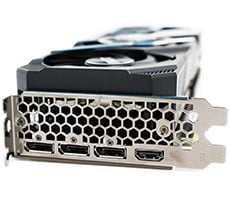
NVIDIA has enjoyed quite a bit of success the last couple of years thanks in part to its GeForce 6 and 7 Series graphics cards. Like every other company in the world, NVIDIA likes to ride its success as long as possible. In NVIDIA's case, this can be done with product refreshes. The most recent refresh brought us the GeForce 7950 GT, interestingly positioned between the 7900 GT and 7900 GTX.
What's attractive about the GeForce 7950 GT is that it doesn't cost much more than a 7900 GT yet it offers nearly the same performance of a much pricier 7900 GTX. Additionally, the 7950 GT sports 512MB DDR3 clocked at 1.4GHz (effective). The GPU core runs at a speedy 550MHz. Just like the 7900 GT and GTX, the 7950 GT also boasts 8 vertex shaders and 24 pixel shaders.
Today, we have a 7950 GT from Gigabyte in the labs to see just how well the new GeForce 7 Series card can perform. The GV-NX795T512H-RH features reference clock speeds and a Zalman cooler for a little differentiation outside of the typical reference design HSF assembly. Read on to find out more...

|
|
|
|
Features
|
Support Memory: 512MB DDR3
Video Output Function
- TV-out (S-Video Connector)
- Dual DVI Connector
256-Bit Memory Interface
|
Clocks:
- GPU: 550 MHz
- Memory: 1.4 GHz (effective)
|
|
|
|
Technical Specifications
|
|
NVIDIA CineFX 4.0 Shading Architecture
Vertex Shaders
-
Support for Microsoft DirectX 9.0 Vertex Shader 3.0
-
Displacement mapping
-
Geometry instancing
-
Infinite length vertex programs
Pixel Shaders
-
Support for DirectX 9.0 Pixel Shader 3.0
-
Full pixel branching support
-
Support for Multiple Render Targets (MRTs)
-
Infinite length pixel programs
Next-Generation Texture Engine
-
Accelerated texture access
-
Up to 16 textures per rendering pass
-
Support for 16-bit floating point format and 32-bit floating point format
-
Support for non-power of two textures
-
Support for sRGB texture format for gamma textures
-
DirectX and S3TC texture compression
-
Full 128-bit studio-quality floating point precision through the entire rendering pipeline with native hardware support for 32bpp, 64bpp, and 128bpp rendering modes
64-Bit Texture Filtering and Blending
-
Full floating point support throughout entire pipeline
-
Floating point filtering improves the quality of images in motion
-
Floating point texturing drives new levels of clarity and image detail
-
Floating point frame buffer blending gives detail to special effects like motion blur and explosions
NVIDIA Intellisample 4.0 Technology
-
Advanced 16x anisotropic filtering (with up to 128 Taps)
-
Blistering- fast antialiasing and compression performance
-
Gamma-adjusted rotated-grid antialiasing removes jagged edges for incredible image quality
-
Transparent multisampling and transparent supersampling modes boost antialiasing quality to new levels
-
Support for normal map compression
-
Support for advanced lossless compression algorithms for color, texture, and z-data at even higher resolutions and frame rates
-
Fast z-clear
|
API Support
-
Complete DirectX support, including the latest version of Microsoft DirectX 9.0 Shader Model 3.0
-
Full OpenGL support, including OpenGL 2.0
NVIDIA Digital Vibrance Control (DVC) 3.0 Technology
-
DVC color controls
-
DVC image sharpening controls
NVIDIA SLI Technology
-
Patented hardware and software technology allows two GPUs to run in parallel to scale performance
-
Scales performance on over 60 top PC games and applications
NVIDIA UltraShadow II Technology
-
Designed to enhance the performance of shadow-intensive games
NVIDIA PureVideo Technology
-
Adaptable programmable video processor
-
High-definition MPEG-2 and WMV9 hardware acceleration
-
Spatial-temporal de- interlacing
-
Inverse 2:2 and 3:2 pull-down (Inverse Telecine)
-
4-tap horizontal, 5-tap vertical scaling
-
Overlay color temperature correction
-
Microsoft Video Mixing Renderer (VMR) supports multiple video windows with full video quality and features in each window
-
Integrated HDTV output
Composited Desktop Hardware Engine
-
Video post-processing
-
Real-time desktop compositing
-
Accelerated antialiased text rendering
-
Pixel shader-driven special effects and animation
Advanced Display Functionality
-
Dual integrated 400MHz RAMDACs for display resolutions up to and including 2048x1536 at 85Hz
-
Dual DVO ports for interfacing to external TMDS transmitters and external TV encoders
-
Full NVIDIA nView multi-display technology capability
Advanced Engineering
-
Designed for PCI Express x16
-
Designed for high-speed GDDR3 memory
|
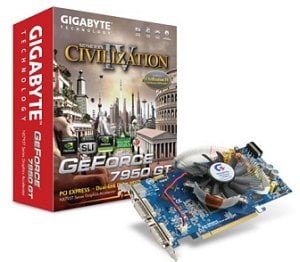
Gigabyte's 7950 GT comes in a standard Gigabyte graphics card box that features Sid Meier's Civilization IV artwork on the front and enticing features and marketing blurbs on the back.
As you probably guessed by now, this card comes bundled with a full version of Sid Meier's Civilization IV. In addition, Gigabyte throws in PowerDVD 6, two DVI-to-VGA adapters and a connector box for S-video and HDTV (component video) output. If you're not looking to add cost with extra frills, this is the 7950GT bundle for you.





;)
;)
;)
;)