|
|
| Introduction, Specifications & Bundle | ||||||
The Radeon X800 XL has been a very successful GPU for ATI. The X800 XL has been widely available for quite some time, it's built using a .11 micron process that make it a cost effective part for ATI to produce, and retail cards based on the X800 XL GPU offer very good performance for the price. 256MB variants of the X800 XL have also been available for under $250, which made them quite popular with both gamers and the overclocking crowd. The Radeon X800 XL's excellent price / performance ratio was undeniable. But then, back in June, ATI launched a 512MB version of the Radeon X800 XL. 512MB cards offered better performance in some applications and when running at high resolutions with anti-aliasing and anisotropic filtering enabled, but the cards were also priced significantly higher than their 256MB counterparts. In fact, upon their initial introduction 512MB Radeon X800 XL prices hovered around $500. Unfortunately, $500 was enough dough for a much more powerful GeForce 7800 GTX and the larger frame buffer didn't offer dramatic performance improvements in today's games, so in the end the 512MB Radeon X800 XL wasn't widely accepted by the gaming community. However, since then, prices for the 512MB Radeon X800 XL have dropped considerably. And companies like Sapphire and Abit now offer 512MB X800 XL's for well under $400. Today on HotHardware we're going to look at Abit's take on the Radeon X800 XL that bares the "Fatal1ty" brand. Unlike virtually every other video card to pass through the labs the past couple of years, Abit has actually veered from ATI's reference design and is offering a unique solution, with features that set it apart from its competition. Abit's Fatal1ty X800 XL 512MB may not be the king of the 3D performance hill, but there is a lot to like about this video card. Check it out...
Like Abit's other "Fatal1ty" branded products, the Fatal1ty X800 XL 512MB bares the mark, and endorsement, of professional gamer Johnathan "Fatal1ty" Wendel right on the box. Inside the box though, there isn't anything special to see, other than the card itself that is. Included with Abit's Fatal1ty X800 XL 512MB were a couple of manuals, one a typical User's Guide and the other a guide detailing the use of Abit's proprietary vGuru software, and the requisite driver / utility CD. Alongside the manuals and driver CD were an assortment of cables and connectors, that included an S-Video to composite adapter, an S-Video cable, a composite video cable, and a dual-Molex to 6-Pin PCI Express power adapter. As you can see, the Fatal1ty X800 XL 512MB's bundle wasn't exactly barren, but it would have been nice to see a game or two included to showcase the capabilities of the card, especially considering its relatively high price. |
| The Card & Its Proprietary Utilities | ||||||||
As we mentioned earlier, Abit didn't simply stamp out a "cookie-cutter" Radeon X800 XL. The card pictured below may be powered by the same GPU and memory as other 512MB Radeon X800 XL cards, but the similarities stop there. The Abit Fatal1ty X800 XL 512MB is unique in a couple of different ways...
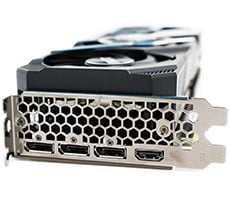
First, let's get some of the particulars out of the way. In one configuration, the 16-pipeline Radeon X800 XL GPU at the core of the Fatal1ty X800 XL is clocked at 400MHz (our sample's actual clock was 398MHz), with its 512MB of GDDR3 memory clocked at 980MHz (986MHz on our sample). That gives the card a peak fillrate of 6.3GPixels/s with a maximum of 31.5GB/s of memory bandwidth. The GPU is cooled by a copper-finned heatsink, with a lighted fan that's equipped with a handful of blinking red LEDs, that flash when the system is powered up. If you find the blinking annoying though, it can be disabled using Abit's vGuru software. The RAM on the front and back of the card are passively cooled as well by individual copper heatsinks mounted to each individual chip. The backplate houses a single DVI output, along with a single analog DB-15 output, an S-Video output, and a unique, little, red button. Note, that in the last paragraph we said, "in one configuration". The main feature that sets the Abit Fatal1ty X800 XL 512MB apart from the other video cards is that little, red button on the backplate. With a simple re-boot and a push of that button, a second BIOS mounted on the card takes over, and overclocks the GPU and memory to 419MHz and 1094MHz, respectively. For those into the numbers, that's a 5% boost to the GPU's clock speed, and an 11% boost to the memory. Abit calls this technology "xTurbo". We call it an innovative feature and hope Abit continues to think outside the box.
The "tweak-ability" of the Abit Fatal1ty X800 XL 512MB doesn't stop with that red button, however. Abit also bundles their vGuru utility with this card, which gives uses control over a host of the Fatal1ty's attributes. With the vGuru software, users can overclock (or underclock) the card, alter the cooling fan's speed for quiet operation or performance, and even alter the GPU core and memory voltages for more aggressive overclocking. And as we mentioned earlier, the vGuru software can also be used to toggle the card's blinking LEDs on and off. The vGuru software, in conjunction with Abit's xTurbo Technology, make the Fatal1ty X800 XL 512MB arguably the most "tweakable" video card to ever pass through the HotHardware labs. Those that like to tinker with their hardware would certainly have some fun with the Fatal1ty X800 XL 512MB. |
| Our Test System & 3DMark05 | ||||||||||||||
HOW WE CONFIGURED THE TEST SYSTEM: We put together two different test systems for this article. We tested our NVIDIA based cards on a Gigabyte K8NXP-SLI nForce 4 SLI chipset based motherboard, powered by an AMD Athlon 64 FX-55 processor and 1GB of low-latency Corsair XMS RAM. However, the ATI based cards were tested on an ATI reference Radeon Xpress 200 motherboard, but with the same processor and RAM. The first thing we did when configuring these test systems was enter each BIOS and load the "High Performance Defaults." The hard drive was then formatted, and Windows XP Professional with SP2 was installed. When the installation was complete, we installed the latest chipset drivers available, installed all of the other necessary drivers for the rest of our components, and removed Windows Messenger from the system. Auto-Updating and System Restore were also disabled, the hard drive was defragmented, and a 768MB permanent page file was created on the same partition as the Windows installation. Lastly, we set Windows XP's Visual Effects to "best performance," installed all of the benchmarking software, and ran the tests.
We'll be including two sets of numbers for the Abit Fatal1ty X800 XL 512MB throughout the performance segment of this article; one set in normal mode (398MHz/986MHz) and another set in xTurbo mode (419MHz/1094MHz). As you can see, switching into the higher-clocked xTurbo mode has a measurable impact on performance in 3DMark05. At its "default" clocks, the Fatal1ty X800 XL 512MB just missed the 5K mark, but when in xTurbo mode the card jumped 349 points, or roughly 7%. Unfortunately though, even with the higher clock speeds, the Fatal1ty X800 XL 512MB wasn't able to catch any of its similarly priced competition. |
| Splinter Cell: Chaos Theory | ||||||
Abit's Fatal1ty X800 XL 512MB handled Splinter Cell: Chaos Theory fairly well. Even though the card is clocked higher than other X800 XLs when in xTurbo mode, and it's got 512MB of frame buffer memory, it wasn't quite able to catch the Radeon X850 XT or GeForce 7800 GT. When anti-aliasing and anisotropic filtering was enabled though, the Fatal1ty X800 XL 512MB was able to nudge ahead of the GeForce 6800 Ultra and narrow the lead held by the other cards we tested. |
| FarCry v1.33 | ||||||
FarCry proved to be somewhat of a strong point for the Abit Fatal1ty X800 XL 512MB. Without any anti-aliasing or anisotropic filtering enabled, the performance results are all over the map, and the Fatal1ty falls short of the competition in both modes. With AA and aniso enabled, however, the Fatal1ty X800 XL 512MB's extra frame buffer memory and higher clocks put it well ahead of the GeForce 6800 Ultra, and it hangs tough just behind the X850 and 7800 GT. |
| Half Life 2 | ||||||
Well, well, well -- look at what we have here. The Abit Fatal1ty X800 XL 512MB's large frame buffer and inflated clock speeds help the card surge ahead of most of the competition in our custom Half Life 2 benchmark. At the lower resolution, all of the cards except the 6800 Ultra are basically CPU bound, and only the X850 XT is able to overtake the Fatal1ty X800 XL when AA and aniso are enabled. At the higher resolution though, the Fatal1ty X800 XL plays second fiddle to only the newer GeForce 7800 GT. We doubt anyone would complain about 97FPS at 1600x1200 with 4XAA and 16X ansio though... |
| Doom 3 | ||||||
Luckily for ATI, the ring-bus memory controller in new the X1000 series of cards has afforded them some much needed performance in OpenGL titles, because Doom 3 performance on the Fatal1ty X800 XL 512MB and Radeon X850 XT looks terrible when compared to either the GeForce 6 or GeForce 7 series of cards, as you can clearly see in the graphs above. Regardless of the card's clock speeds, it get's handily beat by all of the competing cards in our custom Doom 3 benchmark. The GeForce 7800 GT even manages to double the X800 XL's performance in a few test configurations. |
| Chronicles of Riddick | ||||||
The Fatal1ty X800 XL 512MB's performance in our custom Chronicles of Riddick benchmark essentially mirror what we saw with Doom 3. The card's higher-than-stock clock speeds and 512MB frame buffer help push it about 10% ahead of a "normal" X800 XL, but the X850 and both GeForce cards have no trouble outpacing the Fatal1ty X800 XL 512MB in every test configuration, regardless of resolution or whether anti-aliasing or anisotropic filtering are used. |
| Overclocking the Fatal1ty X800 XL | ||||
As we neared the end of our testing, we spent a little time overclocking the Abit Fatal1ty X800 XL 512MB using the clock frequency slider available within its proprietary vGuru application. To find the card's peak core and memory frequencies, we slowly raised their respective sliders until we begun to see visual artifacts on-screen while running a game or benchmark. But because this card also gives users the ability to tweak core and memory voltages, and fan speeds, we also upped those values to their respective maximums of 1.5v and 2.2v and set the fan to run at its highest speed...
When we were done with our overclocking experiments, we were able to boost the Fatal1ty X800 XL 512MB's core frequency to 430MHz and its memory frequency to 1120MHz. These are relatively small increases over the card's "xTurbo" clocks of 419MHz / 1094MHz, but please remember that Abit's xTurbo feature is already overclocking the card well over ATI's reference specifications. While we had the card was overclocked, we re-ran the default 3DMark05 benchmark and also re-ran our custom Doom 3 benchmark at a resolution of 1600x1200, with 4X anti-aliasing and 8X anisotropic filtering enabled. As you can see, the overclocked scores are only nominally higher than the Turbo mode scores, but they are about 10% - 15% higher than the Normal mode scores. |
| Our Summary & Conclusion | ||||||||
Performance Summary: The Abit Fatal1ty X800 XL 512MB performed well throughout our entire battery of benchmarks. More often than not, it fell short of the performance offered by a Radeon X850 XT or GeForce 7800 GT, but it hung alongside or outpaced a GeForce 6800 Ultra in many tests, like FarCry and Half Life 2. When running the Fatal1ty X800 XL 512MB in its xTurbo mode, it was about 10% faster than stock, which would also make it about 10% faster than any other stock Radeon X800 XL.
Abit should be commended for producing the Fatal1ty X800 XL 512MB. This may not be the most powerful video card on the market, but it does offer many things not available anywhere else. Instead of producing a cookie-cutter, reference Radeon X800 XL, the folks at Abit went to work and designed a custom video card with features targeted squarely at enthusiasts. The xTurbo "one-button" overclocking feature is something we really like, and we hope Abit has plans to incorporate it into future products. We also liked the fact that Abit gives users the ability to tweak the Fatal1ty X800 XL's fan speed, and GPU core / memory voltages and clock speeds through the included vGuru application. Our only gripe with this product is the fast that it doesn't ship with any games that'll showcase its performance and capabilities. Yes, there are faster cards available; the Radeon X800 XL was never a world beater. But few cards, if any, can match the Fatal1ty X800 XL 512MB in terms of tweakability. We wouldn't recommend this card to everyone because it lacks SM 3.0 support and is pricier than similarly performing cards, but those with smaller monitors or 17" - 19" LCDs, that don't run at resolutions above 1280x1024 would be well served by the Fatal1ty X800 XL. And its 512MB frame buffer helps make it a bit more "future proof" than some other video cards with 256MB or smaller frame buffers. The Fatal1ty X800 XL 512MB is available on-line for about $390, but that price will obviously drop over time. At $390 it's a tough-sell in a world where the GeForce 7800 GT is available for roughly $340, but we like what Abit has done with this card and give them extra points for innovation and originality. We're giving the Fatal1ty X800 XL a strong 7.5 on the Heat Meter, and hope that Abit plans to offer similar features on their future high-end products.
|