|
|
| Introduction and Specifications | ||||
Intel Core i7-2600K Processor Key Features:
Intel Core i5-2500K Processor Key Features:
Shared Features:
For those of you not quite familiar with Intel’s codenames, Sandy Bridge is the codename of a brand new microarchitecture that will be foundation of an entire line of desktop and mobile processors in 2011 and beyond. It is a “Tock” in Intel’s CPU release cadence, which means it is almost completely new and not a mild revision of an existing microarchitecture.
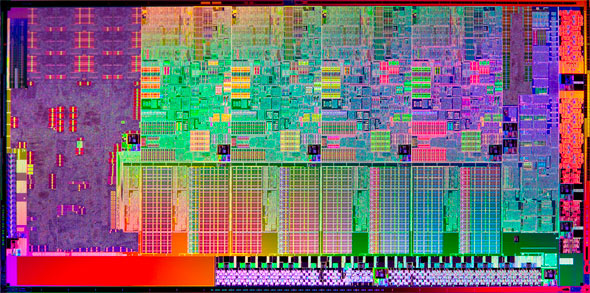
Above we have a die shot of a Sandy Bridge processor, along with the features and specifications of the new Core i5-2500K and Core i7-2600K processors we’ll be showcasing here. Some of the features will sound similar to previous Intel processor offerings, but make no mistake, these are completely new chips. They may borrow some aspects from previous Intel CPU microarchitectures, but with Sandy Bridge, Intel has redesigned virtually all of the execution engines, integrated a relatively powerful graphics core, and implemented a new ring bus to allow core elements to communicate, among many other features and enhancements. |
| Sandy Bridge Microarchitecture |
As we’ve mentioned, the Sandy Bridge microarchitecture is almost completely new. The out of order execution engines and the Floating Point units in Sandy Bridge were re-designed from the ground up in an effort to further optimize for power efficiency and performance over previous Intel processor designs. In the OOO engines, Intel went to a physical register file. This reduces die area and can also lower power because it eliminates duplicated data in various registers and minimizes the amount of of data movement around the chip. This, and other techniques used in the OOO engines allowed Intel to incorporate larger OOO buffers, which also provide a bigger window to find Instruction Level Parallelism (ILP), which can increase performance on legacy code. The reduction in register space and data movement is also essential for AVX (Advanced Vector Extensions), where data vectors are 2x the size of previous generations. AVX is a new set of instructions in Sandy Bridge that improves Floating Point and Vector computation performance. Sandy Bridge is also outfitted with new micro-op cache. The decoded micro-OP cache provides high and consistent bandwidth, at much lower latency, than the traditional front end decode path. It also provides the UOPs at much lower power than the traditional front end.
|
| HD Graphics and Media Encoding |
One of the stand-out features of Intel’s new Sandy Bridge processors is its integrated DX10.1 graphics core. The graphics core that incorporated into Sandy Bridge is a significant step up from any other graphics product Intel has every introduced. With that said, it is not a replacement for a mid-range or high-end discrete graphics card, but it does offer feature and enough performance to satisfy a significant portion of the market. Sandy Bridge based Intel Core i5 and Core i7 processor will feature one of two graphics core configurations, Intel HD Graphics 2000 or Intel HD Graphics 3000. The two differ only in their number of execution units, or cores. Intel HD Graphics will have 6 EUs enabled, while HD 3000 Graphics will have 12. The graphics cores on the different processors will also differ in their peak frequencies as well. For example, the Core i5-2500K has a peak graphics core frequency of 1100MHz, while the Core i7-2600K’s graphics core can hit up to 1350MHz. Quick Sync work much like the GPU accelerated Encoding, Decoding and Transcoding we’ve seen from NVIDIA and AMD and offers vastly increased performance over software-based solutions. Like NVIDIA’s and AMD’s offerings, software vendors will have to specifically code for Intel QuickSync technology, but that should be happening fairly quickly. We have already worked with pre-release packages from Corel, CyberLink and ArcSoft that can take advantage of Quick Sync.
|
| 6-Series Chipsets, Intel Motherboards |
To accompany the new Sandy Bridge Core i5 and i7 based processors, Intel is also introducing a whole family of chipsets—the 6-series. Above is a high-level block diagram of the flagship P67 chipset which is targeted at the performance and enthusiast segments, but there will be a number of other 6-series chipsets arriving as well, that target SMB and consumer segments. There will be mobile variants of each introduced coming down the pipeline too. The various 6-series desktop chipsets are listed above. They chipsets differ mainly in the number of USB and SATA 6Gps ports are supported, and in their support performance tuning, content protection, and RST 10 modes, but they are fundamentally very similar and all are actually based on the same die. Also note that the P67 does not support integrated display outputs, so Sandy Bridge’s integrated processor graphics is not available with the P67. We got our hands on a couple of Intel-built motherboards to test the new Sandy Bridge-based processors, the DH67BL (Bearup Lake) and DP67BG (Burrage). The DH67BL is a micro-ATX motherboard based on the H67 chipset, with full integrated display support. And the DP67GB is an enthusiast-class P67-based motherboard, sans display outputs. Both of the boards exploit all of the features inherent in the H67 and P67 chipsets and also feature NEC USB 3.0 controllers.
|
| P67 Motherboards: Asus, MSI, Gigabyte | |
For the purposes of this article, in addition to the Intel-built boards on the previous page, we acquired a handful of enthusiast-class P67-based motherboards to give you all an idea as to what type of boards would be hitting the scene along with the new Sandy Bridge-based Core i5 and i7 based processors. First up, we have the Asus P8P67 Deluxe. The P8P67 Deluxe is about as feature rich a motherboard as we have come across. In addition to exploiting all of the features inherent to the P67 chipset, the P8P67 Deluxe offers USB 3.0 support (with front panel USB 3.0 ports included), Bluetooth connectivity, additional SATA 6Gbps ports, and what Asus is calling “Dual Intelligent Processors 2”. The Dual Intelligent Processors consist of Asus’ EPU unit, which we’ve covered in the past, and the TurboV processing unit. The processors work together with the P8P67 Deluxe’s 16+2 digital VRM (DIGI+ VRM) and give users the ability to monitor and adjust power delivery. According to Asus, the combination of the programmable digital VRM and DIP2 results in superior efficiency and longevity.
We found the Asus P8P67 Deluxe to be a very stable board that was quite tweaker-friendly too. Performance was also excellent, as you’ll see in the pages ahead.
Here we have the MSI P67A-GD65. Like the other P67-based motherboards featured here, all of the P67 chipset’s features are available on the P67A-GD65, but MSI works a bit of their magic as well. The MSI P67A-GD65 features a mouse-friendly EFI BIOS that’s much easier to navigate than traditional text-based BIOS menus. The board is also in MSI’s “Military Class II” family and features super ferrite chokes, highly conductive polymer capacitors, and solid capacitors throughout, which should offer increases stability and longevity.
Next up we have the Gigabyte P67A-UD7. The P67A-UD7 is an enthusiast class, LGA1155 based motherboard for Sandy Bridge processors and will be Gigabyte’s flagship P67 mobo upon its arrival. It features a 24 phase CPU power design, Gigabyte’s “Ultra Durable 3” technology with two ounces copper layers within the PCB, ten SuperSpeed USB 3.0 ports, six SATA 6Gbps connectors, 3-way CrossFireX and SLI support, DualBIOS technology, and On/Off Charge support.
|
| Sandy Bridge Coolers and Memory |
Intel will be offering two coolers with new Sandy Bridge based processors, a basic circular cooler that’s identical to the model included with Lynnfield-based processors will accompany non-K SKUs and a more capable tower-type model will come with unlocked K SKUs, like the ones we’ve tested here. There’s nothing new to report with regard to the basic cooler, but the tower-type Intel XTS100H is a different story. The XTS100H has three, thick copper heatipes that run though a solid copper base, into an array of densely packed aluminum heatsink fins. A 92mm fan sits at the front, with a speed controller switch at the very top. The switch has two positions—Q for quiet and P for performance. In quiet mode, the cooler is just that, quiet. In performance mode, the fan can spin up considerably when the CPU is under load, but it’s not terribly loud. As was the case when Nehalem and Lynnfield arrived, memory manufacturers are at the ready with low-voltage, dual-channel memory kits qualified for Sandy Bridge 6-seires chipset platforms. The two kits you see here come by way of Corsair and Patriot. The Corsair Vengeance kit includes 8GB (4GB x 2) of memory rated for operation at up to 1600MHz (C9) at 1.5v. The Patriot 4GB (2GB x 2) kit is rated for operation at up to 1866MHz (also C9) at 1.65v, although we found it would run with lower latencies at lower frequencies as well.
|
| Test Setup and SiSoft SANDRA | ||||||||||||||||||||
Test System Configuration Notes: When configuring our test systems for this article, we first entered their respective system BIOSes and set each board to its "Optimized" or "High performance Defaults". We then saved the settings, re-entered the BIOS and set memory to DDR3-1333. The hard drives were then formatted, and Windows 7 Ultimate x64 was installed. When the Windows installation was complete, we updated the OS, and installed the drivers necessary for our components. Auto-Updating and Windows Defender were then disabled and we installed all of our benchmarking software, performed a disk clean-up, defragged the hard drives, and ran all of the tests.
We began our testing with SiSoftware's SANDRA 2011B, the System ANalyzer, Diagnostic and Reporting Assistant. We ran four of the built-in subsystem tests that partially comprise the SANDRA 2011 suite with Intel's new Core i5 and i7 "Sandy Bridge" processors (CPU Arithmetic, Multimedia, Memory Bandwidth, and Cache and Memory). All of the scores reported below were taken with the processors running at their default clock speeds of 3.3GHz (2500K) and 3.4GHz (2600K) with 4GB of DDR3-1333 RAM running in dual-channel mode on the Asus P8P67 Deluxe motherboard.
The new Sandy Bridge-based Core i5-2500K and Core i7-2600K processors performed right about where we expected them too in the various SiSoft SANDRA tests. In the Processor Arithmetic and Multimedia benchmarks, the processors outpaced their previous-generation counterparts by a fair margin, when core counts were similar--the 6-core Core i7-980X remains Intel's fastest processor overall. The Core i5-2500K and Core i7-2600K also performed similarly in the Cache and Memory test and each one offered up about 16GB/s of peak memory bandwidth, when running in a dual-channel configuration at 1333MHz. |
| Futuremark PCMark Vantage | ||||
Next up, we ran a number of different test systems through Futuremark’s latest system performance metric, PCMark Vantage. PCMark Vantage runs through a host of different usage scenarios to simulate different types of workloads including High Definition TV and movie playback and manipulation, gaming, image editing and manipulation, music compression, communications, and productivity. Most of the tests are multi-threaded as well, so the tests can exploit the additional resources offered by a multi-core CPU.
The new Core i5-2500K and Core i7-2600K processor performed very well in the various PCMark Vantage tests. Here, the Core i7-2600K kept pace with or beat the Core i7-975, which was previously Intel's fastest quad-core processor. And the Core i5-2500K made mince-meat of the Core i5-750, also a quad-core with no HT. AMD's processors, regardless of how many cores they had, finished well behind Sandy Bridge, and the 6-core Intel Core i7-980X remained the fastest CPU overall. |
| LAME MT Audio Encoding | ||||
In our custom LAME MT MP3 encoding test, we convert a large WAV file to the MP3 format, which is a popular scenario that many end users work with on a day-to-day basis to provide portability and storage of their digital audio content. LAME is an open-source mid to high bit-rate and VBR (variable bit rate) MP3 audio encoder that is used widely around the world in a multitude of third party applications.
In this test, we created our own 223MB WAV file (a hallucinogenically-induced Grateful Dead jam) and converted it to the MP3 format using the multi-thread capable LAME MT application in single and multi-thread modes. Processing times are recorded below, listed in seconds. Shorter times equate to better performance.
According to our custom LAME MT benchmark, it appears the new Sandy Bridge microarchitecture is very well suited to audio encoding. The Core i5-2500K and Core i7-2600K put up the best scores in this test, outpacing even the Core i7-980X. This workload uses a maximum of only two threads, so the new Core i5-2500K and Core i7-2600K's architectural enhancements, in addition to their relatively high Turbo boost clock speeds, help propel them to the lead here.
|
| Cinebench R11.5 and POV-Ray | ||||||||
Cinebench R11.5 is a 3D rendering performance test based on Cinema 4D from Maxon. Cinema 4D is a 3D rendering and animation tool suite used by animation houses and producers like Sony Animation and many others. It's very demanding of system processor resources and is an excellent gauge of pure computational throughput.
The new Core i5-2500K and Core i7-2600K performed very well in the Cinebench R11.5 benchmark. Here, the Core i7-2600K was easily the fastest Intel quad-core processor and the Core i5-2500K finished well ahead of the Core i5-750. Keep in mind, the Core i5-2500K does not have HyperThreading, so it can processes four fewer threads than the Core i7 processors can. Once again, there was no appreciable difference in performance between the various motherboards we tested and whether or not the Core i5's integrated processor graphics were used in lieu of a discrete GPU.
The performance trend in the POV-Ray benchmark essentially mirrored those of Cinebench. The Core i7-2600K was clearly the fastest of Intel's quad-core processors, falling victim to only the 6-core Core i7-980X. The Core i5-2500K was again significantly faster than the Core i5 as well.
|
| 3DMark06 and Vantage CPU Tests | ||||||||
3DMark06's built-in CPU test is a multi-threaded DirectX gaming metric that's useful for comparing relative performance between similarly equipped systems. This test consists of two different 3D scenes that are processed with a software renderer that is dependent on the host CPU's performance. Calculations that are normally reserved for your 3D accelerator are instead sent to the CPU for processing and rendering. The frame-rate generated in each test is used to determine the final score.
The new Core i5-2500K and Core i7-2600K performed very well in the 3DMark06 CPU benchmark too. Here, only the Core i7 975 and 980X are able to outpace the even the Core i5-2500K and the Core i7-2600K outpaced everything but the 6-core 980X.
3DMark Vantage's CPU Test 2 is a multi-threaded test designed for comparing relative game physics processing performance between systems. This test consists of a single scene that features an air race of sorts, with a complex configuration of gates. There are aircraft in the test that trail smoke and collide with various cloth and soft-body obstacles, each other, and the ground. The smoke spreads, and reacts to the planes as they pass through it as well and all of this is calculated on the host CPU.
The more taxing 3DMark Vantage CPU Test 2 put the Core i5-2500K just behind the Core i7-870 and Phenom II X6 1100T, but once again the Core i7-2600K pulls ahead of every other processor with the sole exception being the Core i7 980X. We should also point out that all of the P67 based motherboards performed at nearly the same level again, as well. |
| Low-Res Gaming: Crysis and ETQW | ||||
For our next set of tests, we moved on to some in-game benchmarking with Crysis and Enemy Territory: Quake Wars. When testing processors with Crysis or ET:QW, we drop the resolution to 800x600, and reduce all of the in-game graphical options to their minimum values to isolate CPU and memory performance as much as possible. However, the in-game effects, which control the level of detail for the games' physics engines and particle systems, are left at their maximum values, since these actually do place some load on the CPU rather than GPU.
The Crysis CPU benchmark had the Core i7-975 (quad-core) and 980X (6-core) processors outpacing the new Core i5-2500K and Core i7-2600K processors, but nothing from the AMD camp came close. ET:QW tests a different story, with the new Core i7-2600K taking the pole position, followed closely behind by the 980X. |
| Hi-Res Gaming Multi-GPU Tests | ||||
For our next set of tests, we moved on to some high-resolution graphics benchmarking with 3DMark Vantage (DX10), ET:QW (OpenGL), and Metro 2033 (DX11). For these tests, we've tested a Core i7-2600K powered system outfitted with single, or dual Asus GeForce GTX 570 (SLI) or Radeon HD 6970 (CrossFire) graphics cards in the Asus P8P67 Deluxe motherboard. Due to the fact that these new Core i5 and i7 Sandy Bridge-based processors feature integrated PCI Express lanes, and the graphics cards essentially connect directly to the CPU, we wanted to see how graphics performance and multi-GPU scaling were affected in more GPU bound circumstances.
No problems to report here. Moving from one to two GPUs with a Core i7-2600K and Asus P8P67 Deluxe motherboard resulted in much better performance, with the total score and framerates scaling from between 81% to 93%, using 3DMark Vantage's "Extreme" testing preset. |
| Hi-Res Gaming Multi-GPU Tests (Cont.) | ||||
Next we moved on to some more high-resolution graphics benchmarking with ET:QW and Metro 2033, using the same Core i7-2600K / Asis P8P67 Deluxe based system and NVIDIA and ATI-based graphics cards.
Once again we saw huge gains in performance moving from one to two GPUs. Both the GeForce GTX 570s and Radeon HD 6970s showed 92% performance improvements in Metro 2033, while the older, less taxing ET:QW showed improvement of 62% (Radeon HD 6970 CrossFire) and 78% (GeForce GTX 570 SLI). |
| HD Graphics vs. Discrete GPU - Gaming | ||||
For this next set of tests, we pitted the integrated processor graphics incorporated into the Sandy Bridge-based Intel Core i5-2500K and Core i7-2600K processors against a couple of the least expensive, current-generation discrete GPUs from NVIDIA and AMD, the GeForce GT 430 and Radeon HD 5550, respectively.
At the high-quality, graphics intensive settings we used, the Intel HD 3000-series graphics integrated into the new Core i5-2500K and Core i7-2600K processors couldn't keep pace with either discrete GPU, plain and simple. The higher peak Turbo frequency for the integrated HD 3000 graphics core in the 4600K gave it a measurable lead over the 2500K, but neither offered anything close to playable framerates.
|
| Quick Sync vs. Discrete GPU | ||||
As we've mentioned, the new Sandy Bridge-based Core i5-2500K and Core i7-2600K processors feature and integrated media encoding engine, dubbed Quick Sync, that's enabled when the integrated Intel HD graphics core is used. We tested the Intel Quick Sync encoder using a pre-release version of Cyberlink's MediaEspresso 6, which was coded to take advantage of Intel Quick Sync technology.
In this test, we took a 256MB AVCHD MTS file recorded using a Canon HD camcorder and converted it to an H.264 encoded MP4 compatible designed for use with an iPhone / iPad (or other portable media playback device).
The Quick Sync engine within the new Sandy Bridge processors offers exceptional encoding performance in terms of speed and quality. In our tests, enabling Quick Sync within MediaEspresso resulted in performance increases of 3.7x to 4.1x, smoking everything else we tested. It's a shame that Quick Sync can't be used when a discrete GPU is installed in a system with a single monitor though. Many of the users who build high-end systems with media encoding in mind aren't going to want to settle for integrated graphics, and may not run dual monitors. And since Windows 7 allows for multiple GPU types to be installed in a system, and Intel will allow Quick Sync to function in notebooks / laptops equipped with discrete GPUs with switchable graphics, we hope they figure out a way to enable it on the desktop as well.
We also played back numerous video types on the new Core i5-2500K and Core i7-2600K while using their integrated Intel HD 3000 series graphics core, including DVDs and a myriad of SD and HD clips of varying file types. All of the local content played back perfectly with very low CPU utilization. High resolutions Flash videos streamed from the web, however, were a bit more stressful on the system, however. We never lost frames or anything along those lines, but CPU utilization was relatively high in comparison to a discrete GPU. Using the latest Adobe Flash plug-in beta that's compatible with Intel's new graphics core, we saw CPU utilization in the mid-20% to high-30% range when playing back high-res Flash video, whereas utilization hovered in the 5% to 8% range with a GeForce GTX 570 installed in the test rig.
|
| Total System Power Consumption | ||||
Throughout all of our benchmarking and testing, we also monitored how much power our test systems consumed using a power meter. Our goal was to give you all an idea as to how much power each configuration used while idling and while under a heavy workload. Please keep in mind that we were testing total system power consumption at the outlet here, not just the power being drawn by the processors alone.
We should point out that the increased power consumption of the 2600K when installed on the Asus motherboard is a result of the additional integrated components of the P8P67 Deluxe in addition to slightly higher default voltages. |
| Performance Summary and Conclusion | ||||
Performance Summary: There are a number of performance related aspects to summarize here, including CPU, graphics, and motherboard / chipset performance. First let’s focus on CPU performance relative to previous generation Intel processors. The Core i7-2600K is arguably the fastest quad-core processor released from Intel to date. It hung with or surpassed the Core i7-975 and was clearly outpaced by only Intel’s 6-core processors. The Core i5-2500K couldn’t quite keep pace with previous generation Core i7 chips across the board, but it was right there alongside them in most tests, and it clearly outperformed the Lynnfield-based Core i5 processors. In relation to AMD’s current crop of processors, the new Sandy Bridge-based chips were clearly faster than AMD’s fastest quad-core, the Phenom II X4 970, and they were able to outpace the 6-core Phenom II X6 1100T in a number of tests as well. The quad-core Intel Sandy Bridge-based processors we have shown you here, along with their standard, non-K counterparts, should be hitting store shelves in roughly the next week or so, with dual-core Core i3 variants arriving in about another month. The price and feature breakdown of the mainstream Core i5 and Core i7 processors due to arrive is as follows.
As you can see, there is a small premium to be paid for an unlocked K SKUs, but for enthusiasts, that will be money well spent in our opinion. We should also note that in addition to the 95W processors listed here, Intel has lower-power 35W (dual-core), 45W, and 65W models coming down the pipeline as well. 6-Series chipset based motherboards should also be hitting the market in droves in the coming weeks at price points similar to the previous-gen 5-series chipsets that arrived alongside Lynnfield. |