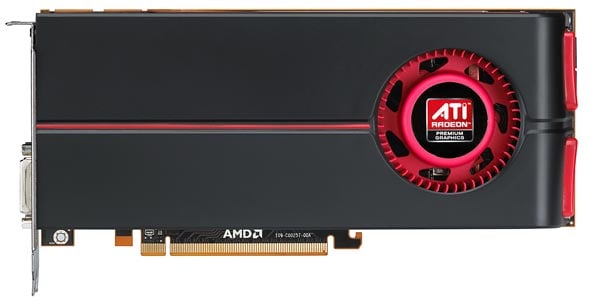
Exactly one week ago today, AMD unleashed the ultra powerful, DirectX 11-ready ATI Radeon HD 5870 upon the PC gaming world and staked a claim as the undisputed 3D performance leader. Having evaluated the features, performance, and image quality of AMD's latest and greatest flagship we were left thoroughly impressed, not only with the new Radeon's killer performance, but its extensive feature set, excellent image quality, power consumption, and competitive price.
In our coverage of the official launch of the Radeon HD 5870, we also revealed AMD's plan to release a more affordable, pared-down version of the card, with a shorter PCB, lower core and memory frequencies, also sans a few stream processors and texture units, dubbed the Radeon HD 5850. Unfortunately, cards did not arrive in time to be tested alongside the 5870. The Radeon HD 5850 did arrive in the lab a few days later, however, and we jumped right on testing it.
We've got our evaluation of the $259 Radeon HD 5850 available on the proceeding pages. First up some specs and a quick refresher, then its onto the close ups, performance, and a little overclocking...

AMD Radeon HD 5850 DirectX 11 Graphics Card
|
|
|
AMD ATI Radeon HD 5850 |
|
Specifications and Features | |
2.15 billion 40nm transistors
TeraScale 2 Unified Processing Architecture
- 1440 Stream Processing Units
- 72 Texture Units
- 128 Z/Stencil ROP Units
- 32 Color ROP Units
GDDR5 Memory Interface
Up To 128GB/sec of memory bandwidth
PCI Express 2.1 x16 bus interface
DirectX 11 support
- Shader Model 5.0
- DirectCompute 11
- Programmable hardware tessellation unit
- Accelerated multi-threading
- HDR texture compression
- Order-independent transparency
OpenGL 3.2 support
Image quality enhancement technology
- Up to 24x multi-sample anti-aliasing
- Super-sample anti-aliasing modes
- Adaptive anti-aliasing
- 16x angle independent anisotropic texture filtering
- 128-bit floating point HDR rendering
ATI Eyefinity
- Advanced multi-display technology
- Three independent display controllers
- Drive three displays simultaneously with independent resolutions, refresh rates, color controls, and video overlays
- Display grouping
- Combine multiple displays to behave like a single large display
ATI Stream acceleration technology
- OpenCL 1.0 compliant
- DirectCompute 11
- Double precision floating point processing support
- Accelerated video encoding, transcoding, and upscaling
- Native support for common video encoding instructions
ATI CrossFireX multi-GPU technology
- Dual, triple, and quad GPU scaling
- Dual-channel bridge interconnect
|
ATI Avivo HD Video & Display technology
- UVD 2 dedicated video playback accelerator
- Advanced post-processing and scaling
- Dynamic contrast enhancement and color correction
- Brighter whites processing (blue stretch)
- Independent video gamma control
- Dynamic video range control
- Support for H.264, VC-1, and MPEG-2
- Dual-stream 1080p playback support
- DXVA 1.0 & 2.0 support
- Integrated dual-link DVI output with HDCP
- Max resolution: 2560x1600
- Integrated DisplayPort output
- Max resolution: 2560x1600
- Integrated HDMI 1.3 output with Deep Color, xvYCC wide gamut support, and high bit-rate audio
- Max resolution: 1920x1200
- Integrated VGA output
- Max resolution: 2048x1536
- 3D stereoscopic display/glasses support
- Integrated HD audio controller
- Output protected high bit rate 7.1 channel surround sound over HDMI with no additional cables required
- Supports AC-3, AAC, Dolby TrueHD and DTS Master Audio formats
ATI PowerPlay power management technology
- Dynamic power management with low power idle state
- Ultra-low power state support for multi-GPU configurations
Certified drivers for Windows 7, Vista, and XP
Speeds & Feeds
- Engine clock speed: 725 MHz
- Processing power (single precision): 2.09 TeraFLOPS
- Processing power (double precision): 418 GigaFLOPS
- Polygon throughput: 725M polygons/sec
- Data fetch rate (32-bit): 209 billion fetches/sec
- Texel fill rate (bilinear filtered): 52.2 Gigatexels/sec
- Pixel fill rate: 23.2 Gigapixels/sec
- Anti-aliased pixel fill rate: 92.8 Gigasamples/sec
- Memory clock speed: 1 GHz
- Memory data rate: 4 Gbps
- Memory bandwidth: 128 GB/sec
- Maximum board power: 151 Watts
- Idle board power: 27 Watts
|
Radeon HD 5850 Feature Summary
The Radeon HD 5850 shares the exact same features as the more powerful Radeon HD 5870. In fact, the GPU powering the card is essentially the same chip with a few functional blocks disabled. Radeon HD 5850 cards are still DirectX 11-ready, support ATI Eyefinity multi-display technology, offer the same UVD updates, and new anti-aliasing and anisotropic filtering modes.
Where the two cards differ are in their allotment of stream processors--the Radeon HD 5850 has 1440 versus 1600 on the 5870. The Radeon HD 5850 also has fewer texture units, a shorter PCB, and a lower clocked GPU and memory. The changes made to the 5850 result in a much lower-power, more affordable product. How much performance has changed remains to be seen, so let's get a move on, shall we?





;)