|
|
| Introduction and Specifications | ||||
When Intel released their first generation 50nm SSD product, the market buzzed with appreciation for the product and its overall performance profile. We in fact took you through the ins and outs of Intel's new MLC-based Solid State Drive product line-up for the consumer market and agreed it was one of the fastest on the market at the time. However, over time, other manufacturers have closed the gap significantly. Perhaps it was the fact that Intel had "skin" in the SSD game or maybe it was just the all-around buzz of the burgeoning SSD market in general but there's no question, the technology itself has a considerable resource commitment from a number of very big name manufacturers.
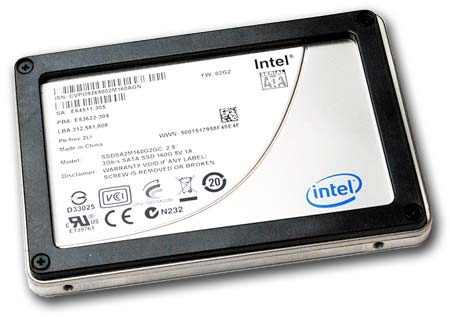
Based on 50nm manufacturing technology, Intel's highly acclaimed line of SSDs have historically commanded a price premium in the market as well, which regardless didn't keep them from selling like hotcakes. However, with the kind of resources that very few manufacturers like Intel can bring to bear, it was abundantly clear that Intel's SSD roadmap would continue to evolve. Today we've got a look at Intel's second generation of SSD products, the recently announced 34nm version of the Intel X25-M SSD. At 160GB and a significantly lower price point, Intel is also claiming performance has been taken up a notch or two as well. Sounds like a proverbial win-win doesn't it? Let's see for ourselves...
A quick-take look at the specs tells you that the drives still share the same capacity offering of 80GB and 160GB and the drive also is still built with Intel's excellent 10 channel parallel architecture but with instead with 34nm MLC flash components. Additionally, the drive is specified for the same 250MB/s sequential read and 70MB/s sequential write performance of the first generation product. However where the drives differ is a reduced read access latency of 65 microseconds versus 85 for the previous generation product and Intel claims random write performance has increased 2x for the 80GB and 2.5x for the 160GB product to for up to 6,600 4KB write IOPS for the 80GB drive and 8,600 write IOPS for the 160GB drive with up to 35,000 read IOPS on either product. Back in September '08 we took a look at Intel's first gen drive, if you'd like to take a look back for a refresher. Additionally, we've also looked Kingston's re-branded version of the first gen X25M in this round-up showcase previously as well. We even recently put a quartet of the SSDs together in RAID 0 and pit them against Fusion-io's ioDrive PCI Express-based SSD for some real excitement in the benchmarks. But that's enough of the rearview, let's take a closer look at what Intel has in store for us with the second generation offering. |
| Test System, IOMeter, and SANDRA | ||||||||||||
Our Test Methodologies: Under each test condition, the Solid State Drives tested here were installed as secondary volumes in our testbed, with a standard spinning hard disk for the OS and benchmark installations. The SSDs were left blank without partitions wherever possible, unless a test required them to be partitioned and formatted, as was the case with our ATTO benchmark tests. Windows firewall, automatic updates and screen savers were all disabled before testing. In all test runs, we rebooted the system and waited several minutes for drive activity to settle before invoking a test.
In the table above, we're showing two sets of access patterns; one with an 8K transfer size, 80% reads (20% writes) and 80% random (20% sequential) access and one with IOMeter's default access pattern of 2K transfers, 67% reads and 100% random access. Here we see this new generation of 34nm Intel SSD offers a noticeable gain in available bandwidth, about 5% or so in our read-intensive Workstation access pattern and it's up to 23% faster in our more write-intensive default access pattern which closely aligns to a database processing workload actually.
In our SiSoft SANDRA testing, we used the Physical Disk test suite. We ran the tests without formatting the drives and read performance metrics are detailed below. Please forgive the use of these screen captures and thumbnails, which will require a few more clicks on your part. However, we felt it was important to show you the graph lines in each of the SANDRA test runs, so you are able to see how the drives perform over time and memory location and not just an average rated result. Here we've only ripped through SANDRA's disk read performance benchmark due to time constraints more than anything but we'll offer up look at writer performance in our ATTO tests next. In terms of read performance in SANDRA, the new Intel gen 2 SSD proved itself to be the fastest of our lot, edging out the OCZ and Corsair drives by a hair, with also a much less saw-toothed performance line, versus the previous generation Intel X25-M SSD. |
| ATTO Disk Benchmark | ||||||||
ATTO is a more straight-forward type of disk benchmark that measures transfers across a specific volume length. It measures raw transfer rates for both reads and writes and graphs them out in an easily interpreted chart. We chose .5kb through 8192kb transfer sizes over a total max volume length of 256MB. This test was performed on blank, formatted drives with NTFS partitions.
The newly updated Intel X25-M Gen 2 drive shows a marked performance improvement over the original in the ATTO Disk Benchmark. In terms of read performance, the two drives are evenly matched, with neither having any real advantage. In the write tests, however, the new drive with the updated 34nm flash memory shows an approximate 31% performance increase, especially as the transfer size increases. |
| HD Tach Performance | ||||||
Simpli Software's HD Tach is described on the company's web site as such: "HD Tach is a low level hardware benchmark for random access read/write storage devices such as hard drives, removable drives, flash devices, and RAID arrays. HD Tach uses custom device drivers and other low level Windows interfaces to bypass as many layers of software as possible and get as close to the physical performance of the device being tested."
|
| PCMark Vantage | ||||
Next we ran the OCZ Apex SSD through a battery of tests in PCMark Vantage from Futuremark Corp. We specifically used only the HDD Test module of this benchmark suite to evaluate all of the drives we tested. Feel free to consult Futuremark's white paper on PCMark Vantage for an understanding of what each test component entails and how it calculates its measurements. For specific information on how the HDD Test module arrives at its performance measurements, we'd encourage you to read pages 35 and 36 of the white paper.
The Gen 2 Intel X25-M with its 34nm flash memory tracked higher than the original drive in all of the PCMark Vantage tests represented here. The gaming test showed the largest improvement over the original, with a 5.7MB/s delta separating the old and new drives, in favor of the newest model. The new X25-M also pulled well ahead of the OCZ Vertex Series drive, but trained the Corsair P256. |
| PCMark Vantage (Continued) | ||||
Our next series of Vantage tests will stress the current weakness of most SSDs, that being write performance. Applications like video editing, streaming and recording are not what we would call a strong suit for the average SSD, due to their high mix of random write transactions. We should also note that it's not so much a weakness of the memory itself, but rather the interface and control algorithms that deal with inherent erase block latency of MLC NAND flash. SSD manufacturers are getting better at this, but still today, there are issues to contend with.
In the remaining PCMark Vantage hard drive tests, the updated Gen 2 Intel X25-M SSD once again pulls ahead of its predecessor. The 'Adding Music To Windows Media Player' test was a dead heat, but in the other three tests the newer drive pulled ahead by margins ranging from 2.16MB/s to 11.49MB/s. With the exception of the Application Loading test, the OCZ and Corsair drives appear to have an advantage here. |
| Power Consumption | ||||
Although solid state drives don't typically draw huge amounts of power, we still wanted to see how this new breed of SSDs compared in terms of power consumption. Throughout all of our benchmarking and testing, we monitored how much power our test system was consuming using a power meter. Our goal was to give you all an idea as to how much power each configuration used while idling and under full load on a secondary test drive. Please keep in mind that we were testing total system power consumption at the outlet here, not just the power being drawn by the drives alone.
|
| Our Summary and Conclusion | ||||
Performance Summary: The second generation Intel 34nm X25-M SSD showed it was marginally faster in traditional application performance tests like PCMark Vantage but was significantly faster in our synthetic tests like IOmeter and ATTO, where it offered performance gains of up to 23%-31% for write-intensive workloads and on the order of about 5% for read-heavy operations. In general, the new 160GB SSD was faster overall and did so with ever so slightly lower power consumption characteristics.
The introduction of Intel's 34nm second generation X25-M and X18-M series of SSDs is more about efficiency in manufacturing process, which though translates to slightly better performance in this case, more-so contributes to the drastic cost reduction the market has been yearning for from Intel's SSD product offerings. When we consider the fact that Intel introduced the 80GB drive for $595 and the 160GB drive for $945 a year ago (currently $345 and $665 street prices), at their new price points of $225 and $440 respectively, we have to give Intel a big pat on the back for pulling the ol' Spike Lee move of "doing the right thing". It's the right thing for the consumer and the market in general, where Intel's new price aggressiveness will set the pace for the competitive landscape as well in the months ahead. In fact, we've already heard rumblings that OEM manufacturers like Indilinx, the manufacturer of the SSD controllers found on OCZ's Vertex line of SSDs, might be levying cost reductions in reaction to Intel's new pricing matrix. Things are heading in the right direction to be sure and we're hearing most drive manufacturers will be following suit as well.
Looking at the direct competitors like the OCZ Vertex and Corsair SSDs we tested today, the new Intel X25-M stacks up very well in terms of performance and price, making it one of the lower cost SSDs on the market currently at at cost per gigabyte of $2.81 for the 80GB drive and $2.75 for the 160GB drive. We'll be taking a look at new offerings from OCZ in the weeks ahead and yet another from the red-hot Fusion-io, so stay tuned. It's going to get really interesting in SSDs straight through the end of '09 -- the year of the SSD.
|