|
|
| Introduction, Features and Specs | |||||||||||||||||||||||||||||||||||||||||||||||||||||||||||||
NVIDIA launched the GeForce GTX 285 about three months ago, and in our launch article, we found it to be a very strong product. As you are no doubt aware, the GTX 285 is a replacement for the GTX 280. The GT200B GPU at the heart of the GTX 285 is nearly identical to the GTX 280's GT200 GPU. The most significant difference between the two GPUs is that the GT200B is manufactured using a 55nm fabrication process while the GT200 is built on a 65nm process. Our testing showed that the GTX 285 performs only slightly better than the GTX 280 in some scenarios. At first, it seemed a little disappointing, but hey, the GTX 280 is good company to be in. Furthermore, the GTX 285 was the fastest single-GPU video card available then, and it still is today. Then consider that this new revision of the GPU also of course offers lower power consumption and a smaller die size that will afford a lower cost structure down the road and things start to look even better.
We take our GTX 285 coverage further in this article as we round up three factory-overclocked cards and pit them against each other. As enthusiasts, we think overclocks are great, but factory provided overclocks covered under warranty are even better. Components that offer more bang for the buck are always welcome in our systems. Recall that the reference NVIDIA GTX 285 clocks speeds are 648 MHz for the core GPU, 1,242 MHz for the GDDR3 memory and 1,476 MHz for the shader clock. The first card in this round-up is the ASUS ENGTX285 TOP, which sports clocks of 670 MHz, 1,300 MHz and 1,550, respectively. Next up, we have the BFG Tech GeForce GTX 285 OCX, the overall fastest card of this bunch, rocking at 702 MHz, 1,332 MHz and 1,584 MHz, respectively. Finally, we have the Zotac GeForce GTX 285 AMP! Edition, which boasts clock speeds of 702 MHz, 1,296 MHz and 1,512 MHz, respectively. As you can see, this should be an interesting battle to see unfold. We are going to put these cards through their paces in our benchmark suite, and along the way, we'll compare them to a reference GeForce GTX 285, a reference GeForce GTX 295 and a reference Radeon HD 4870 X2. To make it even more intriguing, we're throwing in GTX 285 SLI benchmarks in dual and triple configurations. Keep reading to find out which of the three overclocked GTX 285s comes out ahead in the end and to see how they all compare to the other high-end cards.
If you look closely over the table above, you can see that the GeForce GTX 285 features some impressive specs, including 1GB of memory and a 512-bit memory interface. Additionally, the card sports 240 stream processors and Shader Model 4.0 / DirectX 10 support. 2-way and 3-way SLI is also supported. We won't go into the details of the technology behind the GTX 285 in this article, since we've already covered those previously. If you would like to learn more about the GeForce GTX 285 and the GT200/GT200B architecture, we recommend perusing one or more of the following articles:
In these articles, you will find detailed explanations of the features and technologies behind NVIDIA GT200 family of GPUs. Now, let's get to the fun stuff and start taking a closer look at the three GTX 285 cards on the test bench today. |
|||||||||||||||||||||||||||||||||||||||||||||||||||||||||||||
| Unboxing and A Closer Look | |
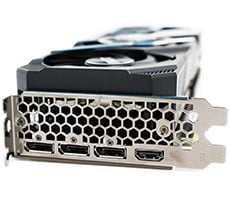
The ASUS ENGTX285 TOP, BFG GTX 285 OCX and Zotac GTX 285 AMP! look very similar to NVIDIA's reference GTX 285 card. The only physical difference is the sticker each company chose to apply to the cooler, and the only technical difference (clock speeds) are as we've noted on the previous page. All three cards, of course, feature 1GB of GDDR3 memory, two dual-link DVI connectors, and an HDTV-out connector. Additionally, they all require two 6-pin PCI Express power connections from your system's power supply. ASUS packs the ENGTX285 TOP in a black and green box. The box and the card are adorned with a horse-riding warrior. Like NVIDIA's reference design, the PCB and the fan shroud are black. Of the three GTX 285 cards, the ENGTX285 TOP has the slowest GPU clock speed at 670 MHz, but it has the second fastest memory and shader clocks at 1,300 MHz and 1,550, respectively. In addition to the ENGTX285 TOP, ASUS fills the box with various CDs and accessories, including a SpeedSetup installation guide, a SPDIF cable connection guide, a driver CD, a multi-language manual CD, a CD case, a DVI-to-VGA adapter, a SPDIF audio cable, a dual Molex to single 6-pin PCI Express power adapter, and a dual 6-pin PCI Express connector to a single 8-pin PCI Express power adapter. We aren't sure why ASUS includes that second power adapter since the GTX 285 doesn't even have an 8-pin power connector. The BFG GTX 285 OCX box touts BFG's free 24/7 tech support and its lifetime warranty. Like the ASUS card, the imagery on the card and the box match. In this case, that imagery is a tattooed, energy-ball wielding fighter. It's a good-looking card with great specs and its clock speeds are the highest of the three cards in this round-up. The GPU clock is 702 MHz, the memory clock is 1,332 MHz, and the shader clock is 1,584 MHz. The BFG GTX 285 OCX is accompanied by a handful of accessories: a card installation guide, a SPDIF cable installation guide, a driver CD, two BFG case badges, a SPDIF audio cable, a DVI-to-VGA adapter, a DVI-to-HDMI adapter, an HDTV/component cable, and a dual Molex to single 6-pin PCI Express power adapter. Zotac bucks the warrior trend and rocks a dragon on its box and card. The GTX 285 AMP! Edition card has the most interesting set of clocks of the three cards. Although it ties with the BFG GTX 285 OCX for fastest GPU clock at 702 MHz, it falls behind with the slowest memory and shader clocks at 1,296 MHz and 1,512 MHz, respectively. We appreciate that Zotac pushed the GPU so far but wonder why it couldn't have bumped up the other clocks as well to complement that high GPU clock better. We were beginning to wonder where the games were in these bundles, but then we opened up the Zotac package and were greeted by a full-version of GRID. Zotac also throws in a copy of 3DMark Vantage. In addition to the software, the bundle includes a quick installation guide, a user's manual, a driver CD, a Zotac case badge, a DVI-to-VGA adapter, a DVI-to-HDMI adapter (not pictured), a SPDIF audio cable, and two power cables. |
| Test System and 3DMark Vantage Results | ||||||||||||
Let's start our round-up battle by examining the test results from Futuremark's latest 3D test suite, 3DMark Vantage. This benchmark does a good job of setting the tone of the relative performance of all the cards we are comparing in this article.
Based on the clocks speeds of the three factory-overclocked GTX 285's, we expected the BFG GTX 285 OCX to perform the best amongst the bunch, followed closely by the Zotac GTX 285 AMP! and then the ASUS ENGTX285 TOP. That's exactly what our results show. All three of the cards offer a nice boost over the reference GTX 285. |
| Unreal Tournament 3 Results | ||||||
Once again, the three featured cards in this round-up fall in the order expected based on their clock speeds. What surprised us here was how all three cards outshined the GTX 285 SLI, GTX 295 and Radeon HD 4870 X2 at 1920x1200. This is possibly due to the increased CPU overhead of SLI and CrossFire transactions and the fact that the Unreal engine is relatively CPU-limited at this resolution. As you can see, though, the same can't be said for 2560x1600. |
| Enemy Territory: Quake Wars Results | ||||||
All of the NVIDIA-based cards compared here perform very similarly at 1920x1200 while the Radeon HD 4870 X2 soars. Of the three overclocked GTX 285's, the Zotac card manages to pull off the victory at 2560x1600, which didn't quite line up with our expectations. Still, it makes this comparison that much more interesting we suppose. |
| Crysis Results | ||||||
Crysis brought things back in line with our expectations, as the BFG GTX 285 OCX tops the other two overclocked GTX 285's. All three cards offer a nice bump in performance over the reference GTX 285, especially at 2560x1600. |
| Far Cry 2 Results | ||||||
At the risk of sounding like a broken record, we weren't surprised how this set of tests turned out among the three overclocked GTX 285's. Here, BFG's GTX 285 OCX took the win, thanks to it having the fastest overall clock speed of the group, and it was followed next by the Zotac GTX 285 AMP! and then the ASUS ENGTX285 TOP. We have to admit that we were surprised by how close the ASUS, BFG and Zotac GTX 285's came to the GTX 295 and the 4870 X2. The three cards actually offer nearly the same or slightly better performance than the Radeon HD 4870 X2 in this game engine. |
| Left 4 Dead Results | ||||||
In this benchmark, we see more of the same between the GTX 285 cards. When compared to the GTX 285 SLI, GTX 295 and the 4870 X2, they all fare well at 1920x1600 though not as well at 2560x1600. Regardless, all frame rates recorded here would obviously appear very fluid with lots of extra headroom actually. |
| Tri SLI Performance Results | ||||
We just know some of you out there are wondering what it would be like to combine all three cards in a triple SLI configuration. We don't like to disappoint our curious readers, and we were admittedly quite curious ourselves. So, we threw the ASUS ENGTX285 TOP, BFG GTX 285 OCX and Zotac GTX 285 AMP! into our system, and re-ran several benchmarks, focusing on ones we knew would scale in a tri-SLI configuration.
In the graphs below, you can see how the tri-SLI setup compares to all the other cards we tested. You can see that 3DMark Vantage and Crysis can definitely benefit from a third card in SLI while Far Cry 2 doesn't scale quite as well. This is likely a driven optimization issue more than anything else.
|
| Summary and Final Thoughts | ||||||||||||
Performance Summary: Out of the gate, we expected all three of the overclocked GTX 285 cards to offer a nice performance advantage over the reference NVIDIA GTX 285, and they all met that expectation. Thanks to its overall fastest clock profile, the BFG GTX 285 OCX performed the best by a small margin in most tests. The Zotac GTX 285 AMP!, with the second fastest clocks overall, offered the second best performance. That leaves the ASUS ENGTX285 TOP, which took a close third place but not by a significant spread. In a few cases, all three cards even performed quite favorably when compared to dual-GPU single card configurations like the Radeon HD 4870 X2 and GeForce GTX 295.
ASUS ENGTX285 TOP: With all that said, we have to admit that we are fans of ASUS's products. The quality and craftsmanship of ASUS products is typically very good, and the ENGTX285 TOP is no exception. We have rarely had issues with ASUS products in the HotHardware labs. For these reasons, if you are leaning towards the ASUS ENGTX285 TOP, you most likely won't be disappointed. Sure, it's not the fastest GTX 285 on the market, and it doesn't have a "lifetime" warranty, but it's a solid product nonetheless.
BFG GTX 285 OCX: The bundle that BFG offers with this card isn't really much to get excited about, though it's practical and includes all the essentials. The case badges are a nice, little touch, but there is no software at all. When it comes down to it, though, we have to put performance first since that's what you'll likely care most about down the road. For its top-notch performance and lifetime warranty, we are awarding the BFG GTX 285 OCX our Editor's Choice.
Zotac GTX 285 AMP! Edition: The one thing that frustrates us about the Zotac card is that its availability seems to be a bit thin currently. When we first searched for the card online, we could only find it in one store. A week or so later, it was available at two stores. While Newegg does offer the standard Zotac GTX 285, it does not currently offer the AMP! Edition reviewed here. Nevertheless, we highly recommend the Zotac GTX 285 AMP! Edition if you find it to be an interesting option. We also hope you can find it in stock and encourage the Zotac sales team to get a bit more aggressive with retail distribution and stocking efforts.
|